Dear Reader,
It is our pleasure to present the latest, 59th issue of the Journal of Management and Financial Sciences, which brings together a set of contributions addressing contemporary challenges at the intersection of finance, economics, public policy, and sustainable development. The articles gathered in this volume reflect the Journal’s mission to provide rigorous, practice‑relevant insights rooted in solid methodological foundations and directed toward the advancement of both academic debate and managerial decision‑making.
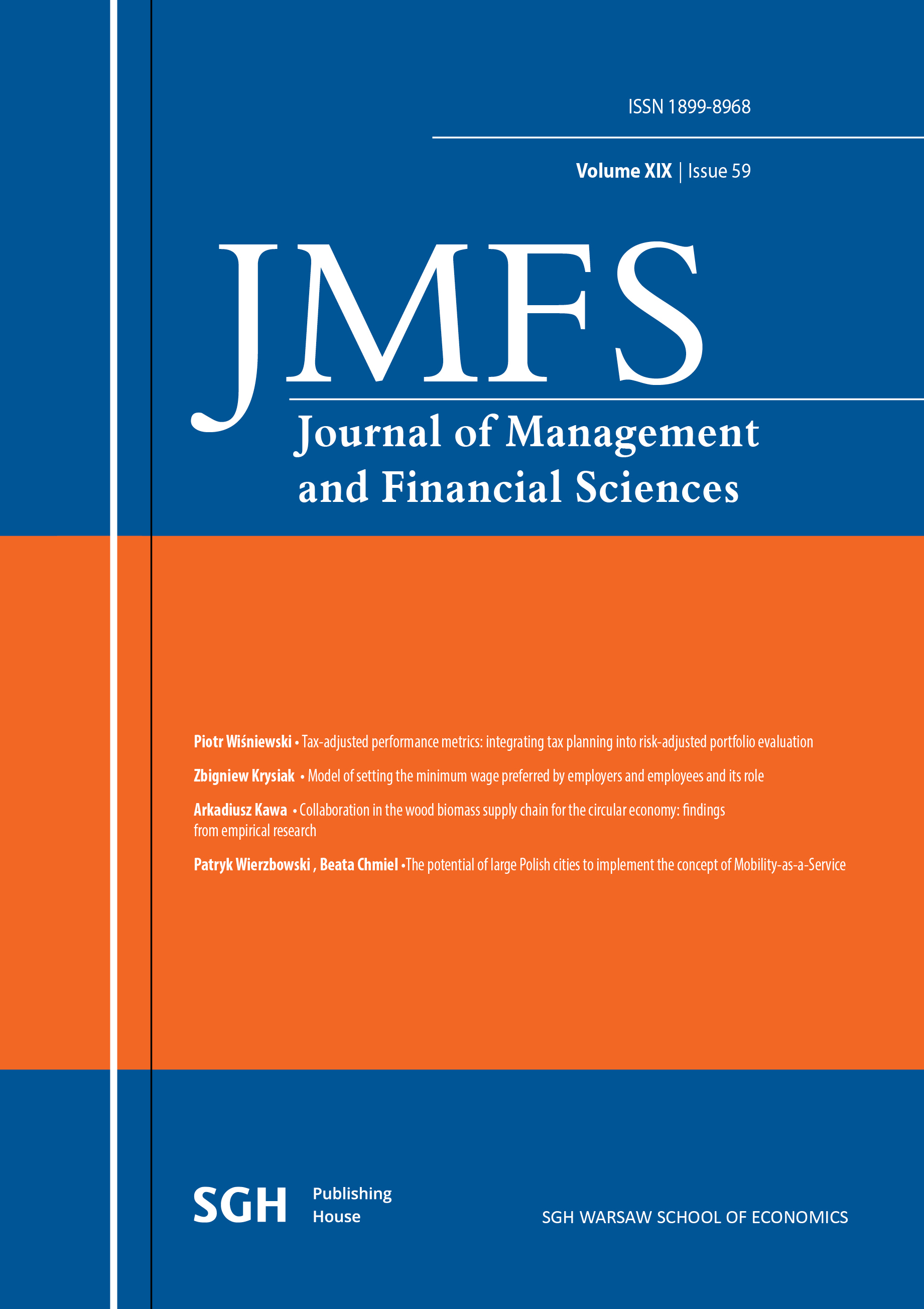
The issue opens with a study by Piotr Wiśniewski, who extends the literature on portfolio evaluation by integrating tax considerations into widely-used risk‑adjusted performance measures. By formalizing after‑tax versions of Jensen’s alpha, the Sharpe ratio, and the Information ratio, the article highlights how tax‑management strategies such as loss harvesting, gain deferral, and tax‑aware rebalancing materially improve investor outcomes. The framework proposed in this paper offers valuable guidance for practitioners seeking to incorporate tax efficiency into performance reporting and portfolio analytics.
In the subsequent contribution, Zbigniew Krysiak develops a new theoretical perspective on the diversification of minimum wage levels across enterprise size groups in Poland. Drawing on extensive empirical investigation conducted between 2016 and 2023, the author demonstrates the economic and social benefits that differentiated minimum wage schemes may generate for employers, employees, and the wider economy. The study sheds a new light on productivity effects, wage dynamics, and purchasing power, while also capturing the attitudes of key labour‑market stakeholders toward reform proposals.
The third article by Arkadiusz Kawa addresses the growing importance of circular economy principles within the wood biomass sector. Based on qualitative research conducted among sawmills, manufacturers, logistics operators, and energy companies, the paper examines existing collaboration mechanisms in the management of wood residues. It identifies barriers related to logistics, standardization, and system integration, while pointing to opportunities 8 Preface for enhancing circularity through shared infrastructure, improved information flow, and cross‑sector coordination.
Completing the issue, Patryk Wierzbowski and Beata Chmiel investigate the potential of large Polish cities to implement the concept of Mobility‑as‑a‑Service (MaaS). Through a systematic literature review and field observations in selected metropolitan areas, the authors assess the current level of transport integration and the readiness of urban mobility systems for digital, user‑centered service models. Their findings highlight persistent gaps in interoperability, inclusiveness, and real‑time information provision, underscoring the need for continued investment in digital infrastructure and transport coordination.
Collectively, the articles featured in this issue offer a multifaceted view of the transformations shaping today’s economic and managerial landscape – from increasingly sophisticated approaches to financial performance measurement, through evolving labour‑market frameworks, to the redesign of supply chains and urban mobility systems in line with sustainability and technological innovation. We hope that this volume will stimulate further research and provide inspiration for scholars, practitioners, and policymakers engaged in these dynamic areas.
We hope that reading this issue will be a source of inspiration for you and will contribute to the further development of your knowledge.
Joanna Wielgórska-Leszczyńska
Chair of the Scientific Council and Dean of the Faculty
Michał Matusewicz
Vice-Chairman of the Scientific Council and Vice-Dean of the Faculty
Published: 2026-06-19