Dear Reader!
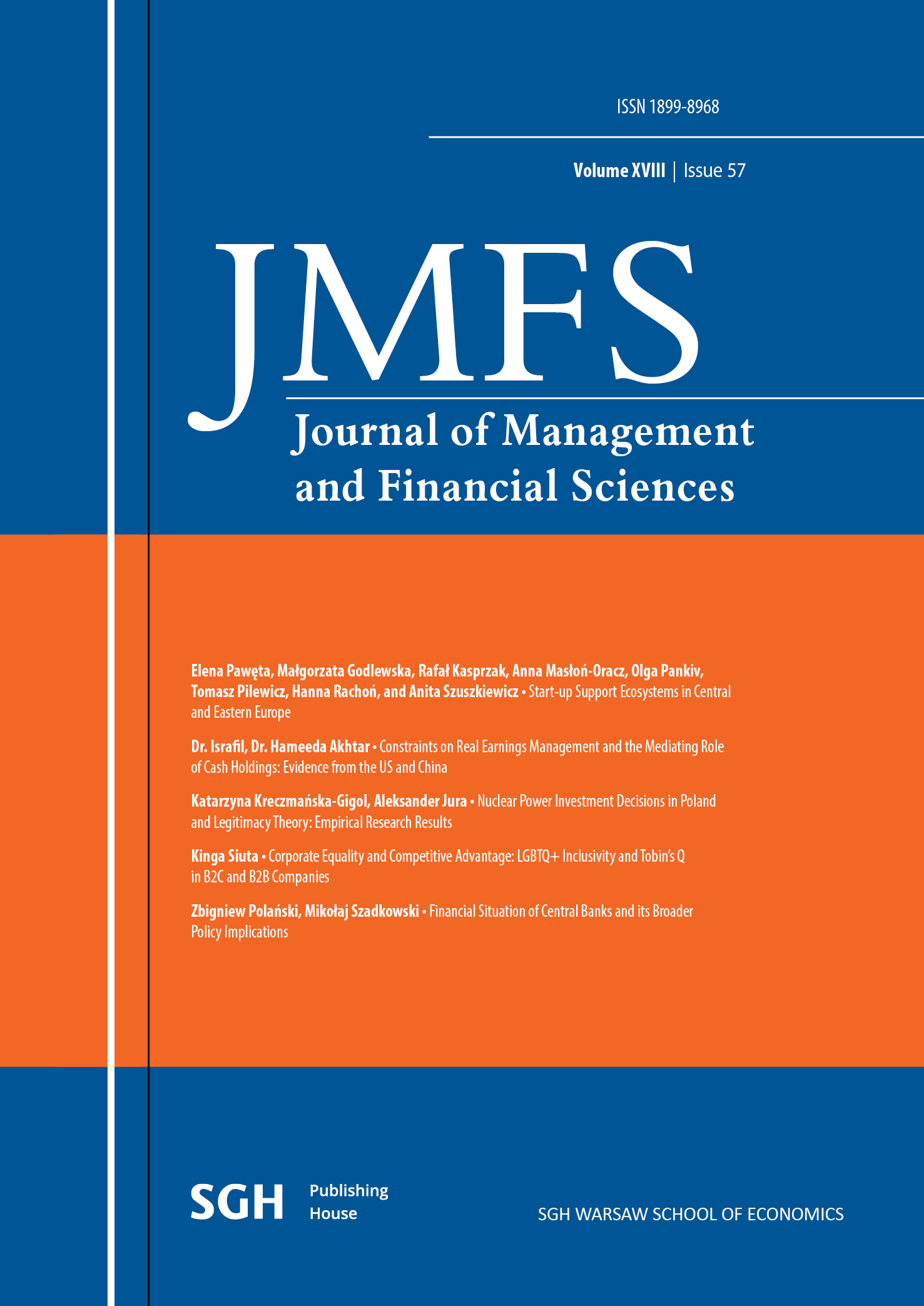
The 57th edition of the Journal of Management and Financial Sciences presents a diverse collection of articles addressing critical and timely topics in the fields of management, finance, public policy, and innovation systems. The contributions explore a wide range of contemporary economic and managerial challenges, spanning from real earnings management in international corporate environments to the legitimacy of nuclear energy investment, financial health of central banks, the relationship between LGBTQ+ inclusivity, as measured by the Corporate Equality Index (CEI) from the Human Rights Campaign, and comparative analyses of start-up ecosystems in Central and Eastern Europe. Our Scientific Journals are a forum for the exchange of ideas and research results in the field of economics, finance and management. Published by the College of Management and Finance of the SGH Warsaw School of Economics, they aim to promote knowledge and develop academic debate in areas that are key to the functioning of a modern economy.
The issue opens with a comprehensive comparative study conducted by Elena Pawęta, Małgorzata Godlewska, Rafał Kasprzak, Anna Masłoń-Oracz, Olga Pankiv, Tomasz Pilewicz, Hanna Rachoń, and Anita Szuszkiewicz, which addresses the development of start-up support ecosystems in Central and Eastern European (CEE) countries. The primary objective of the research is to identify and evaluate the maturity of ecosystem support factors and pinpoint regional leaders in the field. Using a mixed-methods approach – including literature and statistical analysis, expert Delphi panels, and binary comparisons – the study reveals that Lithuania and Estonia currently lead the region in supporting start-ups, followed by Poland, Czechia, Slovenia, and Latvia.
In the following article, Dr. Israfil and Dr. Hameeda Akhtar examine the dynamics of real earnings management (REM) in the corporate sectors of the United States and China. Covering the period 2006–2020, the study investigates how factors such as auditor–client distance, corporate governance standards, IFRS adoption, and tax strategies influence earnings manipulation, thereby contributing to global discourse on financial transparency and managerial ethics by underscoring the importance of institutional frameworks and market discipline.
The next article by Katarzyna Kreczmańska-Gigol and Aleksander Jura shifts the Focus to public perceptions of nuclear energy in Poland. Grounded in stakeholder and legitimacy
theory, the study examines whether public support for civilian nuclear energy investment enhances governmental legitimacy, with the authors hypothesising that Polish society holds a favourable view of nuclear energy for civilian use, a notion confirmed through a CAWIbased diagnostic survey. Interestingly, political preferences were not found to significantly influence attitudes.
The next study, by Kinga Siuta, examines the relationship between LGBTQ+ inclusivity, as measured by the Corporate Equality Index (CEI) from the Human Rights Campaign, and market value measured by Tobin’s Q, with a focus on differentiating between B2C and B2B companies. The analysis highlights the distinct impact of achieving a perfect CEI score on market valuation, revealing that B2C companies may experience a significant, non-linear boost in market value with high inclusivity scores, particularly when achieving a perfect score. This research underscores the strategic value of a perfect CEI score in B2C companies, particularly in politically liberal areas, and highlights the nuanced role of local political climates in shaping the financial benefits of LGBTQ+ inclusivity.
In the last article, Zbigniew Polański and Mikołaj Szadkowski analyse the macroeconomic implications of central banks’ negative financial positions, investigating how central bank losses and resulting negative capital can impact a country’s broader economic policy, contributing to ongoing debates on central banking transparency and financial stability.
We believe that the wide range of topics and thorough analyses featured in this issue will enrich academic discussions and encourage future research in management and finance. We hope you find this edition both insightful and engaging. Thank you for your ongoing interest and readership, and wish you an enjoyable read.
Joanna Wielgórska-Leszczyńska
Chair of the Scientific Council and Dean of the Faculty
Michał Matusewicz
Vice-Chairman of the Scientific Council and Vice-Dean of the Faculty
Opublikowane: 2025-11-27