Dear Reader,
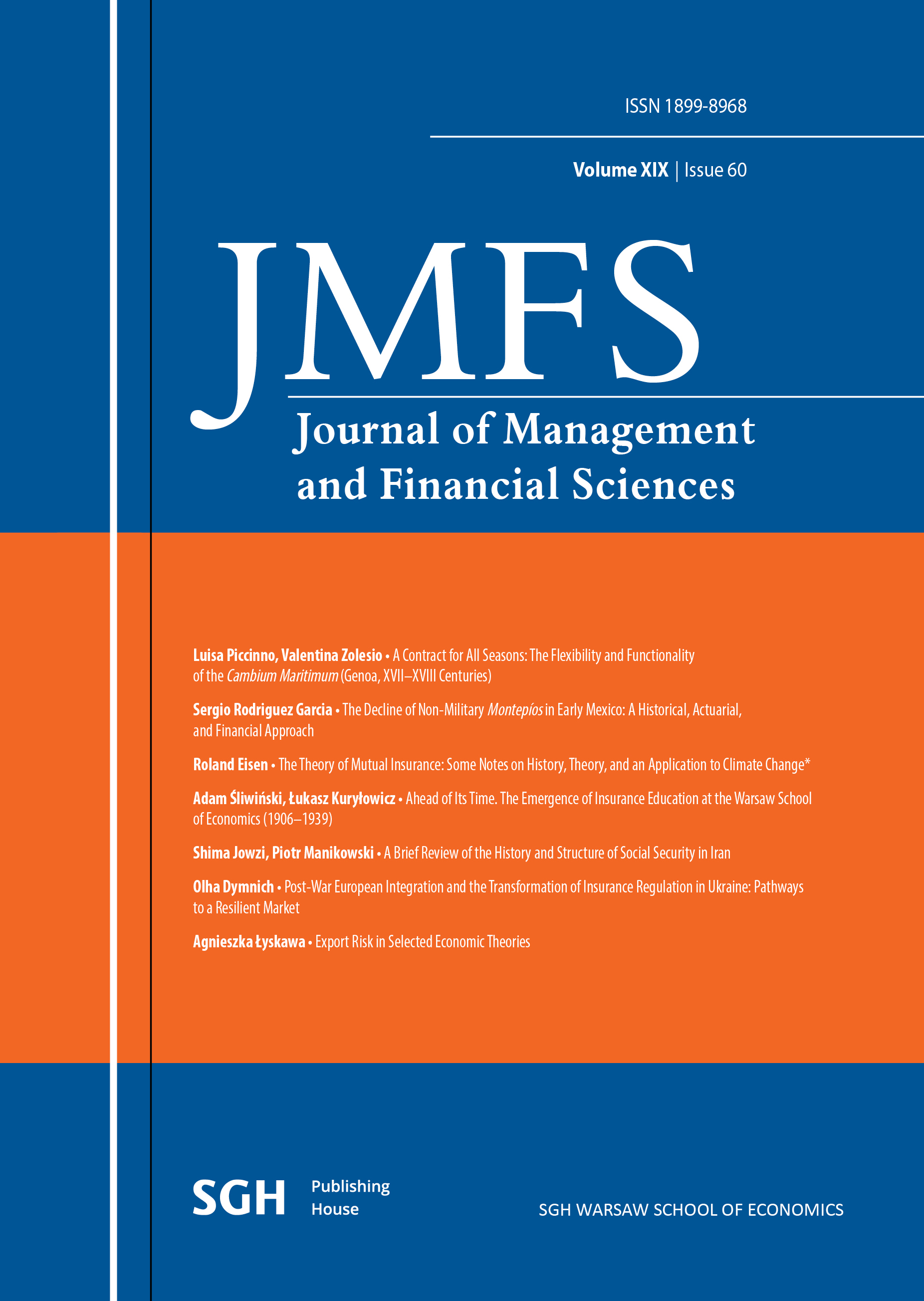
It is our pleasure to present the 60th issue of the Journal of Management and Financial Sciences, which brings together a collection of papers addressing the historical evolution, institutional foundations, and contemporary challenges of insurance and risk management. The contributions included in this volume reflect both the long-term development of insurance mechanisms and the pressing issues faced by modern economies in the context of global uncertainty, demographic change, and regulatory transformation. The issue is structured around three interrelated themes: the origins and early forms of insurance, institutions and social protection systems, and global risks in the contemporary economy.
The first part of the volume, Origins and early forms of insurance, focuses on the historical underpinnings of insurance and risk-sharing mechanisms. The opening article by Valentina Zolesio and Luisa Piccinno explores the cambium maritimum in early modern Genoa, highlighting its flexibility as both a financial instrument and a tool for managing maritime risk. Through legal and archival analysis, the authors demonstrate how this contract adapted to diverse economic contexts. Its various applications are then investigated through a detailed examination of 300 notarial deeds from the years 1668, 1697, 1717 and 1765.
In the second paper, Sergio Rodriguez Garcia continues the historical perspective by analysing the decline of non-military Montepíos in early independent Mexico, combining historical, actuarial and financial approaches to reveal structural imbalances inherent in early pension systems.
The section concludes with a contribution by Roland Eisen, who revisits the theory of mutual insurance, outlining its historical development and theoretical foundations, and applying it to the contemporary challenge of climate change, thereby linking past institutional forms with future-oriented solutions.
The second part, Institutions, education, and social protection, explores the development of insurance-related institutions and their role in shaping social and economic stability. Adam Śliwiński and Łukasz Kuryłowicz analyse the emergence of insurance education at the Warsaw School of Economics in the early twentieth century, demonstrating its pioneering and interdisciplinary character within the European context.
In the next paper, Shima Jowzi and Piotr Manikowski provide an overview of the evolution and structure of the social security system in Iran, drawing attention to issues of fragmentation, inequality and sustainability.
Olha Dymnich addresses the transformation of insurance regulation in Ukraine in the context of European integration and post-war recovery, highlighting both the opportunities and challenges associated with regulatory convergence and market development.
The final part of the issue, Global risks and modern challenges, turns to an analysis of risk in contemporary economic theory and practice. Agnieszka Łyskawa examines the treatment of risk in international trade theories, tracing the evolution from classical approaches – neglecting uncertainty – to more recent frameworks that incorporate the complexity and volatility of global markets. Her contribution underscores the growing importance of risk management in international economic activity.
Taken together, the articles included in this issue provide a comprehensive overview of insurance and risk from a multidimensional perspective. By combining historical inquiry, institutional analysis and theoretical reflection, they contribute to a deeper understanding of the evolution of risk-sharing mechanisms and their capacity to respond to emerging global challenges.
We hope that this issue will serve as a source of inspiration and contribute to the further development of your knowledge in this field.
Joanna Wielgórska-Leszczyńska
Chair of the Scientific Council and Dean of the Faculty
Michał Matusewicz
Vice-Chairman of the Scientific Council and Vice-Dean of the Faculty
Opublikowane: 2026-08-11