Dear Reader,
We present to you the latest 58th issue of the Journal of Management and Financial Sciences, which highlights innovative research in the fields of management and finance. The topics covered in this issue are of immense importance to both the academic community and business practitioners, as they address current challenges and processes shaping the global and local economy.
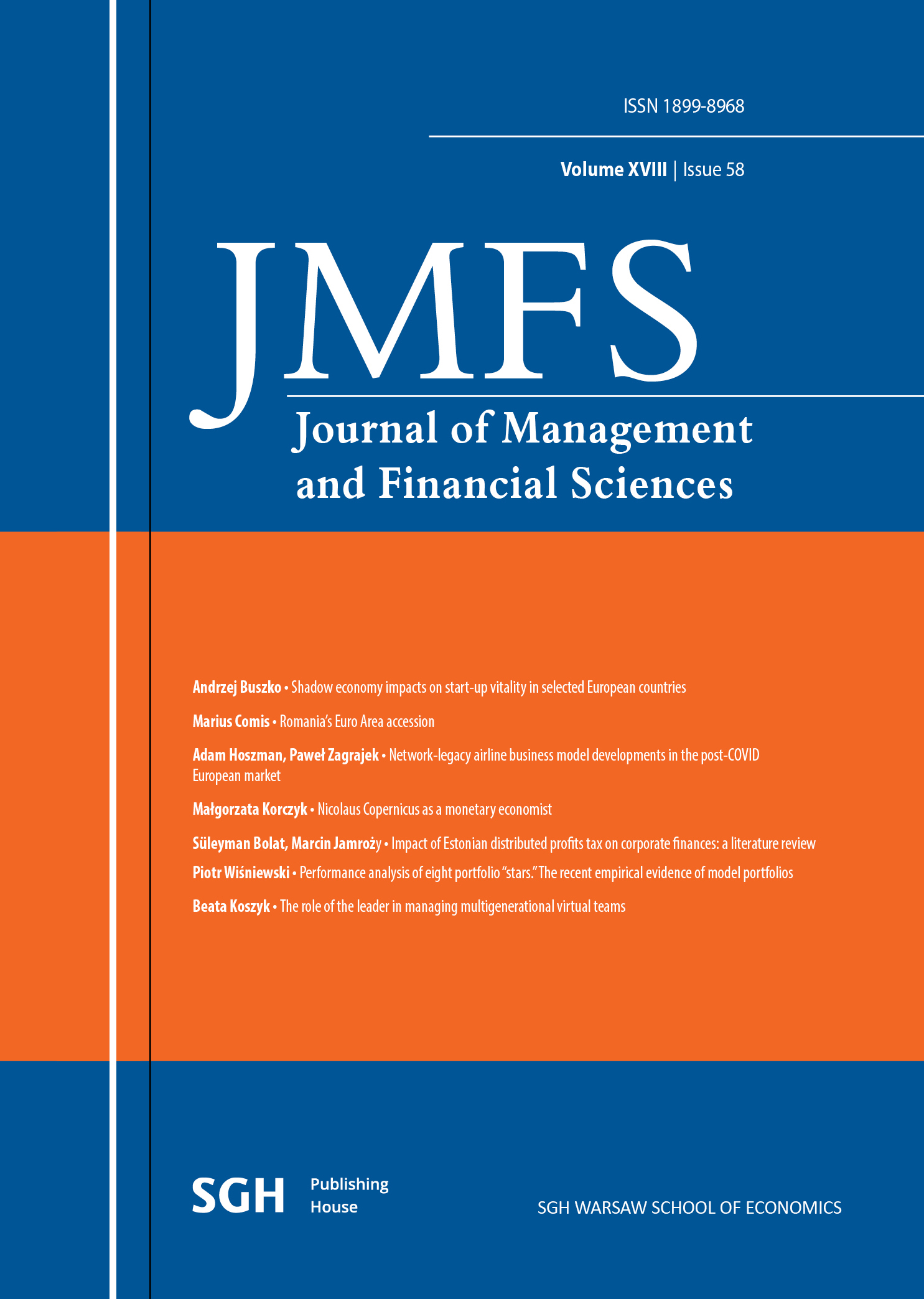
In this issue, the authors delve into a wide range of crucial topics, from analyzing the impact of the shadow economy on the performance of start-ups and evaluating Romania’s fiscal and economic challenges within the context of European integration, to the evolution of business models in the airline industry following the COVID-19 pandemic or the level of competences of virtual team leaders. The Journal also features works on the history of economic thought, such as Nicolaus Copernicus’s contribution to the quantity theory of money, and an analysis of modern tax solutions, including the Estonian corporate income tax on distributed profits. The issue is rounded out by a comprehensive analysis of various model investment portfolios, providing valuable guidance for investors.
In the first paper Andrzej Buszko aims to find the relation between the shadow economy and start-ups performance in selected European countries. The MIMIC approach was employed to indicate the level of the shadow economy. The Pearson correlation index was used to show the dependence between the shadow economy and number of start-ups.
In the next paper by Marius Comis, the author investigates Romania’s fiscal and economic challenges within the broader context of European economic integration. It evaluates the country’s adherence to the Maastricht criteria over the period of 2020–2024, considering economic shocks, fiscal policy decisions, and external influences that have shaped its economic trajectory.
Adam Hoszman and Paweł Zagrajek focus on the developments of airline business models in the wake of the turbulence induced by the COVID-19 pandemic. The focus is on identifying market shifts that have happened since 2020 that led to airlines seeking new opportunitiesto gain competitive advantage. Moreover, the authors aim to identify how network-legacy
carriers adjust their business models to catch up with their low-cost counterparts in terms of traffic recovery and growth.
The aim of the article by Małgorzata Korczyk is an attempt to answer the question of what Copernicus’ contribution is to the formulation of the quantity theory of money. To achieve this goal, the definitions of the quantity theory of money were examined and views that Copernicus had on monetary issues were analyzed.
In their paper Süleyman Bolat and Marcin Jamroży examine tax aspects related to the distributed profits tax (DPT) in Estonia, which was the first country to introduce a corporate income tax on distributed profits (the so-called Estonian CIT).
In the next paper Piotr Wiśniewski analyzes eight widely followed model portfolios through multiple prisms: theoretical foundations, empirical performance, implementation costs, economic efficiency, and adaptability across various market environments. Using both historical and simulated data from January 1, 2005 to May 9, 2025, the paper examines the Bernstein No Brainer, Browne Permanent, Burns Couch Potato, Dalio All Seasons, Faber Global, Ferri Core Four, Schultheis Coffeehouse, and Swensen Yale portfolios.
The purpose of the last article by Beata Koszyk is to present the results of a survey conducted in April 2024 on the expectations of employees from different generations regarding the expected and the current level of competencies of virtual team leaders.
We hope that reading this issue will be a source of inspiration for you and will contribute to the further development of your knowledge.
Joanna Wielgórska - Leszczyńska
Chair of the Scientific Council and Dean of the Faculty
Michał Matusewicz
Vice-Chairman of the Scientific Council and Vice-Dean of the Faculty
Opublikowane: 2025-12-19