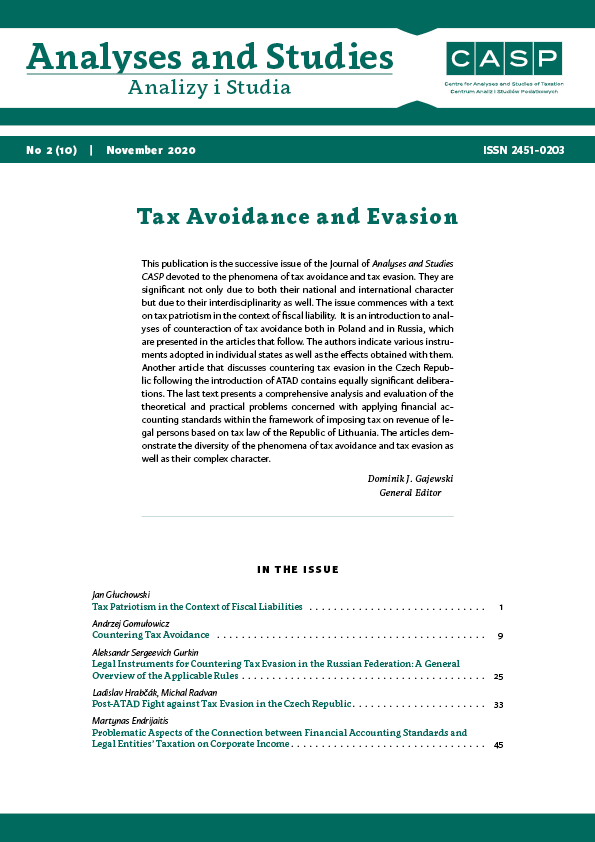
Prawne instrumenty przeciwdziałania uchylaniu się od opodatkowania w Federacji Rosyjskiej: ogólny przegląd obowiązujących norm
DOI:
https://doi.org/10.33119/ASCASP.2020.2.3Słowa kluczowe:
uchylanie się od opodatkowania, odpowiedzialność prawna, klauzula ogólna przeciwdziałająca unikaniu opodatkowania (GAAR), szczególne przepisy przeciwdziałające unikaniu opodatkowania (SAAR), orzecznictwo, koncepcja celu biznesowego, doktryna nieuzasadnionej korzyści podatkowej, doktryna transakcji krokowej, doktryna przewagi treści nad formą, zasady dotyczące rezydencji podatkowej, zasady dotyczące cen transferowych, zasady dotyczące zagranicznych spółek kontrolowanych (zasady CFC), plan działań w zakresie erozji podstawy opodatkowania i przenoszenia zysków (BEPS), umowy międzynarodowe, konwencje, systemy i technologie informatyczne, rescript fiscal, monitorowanie podatkowe, równowaga interesów prywatnych i publicznychAbstrakt
Artykuł jest poświęcony ogólnej analizie różnych instrumentów prawnych przeciwdziałających unikaniu opodatkowania, które są stosowane w Federacji Rosyjskiej*. Zobrazowano w nim główne kierunki działań państwa w zakresie przeciwdziałania unikaniu opodatkowania oraz kwestie interakcji w tym zakresie pomiędzy Federacją Rosyjską a innymi państwami. Poddano analizie klauzule rosyjskie i zagraniczne doświadczenia z punktu widzenia Rosji.
Bibliografia
Eremenok, V.V. (2013). Tax residency of legal entities: legal regulation in the UK and the OECD experience: synopsis of thesis for a Candidate Degree in Law Sciences. Moscow.
Lazarev, V.V. (2002). Problems of the general theory of law and the state: a textbook for universities, V.S. Nersesyants (Ed.). Мoscow, s. 497.
Machekhin, V.A. (2016). Tax deoffshorization in Russia and the BEPS project: an attempt to compare, Bulletin of Kutafin University (MSAL), No. 6.
Ovcharova, E.V. (2019). Tax compliance in Russia: problems of correlation of measures of administrative coercion and incentive, Law. Journal of the Higher School of Economics, No. 1.
Pepelyaev, S. (2006). Commentary to the Decree of the Plenum of the Supreme Arbitration Court of the Russian Federation dated 12 October No. 53, Tax Expert, No. 2.
Pepelyaev, S.G. (red.). (2015). Tax Law: Textbook for universities. Moscow.
Pobrania
Opublikowane
Jak cytować
Numer
Dział
Licencja
Autorzy zachowują autorskie prawa majątkowe do swoich utworów oraz udzielają czasopismu prawa pierwszej publikacji. Jednocześnie artykuły są udostępniane na warunkach licencji Creative Commons Uznanie autorstwa – Użycie niekomercyjne 4.0 Międzynarodowe (CC BY-NC 4.0), która zezwala osobom trzecim na ich rozpowszechnianie do celów niekomercyjnych, pod warunkiem wskazania autorstwa oraz informacji o pierwszej publikacji w niniejszym czasopiśmie.