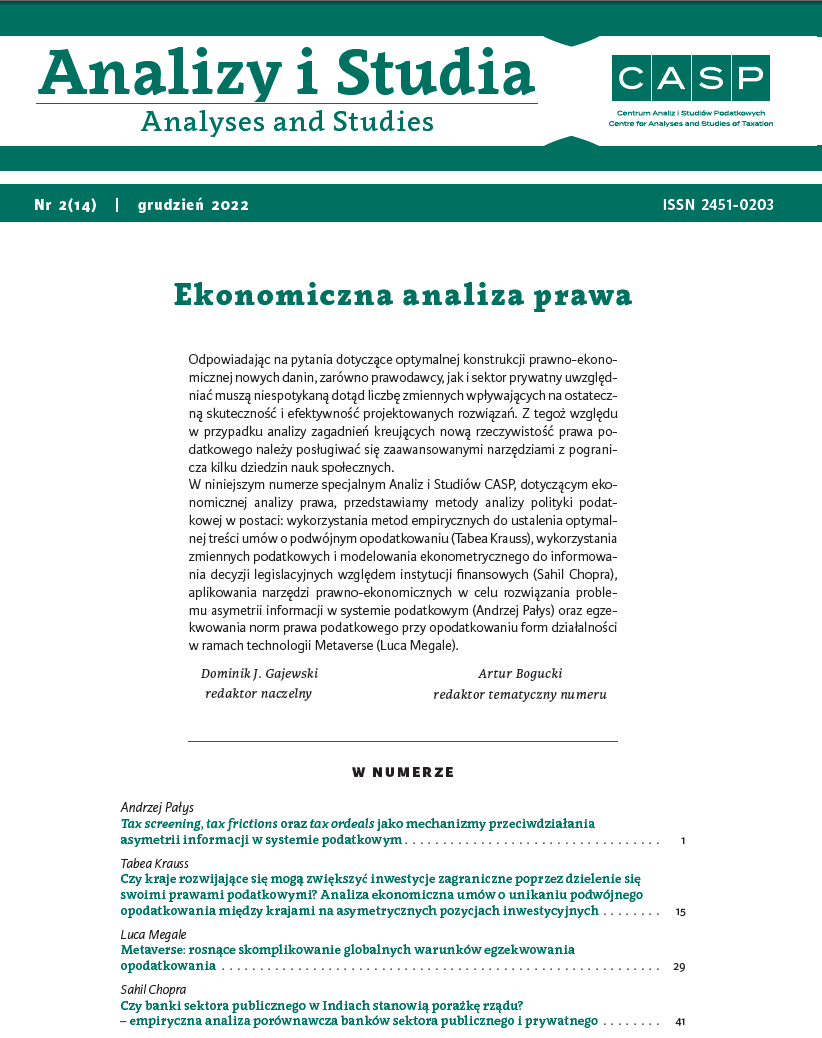
Metaverse: rosnące skomplikowanie globalnych warunków egzekwowania opodatkowania
DOI:
https://doi.org/10.33119/ASCASP.2022.2.3Słowa kluczowe:
Metaverse, aktywa cyfrowe, egzekwowanie przepisów podatkowych, współpraca regulacyjna, zwinna regulacjaAbstrakt
Niniejszy artykuł koncentruje się na potencjalnym wpływie Metaversu na egzekwowanie prawa podatkowego. Bieżące dociekania, które nie stanowią pogłębionej analizy systemów podatkowych, lecz mają za zadanie pobudzić do dyskusji na omawiany temat, podzielono na rozważania z perspektywy osób prywatnych/przedsiębiorstw oraz organów egzekwowania prawa. Wpływ Metaversu na sytuację podatkową jest rozpatrywany z punktu widzenia niezdecentralizowanego Metaversu pozostającego w rękach obecnych gigantów przemysłowych. W związku z tym przedstawia się pewne wnioski, które mogą posłużyć do dokonania oceny potrzeby opracowania zwinnego podejścia regulacyjnego opartego na współpracy zarówno między przedsiębiorstwami, administracjami, jak i państwami.
Bibliografia
Blind, K. et al. (2017). The impact of standards and regulation on innovation in uncertain markets. Research Policy, 46(1), https://doi.org/10.1016/j.respol.2016.11.003
Brekke, J.K. (2020). Hacker-engineers and their economies: The political economy of decentralised networks and ‘cryptoeconomics’. New Political Economy, 26(4), 646–659, https://doi.org/10.1080/13563467.2020.1806223
Bitcoin: A peer-to-peer electronic cash system, https://bitcoin.org/bitcoin.pdf
Colen, J.E. (2019). Between truth and power, https://doi.org/10.1093/oso/9780190246693.001.0001
Casey, M. et al. (2019). The impact of blockchain technology on finance: A catalyst for change. Geneva Reports on the World Economy, https://www.sipotra.it/wpcontent/uploads/2018/07/The-Impact-of-Blockchain-Technology-on-Finance-A-Catalystfor-Change.pdf
Futia, C.A. (1980). Schumpeterian competition. The Quarterly Journal of Economics, 94(4), 675, https://doi.org/10.2307/1885663.
Foo Yun Chee (2020, March 22). Facebook to cut video streaming quality in virus-hit Europe. Reuters, https://www.reuters.com/article/us-health-coronavirusfacebook-idUSKBN2190VH
Kamin, D. (2021, Nov 30). Investors snap up Metaverse real estate in a virtual land boom. The New York Times, Retrieved from: https://www.nytimes.com/2021/11/30/business/metaverse-real-estate.html
McKenzie, R. et al. (2008). In defense of monopoly. The University of Michigan Press, https://doi.org/10.3998/mpub.93419 OECD (2020). Regulatory policy in the Slovak Republic: Towards future-proof regulation. Reviews of Regulatory Reform. Paris: OECD Publishing, https://doi.org/10.1787/ce95a880-en. Nicolaides, Ph. (2006). A theory of regulatory integration, Intereconomics, 41(1), 37–43, https://doi.org/10.1007/s10272-006-0170-y
Patton, M.Q. (2007). Process use as a usefulism, New Directions for Evaluation, 116, 110, https://doi.org/10.1002/ev.246p
Schneider, N. (2019). Decentralization: An incomplete ambition. Journal of Cultural Economy, 12(4), 265–285, https://doi.org/10.1080/17530350.2019.1589553
Stafford, G.T. (2013). Analysis of Social Networks in a Virtual World. Theses and Dissertations, 925, http://scholarworks.uark.edu/etd/925.
Vulpiani, G. (2021). Non fungible tokens, smart contracts e blockchain nell’arte e nella moda: crypto art e digital fashion. Riv. Cammino Diritto, Fasc. 11/2021.
Westland, Ch.J. (2010). Critical mass and willingness to pay for social networks. Electronic Commerce Research and Applications, 9(1), 6–19, https://doi.org/10.1016/j.elerap.2009.05.003
Zwitter, A. et al. (2020). Decentralized network governance: Blockchain technology and the future of regulation. Frontiers in Blockchain, 3, https://doi.org/10.3389/fbloc.2020.00012
Pobrania
Opublikowane
Jak cytować
Numer
Dział
Licencja
Autorzy zachowują autorskie prawa majątkowe do swoich utworów oraz udzielają czasopismu prawa pierwszej publikacji. Jednocześnie artykuły są udostępniane na warunkach licencji Creative Commons Uznanie autorstwa – Użycie niekomercyjne 4.0 Międzynarodowe (CC BY-NC 4.0), która zezwala osobom trzecim na ich rozpowszechnianie do celów niekomercyjnych, pod warunkiem wskazania autorstwa oraz informacji o pierwszej publikacji w niniejszym czasopiśmie.