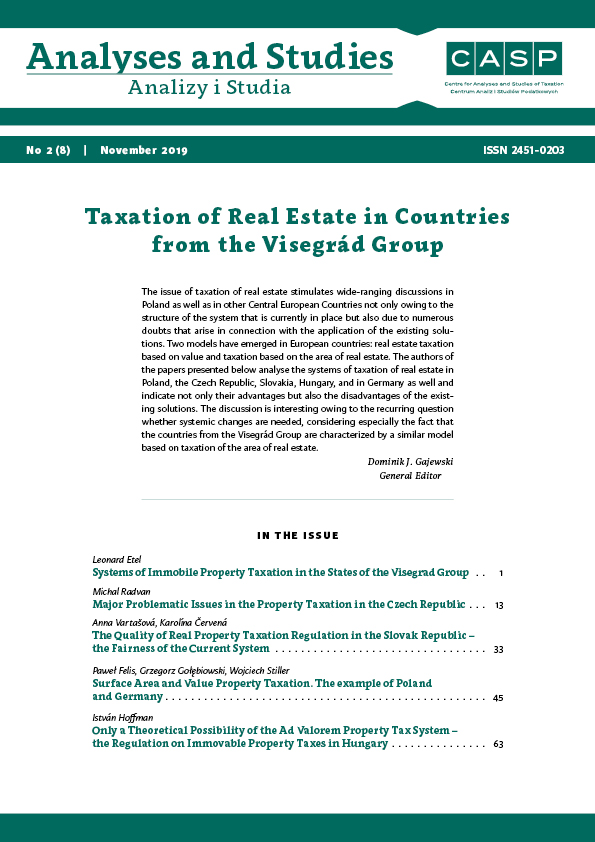
Systemy opodatkowania nieruchomości w państwach Grupy Wyszehradzkiej
DOI:
https://doi.org/10.33119/ASCASP.2019.2.1Słowa kluczowe:
prawo podatkowe, opodatkowanie nieruchomości, wartość nieruchomościAbstrakt
Głównym celem artykułu jest przedstawienie obowiązujących w państwach Grupy Wyszehradzkiej systemów opodatkowania nieruchomości. W Europie obok systemów bazujących na wartości nieruchomości (ad valorem), charakterystycznych dla zdecydowanej większości państw UE, funkcjonują także systemy powierzchniowe i mieszane. Obowiązują one nadal, chociaż już od początku lat 90. ubiegłego wieku daje się zauważyć w Europie Środkowej odchodzenie od systemów odnoszących się do powierzchni nieruchomości na rzecz opodatkowania wartości nieruchomości. W Polsce, Czechach i na Słowacji w dalszym ciągu dominuje powierzchnia jako podstawa opodatkowania, a wartość funkcjonuje jedynie w odniesieniu do niektórych rodzajów nieruchomości. Podobnie jest na Węgrzech, gdzie samorządy nie są zainteresowane wyborem systemów opartych na wartości nieruchomości, chociaż mają taką możliwość. Dlaczego akurat w tych państwach nie zrealizowano jeszcze reformy systemów opodatkowania nieruchomości? Niniejszy artykuł jest próbą odpowiedzi na to pytanie.
Bibliografia
Accace. (2018). 2018 Tax Guideline. Hungary, https://accace.com/wp-content/uploads/2018/02/2018-02-Tax-Guideline-Hungary-EN-compressed-v2.pdf (dostęp: 4.10.2019).
ACIR. (1991). Changing Public Attitudes on Governments and Taxes. Advisory Commision on Intergovernmental Relations, https://library.unt.edu/gpo/acir/Reports/survey/S-20.pdf (dostęp: 4.10.2019).
Ansttet, A. (1999). Rola podatku ad valorem w finansach lokalnych. W: Reforma opodatkowania nieruchomości w Polsce w świetle doświadczeń wdrażania i rozwoju podatku ad valorem w wybranych krajach, (s. 48–55). Warszawa: Biuletyn Biura Studiów i Ekspertyz Kancelarii Sejmu.
Babčák, V. (2008). Daňové právo na Slovensku. Košice: Epos.
Bird, R.M., Slack, E. (2002). Land and Property Taxation: A Review, http://www1.worldbank.org/(dostęp: 4.10.2019).
Bird, R.M., Slack, E. (2005). Land and Property Taxation in 25 Countries: A Comparative Review, CESifo DICE Report 3/2005.
Capital Strategy i International Property Tax Institute. (2014). Propozycja zmiany zasad kształtowania stawek podatku od nieruchomości gruntowych w Polsce. Raport dla Związku Miast Polskich i Unii Metropolii Polskich. Warszawa–Kraków.
CBOS. (2000). Opinie o projekcie podatku katastralnego. Komunikat z badań, https://www.cbos.pl/SPISKOM.POL/2000/K_155_00.PDF (dostęp: 4.10.2019).
Etel, L. (1998). Reforma opodatkowania nieruchomości w Polsce. Białystok: Temida 2.
Etel, L. (red.). (2003). Europejskie systemy opodatkowania nieruchomości. Warszawa: Biuro Studiów i Ekspertyz Kancelarii Sejmu.
European Commission. (2017). Taxation Trends in the European Union. Data for the EU Member States, Iceland and Norway. 2017 Edition, https://ec.europa.eu/ (dostęp: 4.10.2019).
Felis, P. (2015). Podatki od nieruchomości a polityka podatkowa gmin w Polsce. Warszawa: Oficyna Wydawnicza SGH.
Frenzen, R. (1999). Programy edukacji podatników podatku ad valorem. W: Reforma opodatkowania nieruchomości w Polsce w świetle doświadczeń wdrażania i rozwoju podatku ad valorem w wybranych krajach (s. 56–61). Warszawa: Biuletyn Biura Studiów i Ekspertyz Kancelarii Sejmu.
Głuszak, M., Marona, B. (2015). Podatek katastralny. Ekonomiczne uwarunkowania reformy opodatkowania nieruchomości. Warszawa: Poltex.
Kopyściańska, K. (2016). Koncepcja podatku katastralnego w Polsce na tle doświadczeń wybranych krajów. Wrocław: E-Wydawnictwo. Prawnicza i Ekonomiczna Biblioteka Cyfrowa. Wydział Prawa, Administracji i Ekonomii Uniwersytetu Wrocławskiego.
KPMG. (2017). Guide to taxes on real estate in Central and Eastern Europe. Edition 2017, https://home.kpmg/pl/en/home/insights/2017/10/guide-to-taxes-on-real-estate-in-central-and-eastern-europe-2017.html (dostęp: 4.10.2019).
McCluskey, W., Plimmer, F. (2007). The potential for the property tax in the 2004 accession countries of central and eastern Europe, RICS Research Paper Series, Volume 7, Number 17.
Mrkyvka, P. (2003). Podatek od nieruchomości w Republice Czeskiej. W: Europejskie systemy opodatkowania nieruchomości (s. 117–126), L. Etel (red.). Warszawa: Biuro Studiów i Ekspertyz Kancelarii Sejmu.
Nowecki, G. (2009). Ewolucja systemów opodatkowania nieruchomości na świecie, Rzeczoznawca Majątkowy, nr 3.
Nowecki, G. (2010). Podstawa opodatkowania w podatku od nieruchomości. Studium porównawcze. Warszawa: Uniwersytet Warszawski.
Plimmer, F., McCluskey, W.J. (2010). The Basis and Administration of the Property Tax: What can be learned from International Practice?, https://www.fig.net/resources/proceedings/fig_proceedings/fig2010/papers/ts01f/ts01f_plimmer_mccluskey_4174.pdf (dostęp: 4.10.2019).
Popławski, M. (2001). Podatek katastralny w odbiorze opinii publicznej. W: Rola katastru fiskalnego w systemie opodatkowania nieruchomości (s. 46–51), L. Etel (red.). Białystok: Temida 2.
Radvan, M. (2008). Czech Tax Law. Brno: Masarykova univerzita.
Radvan, M. (2012a). The Draft Reform of Land Taxation in the Czech Republic, Lex Localis – Journal of Local Self-Government, Vol. 10, No. 3.
Radvan, M. (2012b). Místní daně. Praha: Wolters Kluwer.
Swianiewicz, P. (2004). Finanse lokalne – teoria i praktyka. Warszawa: Municipium.
Swianiewicz, P., Neneman, J., Łukomska, J. (2013). Koncepcja przekształceń podatku od nieruchomosci, Finanse Komunalne, nr 7–8, s. 25–50.
Verbrugge, H. (1999). Zmienna rola podatków lokalnych w Holandii. W: Podatki od nieruchomości w krajach transformacji gospodarczej. Kraków: Krakowski Instytut Nieruchomości.
Wójtowicz, K. (2007). System opodatkowania nieruchomości w Polsce. Lublin: Wydawnictwo UMCS.
Youngman, J.M. (1996). Tax on Land and Buildings. W: Tax Law Design and Drafting, V. Thuronyi (ed.). International Monetary Fund, www.imf.org/external/pubs/nft/1998/tlaw/eng/ch9.pdf (dostęp: 4.10.2019).
Youngman, J. (2016). A Good Tax. Legal and Policy Issues for the Property Tax in the United States. Cambridge, Massachusetts: Lincoln Institute of Land Policy, https://www.lincolninst.edu/sites/default/files/pubfiles/a-good-tax-full_3.pdf (dostęp: 4.10.2019).
Pobrania
Opublikowane
Jak cytować
Numer
Dział
Licencja
Autorzy zachowują autorskie prawa majątkowe do swoich utworów oraz udzielają czasopismu prawa pierwszej publikacji. Jednocześnie artykuły są udostępniane na warunkach licencji Creative Commons Uznanie autorstwa – Użycie niekomercyjne 4.0 Międzynarodowe (CC BY-NC 4.0), która zezwala osobom trzecim na ich rozpowszechnianie do celów niekomercyjnych, pod warunkiem wskazania autorstwa oraz informacji o pierwszej publikacji w niniejszym czasopiśmie.