Pasek boczny artykułu
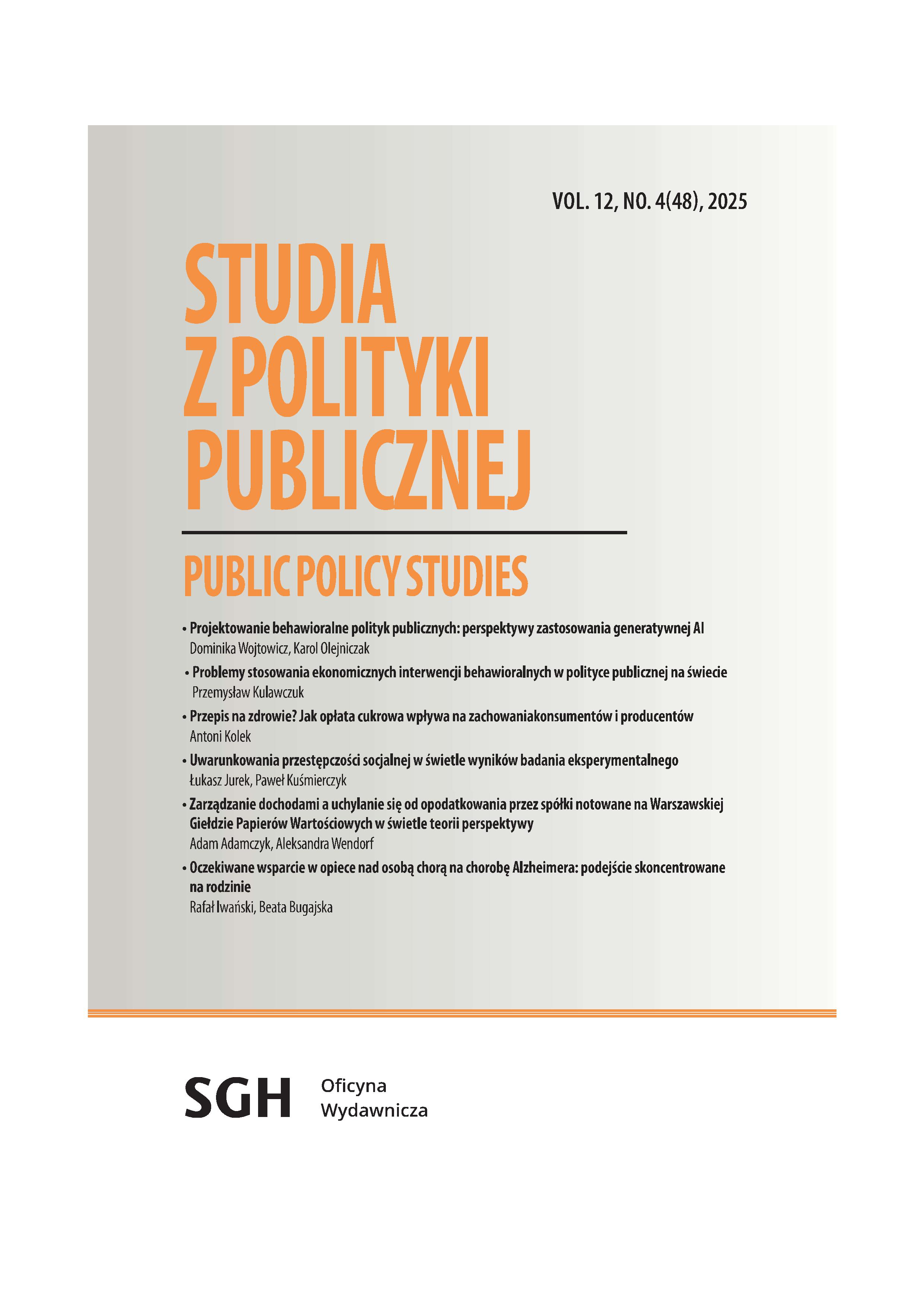
Treść głównego artykułu
Abstrakt
Celem artykułu było zbadanie, na ile generatywna sztuczna inteligencja (GenAI) może wspierać projektantów polityk publicznych w tworzeniu wstępnych koncepcji interwencji
behawioralnych. Autorzy przeprowadzili eksperyment, w którym cztery pomysły rozwiązań redukujących marnotrawienie żywności zostały przygotowane z różnym udziałem GenAI, a następnie ocenione przez 15 praktyków polityk publicznych. Wyniki pokazują, że GenAI może skutecznie wspierać projektantów w tworzeniu spójnych logicznie i przekonujących propozycji rozwiązań publicznych. Warunkami produktywnej współpracy są:
oparcie projektowania na spójnych ramach koncepcyjnych (Teoria Zmiany) i przemyślane zaprojektowanie sposobu wykorzystania różnych GenAI we współpracy z człowiekiem
(metoda TRIP). Artykuł podkreśla też konieczność dalszych badań nad zastosowaniami GenAI w pełnym procesie projektowania obejmującym empiryczne badania grupy docelowej i konsultacje z interesariuszami. Zwraca także uwagę na wyzwania etyczne związane z autorstwem i odpowiedzialnością za treści generowane przez AI. Praca wnosi wkład w rozwój interdyscyplinarnej refleksji nad zastosowaniem przełomowych technologii w procesach formułowania polityk publicznych.
Słowa kluczowe
Szczegóły artykułu
Prawa autorskie (c) 2025 Karol Olejniczak, Dominika Wojtowicz

Utwór dostępny jest na licencji Creative Commons Uznanie autorstwa 4.0 Międzynarodowe.
Czasopismo „Studia z Polityki Publicznej/Public Policy Studies” zapewnia dostęp do treści artykułów w trybie otwartego dostępu (Open Access) na zasadach licencji Creative Commons Uznanie autorstwa 4.0 Międzynarodowe (CC BY 4.0).


Więcej informacji: Polityka Open Access czasopisma "Studia z Polityki Publicznej/Public Policy Studies"
Referencje
- Astbury, B., & Leeuw, F. L. (2010). Unpacking Black Boxes: Mechanisms and Theory Building in Evaluation. American Journal of Evaluation, 31(3), 363–381. doi:10.1177/1098214010371972
- Banerjee, S., & Galizzi, Matteo M. (2024). Behavioral public policy for global challenges. In P. S. Forscher & M. Schmidt (Eds.), A better how: notes on developmental meta-research (pp. 90-101). https://doi.org/10.62372/ISCI6112
- Banerjee, S., & John, P. (2025). Behavioural public policy: past, present, and future. SSRN, 1–30. https://doi.org/10.2139/ssrn.5124029
- Bergman, D. (2024, 15 marca). What is fine-tuning? https://www.ibm.com/think/topics/fine-tuning
- Blomkamp, E. (2018). The Promise of Co-Design for Public Policy. Australian Journal of Public Administration, 77(4), 729–743. https://doi.org/doi:10.1111/1467-8500.12310
- Charalabidis, Y., Medaglia, R., & van Noordt, C. (Eds.). (2024). Research Handbook on Public Management and Artificial Intelligence. Edward Elgar Publishing.
- Dell’Acqua, F., Ayoubi, C., Lifshitz-Assaf, H., Sadun, R., Mollick, E. R., Mollick, L., Han, Y., Goldman, J., Nair, H., Taub, S., & Lakhani, Karim R. (2025). The Cybernetic Teammate: A Field Experiment on Generative AI Reshaping Teamwork and Expertise. Harvard Business School Technology & Operations Mgt. Unit Working Paper, 25(043), 1–54. https://doi.org/http://dx.doi.org/10.2139/ssrn.5188231
- Dolan, P., Hallsworth, M., Halpern, D., King, D., & Vlaev, I. (2010). MINDSPACE. Influencing behaviour throught public policy. UK Cabinet Office and Institute for Government.
- Dwivedi, Y. K., Kshetri, N., Hughes, L., Slade, E. L., Jeyaraj, A., Kar, A. K., Baabdullah, A. M., Koohang, A., Raghavan, V., Ahuja, M., Albanna, H., Albashrawi, M. A., Al-Busaidi, A. S., Balakrishnan, J., Barlette, Y., Basu, S., Bose, I., Brooks, L., Buhalis, D., . . . Wright, R. (2023). Opinion Paper: „So what if ChatGPT wrote it?” Multidisciplinary perspectives on opportunities, challenges and implications of generative conversational AI for research, practice and policy. International Journal of Information Management, 71(102642), 1–63. https://doi.org/10.1016/j.ijinfomgt.2023.102642
- Editorial. (2024). Food loss and waste. Nature Food, 5(8), 639. https://doi.org/10.1038/s43016-024-01041-7
- European Commission: Joint Research Centre, Dupoux, M., Gaudeul, A., Baggio, M., Bruns, H., Ciriolo, E., Krawczyk, M., Kuehnhanss, C., & Nohlen, H. (2025). Unlocking the full potential of behavioural insights for policy (Vol. JRC138028). Publications Office of the European Union. https://doi.org/10.2760/7367599
- Howlett, M. (2019a). Behavioural considerations of public policy: matching policy tools and their targets. In H. Strafheim & S. Beck (Eds.), Handbook of Behavioural Change and Public Policy (pp. 78-88). Edward Elgar Publishing.
- Howlett, M. (2019b). The Policy Design Primer. Choosing the Right Tools for the Job. Routledge.
- Jacob, S. (2025). Artificial Intelligence and the Future of Evaluation: from Augmented to Automated Evaluation. Digital Government: Research and Practice, 6(1), 1–10. https://doi.org/10.1145/3696009
- Kahneman, D. (2013). Foreword. In E. Shafir (Ed.), The Behavioral Foundations of Public Policy (pp. vii-ix). Princeton University Press.
- Kaiser, M., Lohmann, P., Ochieng, P., Shi, I., Sunstein, C. R., & Reisch, L. A. (2024). Leveraging LLMs for Predictive Insights in Food Policy and Behavioral Interventions. arXiv, preprint arXiv:2411.08563, 1–15. https://doi.org/10.48550/arXiv.2411.08563
- Kocoń, J., Cichecki, I., Kaszyca, O., Kochanek, M., Szydło, D., Baran, J., Bielaniewicz, J., Gruza, M., Janz, A., Kanclerz, K., Kocoń, A., Koptyra, B., Mieleszczenko-Kowszewicz, W., Miłkowski, P., Oleksy, M., Piasecki, M., Radliński, Ł., Wojtasik, K., Woźniak, S., . . . Kazienko, P. (2023). ChatGPT: Jack of all trades, master of none. Information Fusion, 99, 101861. https://doi.org/10.1016/j.inffus.2023.101861
- Kuehnhanss, C. R. (2019). The challenges of behavioural insights for effective policy design. Policy and Society, 38(1), 14–40. https://doi.org/http://doi.org/10.1080/14494035.2018.1511188
- Lasswell, H. D. (1951). The policy orientation. In D. Lerner & H. Lasswell, D. (Eds.), The Policy Sciences. Recent Developments in Scope and Method. Stanford University Press.
- Lunn, P. (2014). Regulatory Policy and Behavioural Economics. OECD Publishing.
- Manning, S., Sharma, S. R., & Walton, M. (2023). Realist Review and System Dynamics as a Multimethod Qualitative Synthesis Approach for Analyzing Waste Minimization in Aotearoa New Zealand. Systems, 11(8). https://doi.org/10.3390/systems11080385
- Mayne, J. (2017). Theory of Change Analysis: Building Robust Theories of Change. Canadian Journal of Program Evaluation, 32(2), 155–173. https://doi.org/doi: 10.3138/cjpe.31122
- McKinsey & Company. (2024). What is retrieval-augmented generation (RAG)? McKinsey & Company. https://www.mckinsey.com/featured-insights/mckinsey-explainers/what-is-retrieval-augmented-generation-rag
- Michie, S., van Stralen, M., & West, R. (2011). The behaviour change wheel: A new method for characterising and designing behaviour change interventions. Implementation Science, 6(42), 1–11. https://doi.org/https://doi.org/10.1186/1748-5908-6-42
- Mollick, E. (2024). Co-Intelligence: Living and Working with AI. Penguin.
- Mozafar, M., Moini, A., & Sobhanifard, Y. (2023). A systematic review of behavioral public policy research: origins, mechanisms and outcomes. Transforming Government: People, Process and Policy, 17(4), 603–631. https://doi.org/10.1108/TG-12-2022-0168
- OECD. (2017). Behavioural Insights and Public Policy. Lessons from around the world. OECD Publishing House.
- OECD. (2019). Tools and Ethics for Applied Behavioural Insights: The BASIC Toolkit. OECD Oublishing House.
- Olejniczak, K., Batorski, D., & Pokorski, J. (Eds.). (2025). Generatywna AI w badaniach. Praktyczne zastosowania w ewaluacji polityk publicznych. Polska Agencja Rozwoju Przedsiębiorczości.
- Olejniczak, K., Śliwowski, P., & Leeuw, F. (2020). Comparing Behavioral Assumptions of Policy Tools: Framework for Policy Designers. Journal of Comparative Policy Analysis, 22(6), 498–520. https://doi.org/https://doi.org/10.1080/13876988.2020.1808465
- Open AI (2025, 8 maja). Reasoning best practices. Learn when to use reasoning models and how they compare to GPT models. https://platform.openai.com/docs/guides/reasoning-best-practices
- Phoenix, J., & Taylor, M. (2024). Prompt Engineering for Generative AI. Future-Proof Inputs for Reliable AI Outputs. O’Reilly Media.
- ReFED. (2024). ReFED Insights Engine - food waste solution database. https://insights.refed.org/
- Reynolds, C. (2023). Tackling food loss and waste. An overview of policy actions. In S. Busetti & N. Pace (Eds.), Food Loss and Waste Policy: From Theory to Practice (pp. 42-60). Taylor & Francis. https://doi.org/10.4324/9781003226932-5
- Rhymer, J., Murray, A., & Sirmon, D. (2024). Synthetic stakeholders: engaging the environment in organizational decision-making. In I. Constantiou, P. J. Mayur, & M. Stelmaszak (Eds.), Research Handbook on Artificial Intelligence and Decision Making in Organizations (pp. 226-239). Edward Elgar.
- Safaei, M., & Longo, J. (2024). The End of the Policy Analyst? Testing the Capability of Artificial Intelligence to Generate Plausible, Persuasive, and Useful Policy Analysis. Digit. Gov.: Res. Pract., 5(1), art4:1–35. https://doi.org/10.1145/3604570
- Service, O., Hallsworth, M., Halpern, D., Algate, F., Gallagher, R., Nguyen, S., Ruda, S., & Sanders, M. (2014). EAST. Four simple ways to apply behavioural insights. Behavioural Insights Team.
- Soman, D. (2017). The Last Mile. Creating Social and Economic Value from Behavioral Insights. University of Toronto Press.
- Stephans, E. (Ed.). (2016). Social and Behavioral Science Used in the Advancement of Policy: Applications and Insights. Nova Science Pub Inc.
- Sunstein, C. R., & Reisch, L. A. (Eds.). (2023). Research Handbook on Nudges and Society. Edward Elgar Publishing.
- Thaler, R. H., Sunstein, C. R., & Balz, J. (2013). Choice Architecture. In E. Shafir (Ed.), The Behavioral Foundations of Public Policy (pp. 428-439). Princeton University Press.
- The Economist (2025, Feb 15). Ascension, for some: How AI will divide the best from the rest. The Economist, Finance & economics.
- USF Libraries (2025, 19 marca). AI Tools and Resources: Evaluating the Reliability and Validity of AI Generated text and media. https://guides.lib.usf.edu/c.php?g=1315087&p=9678779
- Wendel, S. (2013). Designing for Behavior Change. Applying Psychology and Behavioral Economics. O’Reilly Media.
- West, R., & Michie, S. (2020). A brief introduction to the COM-B Model of behaviour and the PRIME Theory of motivation. Qeios. https://doi.org/10.32388/WW04E6.2
- World Bank. (2015). Mind, Society, and Behavior. World Bank Group.
Referencje
Astbury, B., & Leeuw, F. L. (2010). Unpacking Black Boxes: Mechanisms and Theory Building in Evaluation. American Journal of Evaluation, 31(3), 363–381. doi:10.1177/1098214010371972
Banerjee, S., & Galizzi, Matteo M. (2024). Behavioral public policy for global challenges. In P. S. Forscher & M. Schmidt (Eds.), A better how: notes on developmental meta-research (pp. 90-101). https://doi.org/10.62372/ISCI6112
Banerjee, S., & John, P. (2025). Behavioural public policy: past, present, and future. SSRN, 1–30. https://doi.org/10.2139/ssrn.5124029
Bergman, D. (2024, 15 marca). What is fine-tuning? https://www.ibm.com/think/topics/fine-tuning
Blomkamp, E. (2018). The Promise of Co-Design for Public Policy. Australian Journal of Public Administration, 77(4), 729–743. https://doi.org/doi:10.1111/1467-8500.12310
Charalabidis, Y., Medaglia, R., & van Noordt, C. (Eds.). (2024). Research Handbook on Public Management and Artificial Intelligence. Edward Elgar Publishing.
Dell’Acqua, F., Ayoubi, C., Lifshitz-Assaf, H., Sadun, R., Mollick, E. R., Mollick, L., Han, Y., Goldman, J., Nair, H., Taub, S., & Lakhani, Karim R. (2025). The Cybernetic Teammate: A Field Experiment on Generative AI Reshaping Teamwork and Expertise. Harvard Business School Technology & Operations Mgt. Unit Working Paper, 25(043), 1–54. https://doi.org/http://dx.doi.org/10.2139/ssrn.5188231
Dolan, P., Hallsworth, M., Halpern, D., King, D., & Vlaev, I. (2010). MINDSPACE. Influencing behaviour throught public policy. UK Cabinet Office and Institute for Government.
Dwivedi, Y. K., Kshetri, N., Hughes, L., Slade, E. L., Jeyaraj, A., Kar, A. K., Baabdullah, A. M., Koohang, A., Raghavan, V., Ahuja, M., Albanna, H., Albashrawi, M. A., Al-Busaidi, A. S., Balakrishnan, J., Barlette, Y., Basu, S., Bose, I., Brooks, L., Buhalis, D., . . . Wright, R. (2023). Opinion Paper: „So what if ChatGPT wrote it?” Multidisciplinary perspectives on opportunities, challenges and implications of generative conversational AI for research, practice and policy. International Journal of Information Management, 71(102642), 1–63. https://doi.org/10.1016/j.ijinfomgt.2023.102642
Editorial. (2024). Food loss and waste. Nature Food, 5(8), 639. https://doi.org/10.1038/s43016-024-01041-7
European Commission: Joint Research Centre, Dupoux, M., Gaudeul, A., Baggio, M., Bruns, H., Ciriolo, E., Krawczyk, M., Kuehnhanss, C., & Nohlen, H. (2025). Unlocking the full potential of behavioural insights for policy (Vol. JRC138028). Publications Office of the European Union. https://doi.org/10.2760/7367599
Howlett, M. (2019a). Behavioural considerations of public policy: matching policy tools and their targets. In H. Strafheim & S. Beck (Eds.), Handbook of Behavioural Change and Public Policy (pp. 78-88). Edward Elgar Publishing.
Howlett, M. (2019b). The Policy Design Primer. Choosing the Right Tools for the Job. Routledge.
Jacob, S. (2025). Artificial Intelligence and the Future of Evaluation: from Augmented to Automated Evaluation. Digital Government: Research and Practice, 6(1), 1–10. https://doi.org/10.1145/3696009
Kahneman, D. (2013). Foreword. In E. Shafir (Ed.), The Behavioral Foundations of Public Policy (pp. vii-ix). Princeton University Press.
Kaiser, M., Lohmann, P., Ochieng, P., Shi, I., Sunstein, C. R., & Reisch, L. A. (2024). Leveraging LLMs for Predictive Insights in Food Policy and Behavioral Interventions. arXiv, preprint arXiv:2411.08563, 1–15. https://doi.org/10.48550/arXiv.2411.08563
Kocoń, J., Cichecki, I., Kaszyca, O., Kochanek, M., Szydło, D., Baran, J., Bielaniewicz, J., Gruza, M., Janz, A., Kanclerz, K., Kocoń, A., Koptyra, B., Mieleszczenko-Kowszewicz, W., Miłkowski, P., Oleksy, M., Piasecki, M., Radliński, Ł., Wojtasik, K., Woźniak, S., . . . Kazienko, P. (2023). ChatGPT: Jack of all trades, master of none. Information Fusion, 99, 101861. https://doi.org/10.1016/j.inffus.2023.101861
Kuehnhanss, C. R. (2019). The challenges of behavioural insights for effective policy design. Policy and Society, 38(1), 14–40. https://doi.org/http://doi.org/10.1080/14494035.2018.1511188
Lasswell, H. D. (1951). The policy orientation. In D. Lerner & H. Lasswell, D. (Eds.), The Policy Sciences. Recent Developments in Scope and Method. Stanford University Press.
Lunn, P. (2014). Regulatory Policy and Behavioural Economics. OECD Publishing.
Manning, S., Sharma, S. R., & Walton, M. (2023). Realist Review and System Dynamics as a Multimethod Qualitative Synthesis Approach for Analyzing Waste Minimization in Aotearoa New Zealand. Systems, 11(8). https://doi.org/10.3390/systems11080385
Mayne, J. (2017). Theory of Change Analysis: Building Robust Theories of Change. Canadian Journal of Program Evaluation, 32(2), 155–173. https://doi.org/doi: 10.3138/cjpe.31122
McKinsey & Company. (2024). What is retrieval-augmented generation (RAG)? McKinsey & Company. https://www.mckinsey.com/featured-insights/mckinsey-explainers/what-is-retrieval-augmented-generation-rag
Michie, S., van Stralen, M., & West, R. (2011). The behaviour change wheel: A new method for characterising and designing behaviour change interventions. Implementation Science, 6(42), 1–11. https://doi.org/https://doi.org/10.1186/1748-5908-6-42
Mollick, E. (2024). Co-Intelligence: Living and Working with AI. Penguin.
Mozafar, M., Moini, A., & Sobhanifard, Y. (2023). A systematic review of behavioral public policy research: origins, mechanisms and outcomes. Transforming Government: People, Process and Policy, 17(4), 603–631. https://doi.org/10.1108/TG-12-2022-0168
OECD. (2017). Behavioural Insights and Public Policy. Lessons from around the world. OECD Publishing House.
OECD. (2019). Tools and Ethics for Applied Behavioural Insights: The BASIC Toolkit. OECD Oublishing House.
Olejniczak, K., Batorski, D., & Pokorski, J. (Eds.). (2025). Generatywna AI w badaniach. Praktyczne zastosowania w ewaluacji polityk publicznych. Polska Agencja Rozwoju Przedsiębiorczości.
Olejniczak, K., Śliwowski, P., & Leeuw, F. (2020). Comparing Behavioral Assumptions of Policy Tools: Framework for Policy Designers. Journal of Comparative Policy Analysis, 22(6), 498–520. https://doi.org/https://doi.org/10.1080/13876988.2020.1808465
Open AI (2025, 8 maja). Reasoning best practices. Learn when to use reasoning models and how they compare to GPT models. https://platform.openai.com/docs/guides/reasoning-best-practices
Phoenix, J., & Taylor, M. (2024). Prompt Engineering for Generative AI. Future-Proof Inputs for Reliable AI Outputs. O’Reilly Media.
ReFED. (2024). ReFED Insights Engine - food waste solution database. https://insights.refed.org/
Reynolds, C. (2023). Tackling food loss and waste. An overview of policy actions. In S. Busetti & N. Pace (Eds.), Food Loss and Waste Policy: From Theory to Practice (pp. 42-60). Taylor & Francis. https://doi.org/10.4324/9781003226932-5
Rhymer, J., Murray, A., & Sirmon, D. (2024). Synthetic stakeholders: engaging the environment in organizational decision-making. In I. Constantiou, P. J. Mayur, & M. Stelmaszak (Eds.), Research Handbook on Artificial Intelligence and Decision Making in Organizations (pp. 226-239). Edward Elgar.
Safaei, M., & Longo, J. (2024). The End of the Policy Analyst? Testing the Capability of Artificial Intelligence to Generate Plausible, Persuasive, and Useful Policy Analysis. Digit. Gov.: Res. Pract., 5(1), art4:1–35. https://doi.org/10.1145/3604570
Service, O., Hallsworth, M., Halpern, D., Algate, F., Gallagher, R., Nguyen, S., Ruda, S., & Sanders, M. (2014). EAST. Four simple ways to apply behavioural insights. Behavioural Insights Team.
Soman, D. (2017). The Last Mile. Creating Social and Economic Value from Behavioral Insights. University of Toronto Press.
Stephans, E. (Ed.). (2016). Social and Behavioral Science Used in the Advancement of Policy: Applications and Insights. Nova Science Pub Inc.
Sunstein, C. R., & Reisch, L. A. (Eds.). (2023). Research Handbook on Nudges and Society. Edward Elgar Publishing.
Thaler, R. H., Sunstein, C. R., & Balz, J. (2013). Choice Architecture. In E. Shafir (Ed.), The Behavioral Foundations of Public Policy (pp. 428-439). Princeton University Press.
The Economist (2025, Feb 15). Ascension, for some: How AI will divide the best from the rest. The Economist, Finance & economics.
USF Libraries (2025, 19 marca). AI Tools and Resources: Evaluating the Reliability and Validity of AI Generated text and media. https://guides.lib.usf.edu/c.php?g=1315087&p=9678779
Wendel, S. (2013). Designing for Behavior Change. Applying Psychology and Behavioral Economics. O’Reilly Media.
West, R., & Michie, S. (2020). A brief introduction to the COM-B Model of behaviour and the PRIME Theory of motivation. Qeios. https://doi.org/10.32388/WW04E6.2
World Bank. (2015). Mind, Society, and Behavior. World Bank Group.