Pasek boczny artykułu
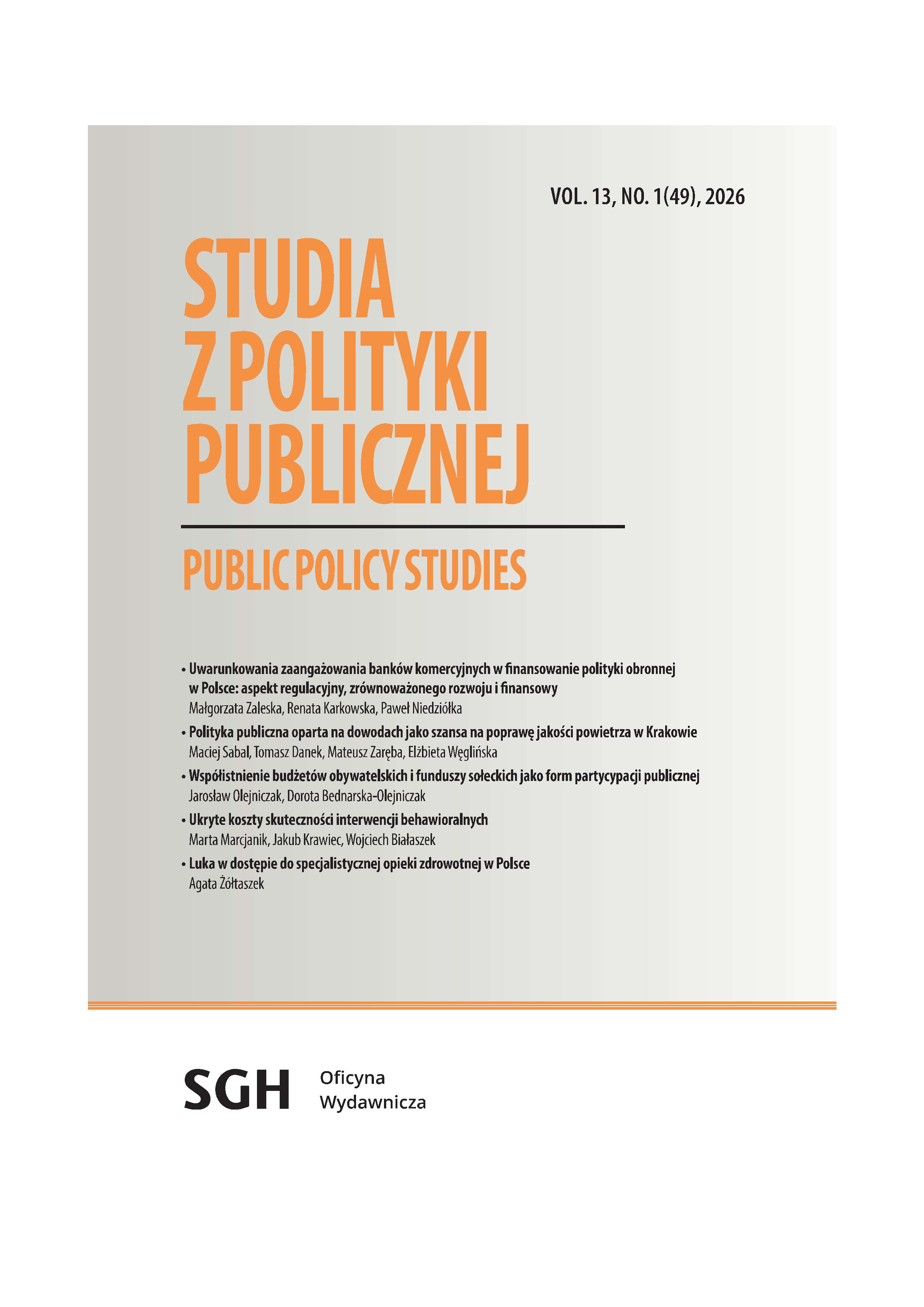
Treść głównego artykułu
Abstrakt
Odpowiedzią na eskalację ryzyka geopolitycznego oraz rosnące zagrożenie ze strony Federacji
Rosyjskiej jest znaczące zwiększenie wydatków na bezpieczeństwo i obronność. Powstaje jednocześnie pytanie o wpływ tych inwestycji na polską gospodarkę oraz finanse publiczne. Do rozwiązań zmniejszających obciążenia budżetu wydatkami zbrojeniowymi zaliczyć można zaangażowanie banków komercyjnych w proces finansowania. Dlatego celem niniejszego artykułu jest odpowiedź na pytanie, na ile sektor banków komercyjnych w Polsce mógłby stać się częściowym substytutem państwa w zakresie finansowania wydatków na bezpieczeństwo i obronność. W artykule zaakcentowano potrzebę zbudowania modelu finansowania sektora obronnego, który charakteryzuje się kreowaniem efektu mnożnikowego oraz stymulowaniem wzrostu gospodarczego przy jednoczesnym
zachowaniu kontroli nad deficytem i zadłużeniem sektora instytucji rządowych i samorządowych
w kontekście zbliżania się do wartości określonych w kryteriach z Maastricht, a także stabilności finansowej. Analizie poddano kluczowe uwarunkowania włączenia się sektora bankowego w finansowanie polityki obronnej.
Słowa kluczowe
Szczegóły artykułu
Prawa autorskie (c) 2026 Paweł Niedziółka, Małgorzata Zaleska, Renata Karkowska

Utwór dostępny jest na licencji Creative Commons Uznanie autorstwa 4.0 Międzynarodowe.
Czasopismo „Studia z Polityki Publicznej/Public Policy Studies” zapewnia dostęp do treści artykułów w trybie otwartego dostępu (Open Access) na zasadach licencji Creative Commons Uznanie autorstwa 4.0 Międzynarodowe (CC BY 4.0).


Więcej informacji: Polityka Open Access czasopisma "Studia z Polityki Publicznej/Public Policy Studies"
Referencje
- Air Quality in Europe. (2023). Europe’s Air Quality Status 2025, European Environment Agency,
- https://www.eea.europa.eu/publications/europes-air-quality-status-2024 (dostęp: 22.02.2026).
- Airly.org, https://airly.org (dostęp: 22.02.2026).
- Apley, D. W., Zhu, J. (2020). Visualizing the Effects of Predictor Variables in Black Box Supervised
- Learning Models, Journal of the Royal Statistical Society: Series B (Statistical Methodology),
- (4): 1059–1086, https://doi.org/10.48550/arXiv.1612.08468.
- Bank Światowy (2019). Air Quality in Poland: What Are the Issues and What Can Be Done?,
- https://documents1.worldbank.org/curated/ar/426051575639438457/pdf/Air-Quality-in-
- Poland-What-are-the-Issues-and-What-can-be-Done.pdf (dostęp: 22.02.2026).
- Baron, J. (2018). A Brief History of Evidence-Based Policy, The Annals of the American Academy
- of Political and Social Science, 678 (1): 40–50, https://doi.org/10.1177/0002716218770642.
- Bellamy, J. L., Bledsoe, S. E., Traube, D. E. (2006). The Current State of Evidence-Based Practice
- in Social Work: A Review of the Literature and Qualitative Analysis of Expert Interviews,
- Journal of Evidence-Based Social Work, 3: 23–48.
- Bokwa, A. (2019). Rozwój badań nad klimatem lokalnym Krakowa, Acta Geographica Lodziensia,
- : 7–20, https://doi.org/10.26485/AGL/2019/108/1.
- Behn, M., Lang, J. H., Reghezza, A. (2025). Geopolitical Risk and Its Implications for Macroprudential
- Policy, Macroprudential Bulletin, 28, April 2025, https://www.ecb.europa.eu/press/
- financial-stability-publications/macroprudential-bulletin/html/ecb.mpbu202504_01~6aa0c34852.
- en.html (dostęp: 16.06.2025).
- Bernardelli, M., Korzeb, Z., Niedziółka, P., Waliszewski, K. (2023). Channels for the Impact of
- the War in Ukraine on the Commercial Banking Sector in Poland, Contemporary Economics,
- (2): 142–173, https:/doi.org/10.5709/ce.1897-9254.504.
- Buch, C. (2024). Global Rifts and Financial Shifts: Supervising Banks in an Era of Geopolitical
- Instability, keynote speech by Claudia Buch, Chair of the Supervisory Board of the ECB,
- at the 8th European Systemic Risk Board (ESRB) Annual Conference on “New Frontiers
- in Macroprudential Policy”, https://www.bankingsupervision.europa.eu/press/speeches/
- date/2024/html/ssm.sp240926_1~ebf2df6685.en.html (dostęp: 30.05.2025).
- Caiazza, S., Galloppo, G., La Rosa, G. (2023). The Mitigation Role of Corporate Sustainability:
- Evidence from the CDS Spread, Finance Research Letters, 52: 103561, https://doi.
- org/10.1016/j.frl.2022.103561.
- Caldara, D., Iacoviello, M. (2022). Measuring Geopolitical Risk, American Economic Review,
- (4): 1194–1225, https://doi.org/10.1257/aer.20191823.
- Chimczak-Bratkowski, P. (2025). ESG a finansowanie przemysłu obronnego w Europie, https://
- akademiaesg.pl/baza-wiedzy/ewolucja-polityk-esg-w-europejskim-sektorze-bankowym-
- -geopolityczne-paradygmaty-2025-2026/ (dostęp: 1.07.2025).
- Defense News (2025). https://www.defensenews.com/global/europe/2025/03/04/eu-pitchesplan-
- to-free-up-800‑billion-for-defense-spending/ (dostęp: 30.07.2025).
- Dieckelmann, D., Kaufmann, Ch., Larkou, Ch., McQuade, P., Negri, C., Pancaro, C. Rößler, D.
- (2024). Turbulent Times: Geopolitical Risk and its Impact on Euro Area Financial Stability,
- https://www.ecb.europa.eu/press/financial-stability-publications/fsr/special/html/ecb.
- fsrart202405_01~4e4e30f01f.en.html (dostęp: 12.04.2025).
- Dudek, S. (2025). Czołgi na kredyt. Czy Polska buduje trwałe bezpieczeństwo?, Gazeta SGH,
- https://gazeta.sgh.waw.pl/meritum/czolgi-na-kredyt-czy-polska-buduje-trwale-bezpieczenstwo
- (dostęp: 20.07.2025).
- European Banking Authority (EBA). (2025). EU-wide Stress Testing, https://www.eba.europa.
- eu/risk-and-data-analysis/risk-analysis/eu-wide-stress-testing (dostęp: 18.06.2025).
- European Central Bank (ECB). (2024). ECB Concludes Cyber Resilience Stress Test, https://
- www.bankingsupervision.europa.eu/press/pr/date/2024/html/ssm.pr240726~06d5776a02.
- pl.html (dostęp: 19.03.2025).
- European Commission (EC). (2025). Accommodating Increased Defence Expenditure within the
- Stability and Growth Pact, https://defence-industry-space.ec.europa.eu/document/download/
- a57304ce-1a98-4a2c-aed5-36485884f1a0_en?filename=Communication-on-the-national-
- escape-clause.pdf (dostęp: 20.04.2025).
- European Defence Agency (EDA). (2023). Strengthening the EDTIB’s Access to Finance and
- its Ability to Contribute to Peace, Stability, and Sustainability in Europe, EDA202311066,
- https://eda.europa.eu/docs/default-source/news/20231114_jointstatement_accesstofinance.
- pdf (dostęp: 22.03.2025).
- European Investment Bank (EIB). (2025). EIB is Stepping up Support Europe’s Security and
- Defence Industry, July 2025.
- Geçikli, S., Zalinyan, I. (2025). ESG and Defence: A Financial Stand-off or a Strategic Opportunity?,
- https://www.rsm.global/netherlands/en/insights/esg-and-defence-financial-standor-
- strategic-opportunity (dostęp: 19.07.2025).
- Gholami, A., Sands, J. Rahman, H. U. (2022). Environmental, Social and Governance Disclosure
- and Value Generation: Is the Financial Industry Different?, Sustainability, 14: 2647, https://
- doi.org/10.3390/su14052647.
- International Monetary Fund (IMF). (2024). Global Financial Stability Report. Steadying the
- Course: Uncertainty, Artificial Intelligence, and Financial Stability, https://www.imf.org/-/
- media/files/publications/gfsr/2024/october/english/textrevised.pdf (dostęp: 19.07.2025).
- Jones, D., Templeman, L. (2022). Will defence and nuclear pivot to ESG?, dbSustainability,
- https://www.dbresearch.com/PROD/RPS_EN-PROD/PROD0000000000522744/dbSustainability_
- Spotlight%3A_Will_defence_and_nucle.PDF (dostęp: 27.04.2025).
- Jordà, Ò., Schularick, M., Taylor, A. M. (2016). Macrofinancial History and the New Business
- Cycle Facts, NBER Working Paper, 22743. https://www.nber.org/system/files/working_
- papers/w22743/w22743.pdf (dostęp: 20.03.2025).
- Karkowska, R., Niedziółka, P. (2019). Rentowność banków komercyjnych a ich płynność w kontekście
- implementacji ilościowych norm płynności rekomendowanych przez Bazylejski
- Komitet ds. Nadzoru Bankowego, Bank i Kredyt, 50 (2): 149–172.
- Khan, K., Khurshid, A., Cifuentes-Faura, J. (2025). Do Geopolitical Risks Induce a Butterfly Effect on
- Cybersecurity?, Information Development, 0 (0), https://doi.org/10.1177/02666669251325455.
- Komisja Europejska (KE) – Dyrekcja Generalna ds. Przemysłu Obronnego i Przestrzeni
- Kosmicznej (DG DEFIS) (2025). European Commission Unveils Defence Readiness Omnibus
- and EDF Interim Evaluation, https://defence-industry-space.ec.europa.eu/european-commission-
- unveils-defence-readiness-omnibus-and-edf-interim-evaluation-2025-06-17_en
- (dostęp: 29.07.2025).
- Merler, S. (2025). Sustainability Rules Are Not a Block on EU Defence Financing, but Reputational
- Fears Are, https://www.bruegel.org/analysis/sustainability-rules-are-not-block-eudefence-
- financing-reputational-fears-are (dostęp: 19.03.2025).
- Ministerstwo Finansów (MF). (2025). Zadłużenie sektora finansów publicznych, https://www.
- gov.pl/web/finanse/szeregiczasowe (dostęp: 7.10.2025).
- Murray, R. (2024). How a New Global Defense Bank – The ‘Defense, Security, and Resilience
- Bank’ – Can Solve US and Allied Funding Problems, https://www.atlanticcouncil.org/indepth-
- research-reports/report/how-a-new-global-defense-bank-can-solve-us-and-alliedfunding-
- problems/ (dostęp: 4.04.2025).
- Narodowy Bank Polski (NBP). (2025). Raport o stabilności systemu finansowego, https://nbp.
- pl/wp-content/uploads/2025/06/Raport-o-stabilnosci-systemu-finansowego.‑Czerwiec-
- ‑r.pdf (dostęp: 14.03.2025).
- NATO (2024). Defence Expenditure of NATO Countries (2014–2024), https://www.nato.int/
- nato_static_fl2014/assets/pdf/2024/6/pdf/240617‑def-exp-2024‑en.pdf (dostęp: 29.03.2025).
- Niepmann, F., Sheng Shen, L. (2024). Geopolitical Risk and Global Banking, Federal Reserve
- Board, Federal Reserve Bank of Boston, Joint ECB-IMF-IMFER conference on “Global
- Challenges and Channels for Fiscal and Monetary Policy”, Frankfurt, 23–24 July 2024,
- https://www.ecb.europa.eu/press/conferences/shared/pdf/20240723/presentation_Niepmann.
- pdf (dostęp: 16.05.2025).
- Nowa Technika Wojskowa (2025). Budżet Ministerstwa Obrony Narodowej – edycja 2025,
- Nowa Technika Wojskowa, 4, https://portalmilitarny.pl/artykuly/budzet-ministerstwa-
- -obrony-narodowej-edycja-2025/ (dostęp: 20.07.2025).
- Palmieri, E., Ferilli, G. B., Altunbas, Y., Stefanelli, V. Geretto, E. (2023). Business Model and ESG
- Pillars: The Impacts on Banking Default Risk, International Review of Financial Analysis,
- , https://doi.org/10.1016/j.irfa.2023.102978.
- Paquette, S. (2025). The DSR Bank: A New Finance Mechanism for Collective Defence, https://
- carleton.ca/eetn/2025/the-dsr-bank-a-new-finance-mechanism-for-collective-defence/
- (dostęp: 22.07.2025).
- Phan, D., Tran, V., Iyke, B. (2022). Geopolitical Risk and Bank Stability, Finance Research Letters,
- (B), https://doi.org/1016/j.frl.2021.102453.
- Prayitno, A. (2025). Sustainable Business Practices in the Defense Industry: Between Efficiency
- and National Security, MAR-Ekonomi: Jurnal Manajemen, Akuntansi Dan Rumpun Ilmu
- Ekonomi, 3 (02): 87–95, https://doi.org/10.58471/mar-ekonomi.v3i02.667.
- Rozporządzenie delegowane Komisji (UE) 2020/1818 z dnia 17 lipca 2020 r. uzupełniające
- rozporządzenie Parlamentu Europejskiego i Rady (UE) 2016/1011 w odniesieniu do
- minimalnych norm dotyczących unijnych wskaźników referencyjnych transformacji klimatycznej
- i unijnych wskaźników referencyjnych dostosowanych do porozumienia paryskiego,
- Dz. Urz. Unii Europejskiej L 406/17, https://eur-lex.europa.eu/legal-content/PL/
- TXT/PDF/?uri=CELEX:32020R1818 (dostęp: 15.07.2025).
- Szymański, P. (2025). Szczyt NATO w Hadze – powrót Trumpa i dwuskładnikowe 5% PKB
- na obronność, https://www.osw.waw.pl/pl/publikacje/komentarze-osw/2025-06-26/szczytnato-
- w-hadze-powrot-trumpa-i-dwuskladnikowe-5‑pkb-na (dostęp: 4.07.2025).
- Tarmuji, I., Maelah, R. Tarmuji, N. (2016). The Impact of Environmental, Social and Governance
- Practices (ESG) on Economic Performance: Evidence from ESG Score, International Journal
- of Trade, Economics and Finance, 7: 67–74, https://doi.org/10.18178/ijtef.2016.7.3.501.
- Ustawa z dnia 11 marca 2022 r. o obronie Ojczyzny (Dz.U. 2022 poz. 655).
- Zaleska, M. (2025). Koło zamachowe gospodarki – jak banki mogą i powinny efektywnie wspierać
- rozwój Polski?, Rzeczpospolita, 22.05.2025.
- Zaleska, M. (2022). Wybrane trendy w bankowości centralnej, Bank i Kredyt, 53 (3): 279–294.
- Związek Banków Polskich (ZBP). (2025). Infokredyt, wydanie 2024, https://zbp.pl/getmedia/4680
- fbf6-625c-4dcd-bcfd-3dd235d25049/infokredyt_raport_2024_m4‑final (dostęp: 27.07.2025).
Referencje
Air Quality in Europe. (2023). Europe’s Air Quality Status 2025, European Environment Agency,
https://www.eea.europa.eu/publications/europes-air-quality-status-2024 (dostęp: 22.02.2026).
Airly.org, https://airly.org (dostęp: 22.02.2026).
Apley, D. W., Zhu, J. (2020). Visualizing the Effects of Predictor Variables in Black Box Supervised
Learning Models, Journal of the Royal Statistical Society: Series B (Statistical Methodology),
(4): 1059–1086, https://doi.org/10.48550/arXiv.1612.08468.
Bank Światowy (2019). Air Quality in Poland: What Are the Issues and What Can Be Done?,
https://documents1.worldbank.org/curated/ar/426051575639438457/pdf/Air-Quality-in-
Poland-What-are-the-Issues-and-What-can-be-Done.pdf (dostęp: 22.02.2026).
Baron, J. (2018). A Brief History of Evidence-Based Policy, The Annals of the American Academy
of Political and Social Science, 678 (1): 40–50, https://doi.org/10.1177/0002716218770642.
Bellamy, J. L., Bledsoe, S. E., Traube, D. E. (2006). The Current State of Evidence-Based Practice
in Social Work: A Review of the Literature and Qualitative Analysis of Expert Interviews,
Journal of Evidence-Based Social Work, 3: 23–48.
Bokwa, A. (2019). Rozwój badań nad klimatem lokalnym Krakowa, Acta Geographica Lodziensia,
: 7–20, https://doi.org/10.26485/AGL/2019/108/1.
Behn, M., Lang, J. H., Reghezza, A. (2025). Geopolitical Risk and Its Implications for Macroprudential
Policy, Macroprudential Bulletin, 28, April 2025, https://www.ecb.europa.eu/press/
financial-stability-publications/macroprudential-bulletin/html/ecb.mpbu202504_01~6aa0c34852.
en.html (dostęp: 16.06.2025).
Bernardelli, M., Korzeb, Z., Niedziółka, P., Waliszewski, K. (2023). Channels for the Impact of
the War in Ukraine on the Commercial Banking Sector in Poland, Contemporary Economics,
(2): 142–173, https:/doi.org/10.5709/ce.1897-9254.504.
Buch, C. (2024). Global Rifts and Financial Shifts: Supervising Banks in an Era of Geopolitical
Instability, keynote speech by Claudia Buch, Chair of the Supervisory Board of the ECB,
at the 8th European Systemic Risk Board (ESRB) Annual Conference on “New Frontiers
in Macroprudential Policy”, https://www.bankingsupervision.europa.eu/press/speeches/
date/2024/html/ssm.sp240926_1~ebf2df6685.en.html (dostęp: 30.05.2025).
Caiazza, S., Galloppo, G., La Rosa, G. (2023). The Mitigation Role of Corporate Sustainability:
Evidence from the CDS Spread, Finance Research Letters, 52: 103561, https://doi.
org/10.1016/j.frl.2022.103561.
Caldara, D., Iacoviello, M. (2022). Measuring Geopolitical Risk, American Economic Review,
(4): 1194–1225, https://doi.org/10.1257/aer.20191823.
Chimczak-Bratkowski, P. (2025). ESG a finansowanie przemysłu obronnego w Europie, https://
akademiaesg.pl/baza-wiedzy/ewolucja-polityk-esg-w-europejskim-sektorze-bankowym-
-geopolityczne-paradygmaty-2025-2026/ (dostęp: 1.07.2025).
Defense News (2025). https://www.defensenews.com/global/europe/2025/03/04/eu-pitchesplan-
to-free-up-800‑billion-for-defense-spending/ (dostęp: 30.07.2025).
Dieckelmann, D., Kaufmann, Ch., Larkou, Ch., McQuade, P., Negri, C., Pancaro, C. Rößler, D.
(2024). Turbulent Times: Geopolitical Risk and its Impact on Euro Area Financial Stability,
https://www.ecb.europa.eu/press/financial-stability-publications/fsr/special/html/ecb.
fsrart202405_01~4e4e30f01f.en.html (dostęp: 12.04.2025).
Dudek, S. (2025). Czołgi na kredyt. Czy Polska buduje trwałe bezpieczeństwo?, Gazeta SGH,
https://gazeta.sgh.waw.pl/meritum/czolgi-na-kredyt-czy-polska-buduje-trwale-bezpieczenstwo
(dostęp: 20.07.2025).
European Banking Authority (EBA). (2025). EU-wide Stress Testing, https://www.eba.europa.
eu/risk-and-data-analysis/risk-analysis/eu-wide-stress-testing (dostęp: 18.06.2025).
European Central Bank (ECB). (2024). ECB Concludes Cyber Resilience Stress Test, https://
www.bankingsupervision.europa.eu/press/pr/date/2024/html/ssm.pr240726~06d5776a02.
pl.html (dostęp: 19.03.2025).
European Commission (EC). (2025). Accommodating Increased Defence Expenditure within the
Stability and Growth Pact, https://defence-industry-space.ec.europa.eu/document/download/
a57304ce-1a98-4a2c-aed5-36485884f1a0_en?filename=Communication-on-the-national-
escape-clause.pdf (dostęp: 20.04.2025).
European Defence Agency (EDA). (2023). Strengthening the EDTIB’s Access to Finance and
its Ability to Contribute to Peace, Stability, and Sustainability in Europe, EDA202311066,
https://eda.europa.eu/docs/default-source/news/20231114_jointstatement_accesstofinance.
pdf (dostęp: 22.03.2025).
European Investment Bank (EIB). (2025). EIB is Stepping up Support Europe’s Security and
Defence Industry, July 2025.
Geçikli, S., Zalinyan, I. (2025). ESG and Defence: A Financial Stand-off or a Strategic Opportunity?,
https://www.rsm.global/netherlands/en/insights/esg-and-defence-financial-standor-
strategic-opportunity (dostęp: 19.07.2025).
Gholami, A., Sands, J. Rahman, H. U. (2022). Environmental, Social and Governance Disclosure
and Value Generation: Is the Financial Industry Different?, Sustainability, 14: 2647, https://
doi.org/10.3390/su14052647.
International Monetary Fund (IMF). (2024). Global Financial Stability Report. Steadying the
Course: Uncertainty, Artificial Intelligence, and Financial Stability, https://www.imf.org/-/
media/files/publications/gfsr/2024/october/english/textrevised.pdf (dostęp: 19.07.2025).
Jones, D., Templeman, L. (2022). Will defence and nuclear pivot to ESG?, dbSustainability,
https://www.dbresearch.com/PROD/RPS_EN-PROD/PROD0000000000522744/dbSustainability_
Spotlight%3A_Will_defence_and_nucle.PDF (dostęp: 27.04.2025).
Jordà, Ò., Schularick, M., Taylor, A. M. (2016). Macrofinancial History and the New Business
Cycle Facts, NBER Working Paper, 22743. https://www.nber.org/system/files/working_
papers/w22743/w22743.pdf (dostęp: 20.03.2025).
Karkowska, R., Niedziółka, P. (2019). Rentowność banków komercyjnych a ich płynność w kontekście
implementacji ilościowych norm płynności rekomendowanych przez Bazylejski
Komitet ds. Nadzoru Bankowego, Bank i Kredyt, 50 (2): 149–172.
Khan, K., Khurshid, A., Cifuentes-Faura, J. (2025). Do Geopolitical Risks Induce a Butterfly Effect on
Cybersecurity?, Information Development, 0 (0), https://doi.org/10.1177/02666669251325455.
Komisja Europejska (KE) – Dyrekcja Generalna ds. Przemysłu Obronnego i Przestrzeni
Kosmicznej (DG DEFIS) (2025). European Commission Unveils Defence Readiness Omnibus
and EDF Interim Evaluation, https://defence-industry-space.ec.europa.eu/european-commission-
unveils-defence-readiness-omnibus-and-edf-interim-evaluation-2025-06-17_en
(dostęp: 29.07.2025).
Merler, S. (2025). Sustainability Rules Are Not a Block on EU Defence Financing, but Reputational
Fears Are, https://www.bruegel.org/analysis/sustainability-rules-are-not-block-eudefence-
financing-reputational-fears-are (dostęp: 19.03.2025).
Ministerstwo Finansów (MF). (2025). Zadłużenie sektora finansów publicznych, https://www.
gov.pl/web/finanse/szeregiczasowe (dostęp: 7.10.2025).
Murray, R. (2024). How a New Global Defense Bank – The ‘Defense, Security, and Resilience
Bank’ – Can Solve US and Allied Funding Problems, https://www.atlanticcouncil.org/indepth-
research-reports/report/how-a-new-global-defense-bank-can-solve-us-and-alliedfunding-
problems/ (dostęp: 4.04.2025).
Narodowy Bank Polski (NBP). (2025). Raport o stabilności systemu finansowego, https://nbp.
pl/wp-content/uploads/2025/06/Raport-o-stabilnosci-systemu-finansowego.‑Czerwiec-
‑r.pdf (dostęp: 14.03.2025).
NATO (2024). Defence Expenditure of NATO Countries (2014–2024), https://www.nato.int/
nato_static_fl2014/assets/pdf/2024/6/pdf/240617‑def-exp-2024‑en.pdf (dostęp: 29.03.2025).
Niepmann, F., Sheng Shen, L. (2024). Geopolitical Risk and Global Banking, Federal Reserve
Board, Federal Reserve Bank of Boston, Joint ECB-IMF-IMFER conference on “Global
Challenges and Channels for Fiscal and Monetary Policy”, Frankfurt, 23–24 July 2024,
https://www.ecb.europa.eu/press/conferences/shared/pdf/20240723/presentation_Niepmann.
pdf (dostęp: 16.05.2025).
Nowa Technika Wojskowa (2025). Budżet Ministerstwa Obrony Narodowej – edycja 2025,
Nowa Technika Wojskowa, 4, https://portalmilitarny.pl/artykuly/budzet-ministerstwa-
-obrony-narodowej-edycja-2025/ (dostęp: 20.07.2025).
Palmieri, E., Ferilli, G. B., Altunbas, Y., Stefanelli, V. Geretto, E. (2023). Business Model and ESG
Pillars: The Impacts on Banking Default Risk, International Review of Financial Analysis,
, https://doi.org/10.1016/j.irfa.2023.102978.
Paquette, S. (2025). The DSR Bank: A New Finance Mechanism for Collective Defence, https://
carleton.ca/eetn/2025/the-dsr-bank-a-new-finance-mechanism-for-collective-defence/
(dostęp: 22.07.2025).
Phan, D., Tran, V., Iyke, B. (2022). Geopolitical Risk and Bank Stability, Finance Research Letters,
(B), https://doi.org/1016/j.frl.2021.102453.
Prayitno, A. (2025). Sustainable Business Practices in the Defense Industry: Between Efficiency
and National Security, MAR-Ekonomi: Jurnal Manajemen, Akuntansi Dan Rumpun Ilmu
Ekonomi, 3 (02): 87–95, https://doi.org/10.58471/mar-ekonomi.v3i02.667.
Rozporządzenie delegowane Komisji (UE) 2020/1818 z dnia 17 lipca 2020 r. uzupełniające
rozporządzenie Parlamentu Europejskiego i Rady (UE) 2016/1011 w odniesieniu do
minimalnych norm dotyczących unijnych wskaźników referencyjnych transformacji klimatycznej
i unijnych wskaźników referencyjnych dostosowanych do porozumienia paryskiego,
Dz. Urz. Unii Europejskiej L 406/17, https://eur-lex.europa.eu/legal-content/PL/
TXT/PDF/?uri=CELEX:32020R1818 (dostęp: 15.07.2025).
Szymański, P. (2025). Szczyt NATO w Hadze – powrót Trumpa i dwuskładnikowe 5% PKB
na obronność, https://www.osw.waw.pl/pl/publikacje/komentarze-osw/2025-06-26/szczytnato-
w-hadze-powrot-trumpa-i-dwuskladnikowe-5‑pkb-na (dostęp: 4.07.2025).
Tarmuji, I., Maelah, R. Tarmuji, N. (2016). The Impact of Environmental, Social and Governance
Practices (ESG) on Economic Performance: Evidence from ESG Score, International Journal
of Trade, Economics and Finance, 7: 67–74, https://doi.org/10.18178/ijtef.2016.7.3.501.
Ustawa z dnia 11 marca 2022 r. o obronie Ojczyzny (Dz.U. 2022 poz. 655).
Zaleska, M. (2025). Koło zamachowe gospodarki – jak banki mogą i powinny efektywnie wspierać
rozwój Polski?, Rzeczpospolita, 22.05.2025.
Zaleska, M. (2022). Wybrane trendy w bankowości centralnej, Bank i Kredyt, 53 (3): 279–294.
Związek Banków Polskich (ZBP). (2025). Infokredyt, wydanie 2024, https://zbp.pl/getmedia/4680
fbf6-625c-4dcd-bcfd-3dd235d25049/infokredyt_raport_2024_m4‑final (dostęp: 27.07.2025).