Pasek boczny artykułu
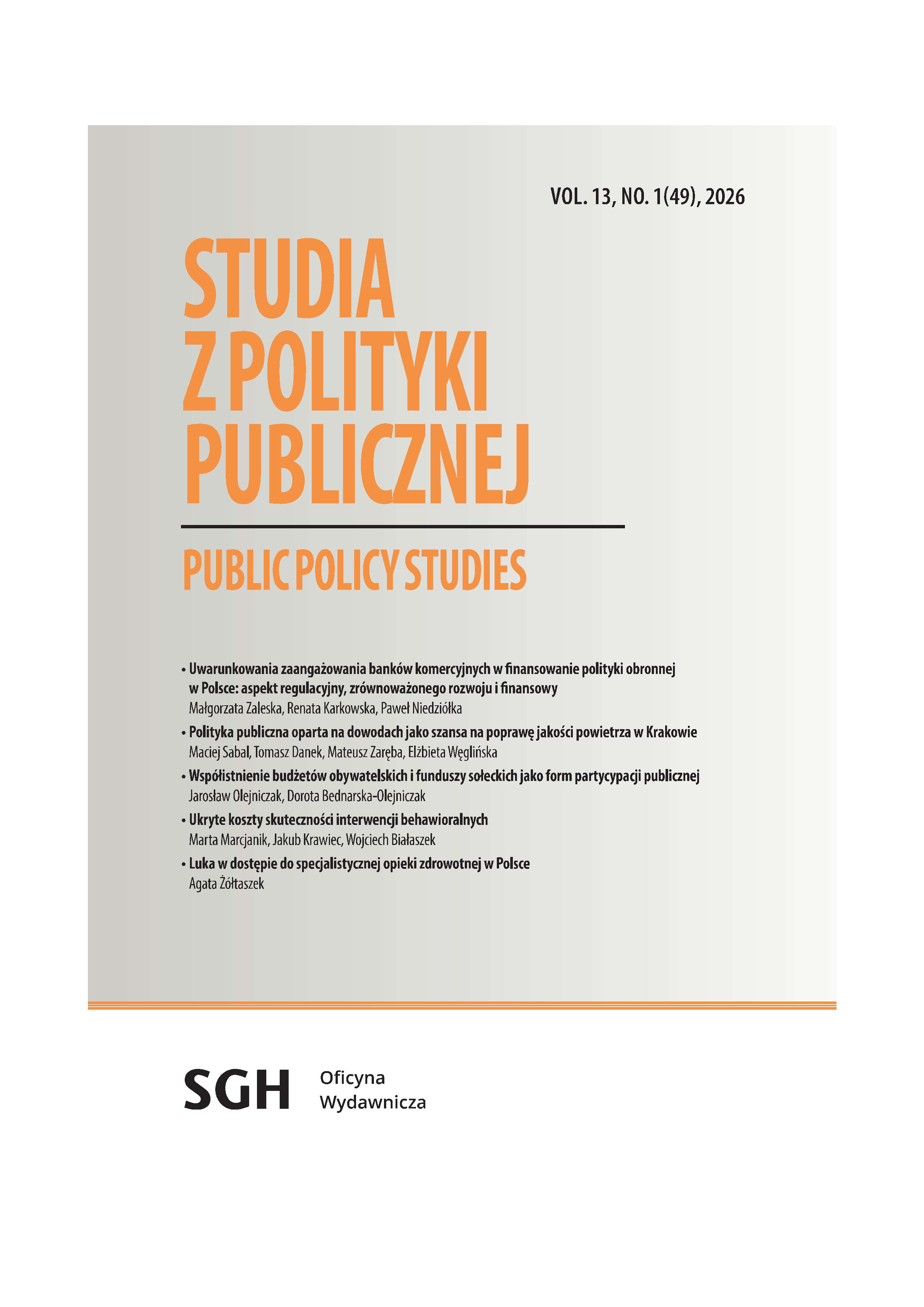
Treść głównego artykułu
Abstrakt
Zanieczyszczone powietrze jest jednym z głównych zagrożeń zdrowotnych dla mieszkańców miast. Problem dotyczy polskich metropolii, dlatego został dostrzeżony przez władze krajowe, regionalne i lokalne. W Krakowie przez dekady odnotowywano wysokie stężenia szkodliwych substancji, w tym PM 2,5. W ostatnich latach w mieście dokonane zostały radykalne kroki w zakresie poprawy jakości powietrza, których ukoronowaniem był zakaz stosowania paliw stałych od 2019 r. Mimo pewnej poprawy, w Krakowie wciąż notowane są wysokie stężenia pyłów zawieszonych, spowodowane napływem zanieczyszczonego powietrza z sąsiednich miejscowości. Autorzy przeprowadzili analizę predyktorów wpływających na zanieczyszczenie powietrza w Krakowie, opartą o dane z ogólnodostępnych czujników firmy Airly zlokalizowanych w okolicach miasta. Następnie zestawiono te wyniki z informacjami na temat liczby i rodzaju źródeł ogrzewania w gminach wokół Krakowa oraz poziomem zamożności w tych gminach. Na tej podstawie sporządzono rekomendacje dla władz regionalnych i lokalnych. Celem publikacji jest ocena użyteczności zintegrowanych trzech źródeł danych (dane z czujników powietrza, dane o źródłach ogrzewania, dane o dochodach) do zastosowania polityki publicznej opartej na dowodach w Aglomeracji
Krakowskiej w obszarze poprawy jakości powietrza.
Słowa kluczowe
Szczegóły artykułu
Prawa autorskie (c) 2026 Maciej Sabal, Tomasz Danek, Mateusz Zaręba, Elżbieta Węglińska

Utwór dostępny jest na licencji Creative Commons Uznanie autorstwa 4.0 Międzynarodowe.
Czasopismo „Studia z Polityki Publicznej/Public Policy Studies” zapewnia dostęp do treści artykułów w trybie otwartego dostępu (Open Access) na zasadach licencji Creative Commons Uznanie autorstwa 4.0 Międzynarodowe (CC BY 4.0).


Więcej informacji: Polityka Open Access czasopisma "Studia z Polityki Publicznej/Public Policy Studies"
Referencje
- Air Quality in Europe. (2023). Europe’s Air Quality Status 2025, European Environment Agency,
- https://www.eea.europa.eu/publications/europes-air-quality-status-2024 (dostęp: 22.02.2026).
- Airly.org, https://airly.org (dostęp: 22.02.2026).
- Apley, D. W., Zhu, J. (2020). Visualizing the Effects of Predictor Variables in Black Box Supervised
- Learning Models, Journal of the Royal Statistical Society: Series B (Statistical Methodology),
- (4): 1059–1086, https://doi.org/10.48550/arXiv.1612.08468.
- Bank Światowy (2019). Air Quality in Poland: What Are the Issues and What Can Be Done?,
- https://documents1.worldbank.org/curated/ar/426051575639438457/pdf/Air-Quality-in-
- Poland-What-are-the-Issues-and-What-can-be-Done.pdf (dostęp: 22.02.2026).
- Baron, J. (2018). A Brief History of Evidence-Based Policy, The Annals of the American Academy
- of Political and Social Science, 678 (1): 40–50, https://doi.org/10.1177/0002716218770642.
- Bellamy, J. L., Bledsoe, S. E., Traube, D. E. (2006). The Current State of Evidence-Based Practice
- in Social Work: A Review of the Literature and Qualitative Analysis of Expert Interviews,
- Journal of Evidence-Based Social Work, 3: 23–48.
- Bokwa, A. (2019). Rozwój badań nad klimatem lokalnym Krakowa, Acta Geographica Lodziensia,
- : 7–20, https://doi.org/10.26485/AGL/2019/108/1.
- Bryson, J. M. (2004). Strategic Planning for Public and Nonprofit Organizations: A Guide
- to Strengthening and Sustaining Organizational Achievement. San Francisco: Jossey-Bass.
- Buskist, W., Groccia, J. E. (2011). Evidence-Based Teaching: Now and in the Future, New Directions
- for Teaching and Learning, 128: 105–111.
- Cabinet Office (1999). White Paper Modernising Government.
- Cairney, P. (2016). The Politics of Evidence-Based Policymaking. London: Palgrave Macmillan,
- https://doi.org/10.1057/978-1-137-51781-4.
- Cairney, P. (2022). The Myth of ‘Evidence-Based Policymaking’ in a Decentred State, Public
- Policy and Administration, 37 (1): 46–66, https://doi.org/10.1177/0952076720905016.
- Cambridge Dictionary (2025). Politics, Political, Politician or Policy, https://dictionary.cambridge.
- org/grammar/british-grammar/politics-political-politician-or-policy (dostęp: 22.02.2026).
- Chau, T.‑T., Wang, K.‑Y. (2020). An Association Between Air Pollution and Daily Most Frequently
- Visits of Eighteen Outpatient Diseases in an Industrial City, Scientific Reports, 10:
- , https://doi.org/10.1038/s41598-020-58721-0.
- Cochrane, A. L. (1972). Effectiveness and Efficiency: Random Reflections on Health Services.
- London: Nuffield Provincial Hospitals Trust.
- Cohen, A. J., Brauer, M., Burnett, R., Anderson, H. R., Frostad, J., Estep, K., Forouzanfar, M. H.
- (2017). Estimates and 25‑Year Trends of the Global Burden of Disease Attributable to Ambient
- Air Pollution: An Analysis of Data from the Global Burden of Diseases Study 2015,
- The Lancet, 389 (10082): 1907–1918, https://doi.org/10.1016/S0140-6736(17)30505-6.
- Danek, T., Węglińska, E., Zaręba, M. (2022). The Influence of Meteorological Factors and Terrain
- on Air Pollution Concentration and Migration: A Geostatistical Case Study from Krakow,
- Poland, Scientific Reports, 12: 11050, https://doi.org/10.1038/s41598-022-15160-3.
- Davies, H. T. O., Nutley, S. M., Smith, P. C. (Eds.). (2009). What Works? Evidence-Based Policy
- and Practice in Public Services. Bristol: The Policy Press.
- Feinstein, A. R. (1967). Clinical Judgment. Baltimore: Williams and Wilkins.
- Flyvbjerg, B. (2001). Making Social Science Matter: Why Social Inquiry Fails and How it Can
- Succeed Again. Cambridge: Cambridge University Press.
- Friedman, J. H., Popescu, B. E. (2008). Predictive Learning Via Rule Ensembles, The Annals of
- Applied Statistics, 2 (3): 916–954, https://doi.org/10.1214/07‑AOAS148.
- Geodecki, T., Gorzelak, G., Górniak, J., Hausner, J., Mazur, S., Szlachta, J., Zalewski, J. (2012).
- Kurs na innowacje. Jak wyprowadzić Polskę z rozwojowego dryfu? Warszawa: Fundacja
- Gospodarki i Administracji Publicznej.
- GIOŚ. (2023). Jakość powietrza w Polsce w roku 2022 w świetle wyników pomiarów prowadzonych
- w ramach Państwowego Monitoringu Środowiska. Warszawa: Główny Inspektorat
- Ochrony Środowiska.
- Górniak, J., Keler, K. (2008). Ewaluacja i wskaźniki w cyklu planowania i realizacji polityk
- publicznych, Journal of Public Governance, 3 (1): 109–124.
- Górniak, J., Mazur, S. (red.). (2011). W kierunku polityki rynku pracy opartej na dowodach.
- Warszawa: Pracodawcy RP.
- Górniak, J., Mazur, S. (2012). Zarządzanie strategiczne rozwojem. Warszawa: Ministerstwo
- Rozwoju Regionalnego.
- Hanigan, I. C., Rolfe, M. I., Knibbs, L. D., Salimi, F., Cowie, C. T., Heyworth, J., …, Bauman, A.
- (2019). All-Cause Mortality and Long-Term Exposure to Low Level Air Pollution in the
- ‘45 and Up Study’ Cohort, Sydney, Australia, 2006–2015, Environment International, 126:
- –770, https://doi.org/10.1016/j.envint.2019.02.038.
- Hammersley, M. (2005). Is the Evidence-Based Practice Movement Doing More Good than
- Harm? Reflections on Iain Chalmers’ Case for Research-Based Policy Making and Practice,
- Evidence and Policy, 1 (1): 85–100.
- Hoffman, T., Bennett, S., Del Mar, C. (2013). Evidence-Based Practice: Across the Health Professions
- (2nd ed.). Amsterdam: Elsevier.
- Hrehorowicz-Gaber, H. (2015). Role of Green Areas for Space Integration of Krakow’s Metropolitan
- Area, Bulletin of Geography. Socio-Economic Series, 29: 69–76, https://doi.
- org/10.1515/bog-2015–0016.
- Jendritzky, G., Maarouf, A., Staiger, H. (2001). Looking for a Universal Thermal Climate Index
- UTCI for Outdoor Applications, International Society of Biometeorology, https://utci.org/
- resources/develop_utci.pdf (dostęp: 22.02.2026).
- Jędruszkiewicz, J., Czernecki, B., Marosz, M. (2017). The Variability of PM10 and PM2.5 Concentrations
- in Selected Polish Agglomerations: The Role of Meteorological Conditions,
- –2016, Internatioal Journal of Environmental Health Research, 27: 441–462.
- Kepes, S., Bennet, A., McDaniel, M. (2014). Evidence-Based Management and the Trustworthiness
- of Our Cumulative Scientific Knowledge, Academy of Management Learning & Education,
- : 446–466, https://doi.org/10.5465/amle.2013.0193.
- Kleczkowski, P. (2019). Smog in Poland: Causes, Effects, Prevention. Warszawa: Wydawnictwo
- Naukowe PWN.
- Mathison, S. (red.). (2004). Encyclopedia of Evaluation. Thousand Oaks: Sage.
- Mears, D. P., Barnes, J. C. (2010). Toward a Systematic Foundation for Identifying Evidence-
- Based Criminal Justice Sanctions and Their Relative Effectiveness, Journal of Criminal Justice,
- (4): 702–710, https://doi.org/10.1016/j.jcrimjus.2010.04.007.
- Miasto Kraków (2010). Program Ograniczania Niskiej Emisji w Krakowie, https://www.bip.krakow.
- pl/?dok_id=30445&lid=90154404&vReg=2 (dostęp: 22.02.2026).
- Miasto Kraków (2023). Uchwała nr CIV/2833/23 Rady Miasta Kraków z dnia 25 stycznia
- r., https://www.bip.krakow.pl/?dok_id=167&sub_dok_id=167&sub=uchwala&query=
- id%3D26938%26typ%3Du (dostęp: 22.02.2026).
- Milewska, A., Parlińska, A. (2021). Ekonomiczno-prawne uwarunkowania gospodarki niskoemisyjnej
- w samorządach terytorialnych – wybrane aspekty, Studia Iuridica, 254: 239–
- , https://doi.org/10.31338/2544–3135.si.2022-89.12.
- Ministerstwo Finansów (2024). Informacje o dochodach podatkowych na 1 mieszkańca gminy
- (w PLN) za rok 2022, https://www.gov.pl/web/finanse/wskazniki-dochodow-podatkowych-
- -gmin-powiatow-i-wojewodztw-na-2024‑r (dostęp: 22.02.2026).
- Ministerstwo Klimatu i Środowiska. (2024). Program Czyste Powietrze, https://czystepowietrze.
- gov.pl/wez-dofinansowanie/dokumenty-programowe/dokumenty-obowiazujace
- (dostęp: 22.02.2026).
- Moldoveanu, M. C., Baum, J. C. (2005). Contemporary Debates in Organizational Epistemology.
- W: The Blackwell companion to organizations (733–751), J. C. Baum (Ed.). London:
- Blackwell Publishing.
- Molnar, C., Bischl, B., Casalicchio, G. (2018). Interpretable Machine Learning (Version 3) [Software],
- Journal of Open Source Software, 3 (26): 786, https://doi.org/10.21105/joss.00786.
- Morawska-Horawska, M., Lewik, P. (2003). Wpływ wysokości i ukształtowania terenu na zróżnicowanie
- warunków meteorologicznych w Krakowie. W: Dynamika zmian środowiska
- geograficznego pod wpływem antropopresji (85–94), J. Lach (red.). Kraków: Instytut Geografii
- Akademii Pedagogicznej w Krakowie.
- Muers, S. (2020). Culture and Values at the Heart of Policy Making: An Insider’s Guide. Bristol:
- Bristol University Press, https://doi.org/10.2307/j.ctv13gvj0f.
- Ośródka, L., Godłowska, J., Hajto, M., Rozwoda, W., Wojtylak, M. (2010). Determining the
- Anemological Conditions for the Area of Kraków. KHK SA.
- Pfeffer, J., Sutton, R. I. (2006). Profiting from Evidence‐Based Management, Strategy & Leadership,
- (2): 35–42, https://doi.org/10.1108/10878570610652617.
- Rajagopalan, S., Al-Kindi, S. G., Brook, R. D. (2018). Air Pollution and Cardiovascular Disease,
- Journal of the American College of Cardiology, 72 (17): 2054–2070, https://doi.org/10.1016/j.
- jacc.2018.07.099.
- Rousseau, D. M. (2006). Is There Such a Thing as “Evidence-Based Management”?, Academy of
- Management Review, 31 (2): 256–269, https://doi.org/10.2307/20159200.
- Rousseau, D. M., McCarthy, S. (2007). Educating Managers from an Evidence-Based Perspective,
- Academy of Management Learning and Education, 6: 84–101, https://doi.org/10.5465/
- amle.2007.24401705.
- Sackett, D. L., Rosenberg, W. M. C., Gray, J. A. M., Haynes, R. B., Richardson, W. S. (1996). Evidence
- Based Medicine: What it is and What it isn’t, BMJ, 312: 71–73, https://doi.org/10.1136/
- bmj.312.7023.71.
- Sejm RP (2020). Ustawa z dnia 28 października 2020 r., https://isap.sejm.gov.pl/isap.nsf/DocDetails.
- xsp?id=WDU20200002127 (dostęp: 22.02.2026).
- Sejm RP (2023). Ustawa z dnia 20 lipca 2018 r. Prawo o szkolnictwie wyższym i nauce, https://
- isap.sejm.gov.pl/isap.nsf/DocDetails.xsp?id=WDU20230000742 (dostęp: 22.02.2026).
- Shapiro, D. L., Kirkman, B. L., Courtney, H. G. (2007). Perceived Causes and Solutions of the
- Translation Problem in Management Research, Academy of Management Journal, 50 (2):
- –266, https://doi.org/10.5465/AMJ.2007.24634433.
- Sutcliffe, S., Court, J. (2005). Evidence-Based Policymaking: What is it? How Does it Work? What
- Relevance for Developing Countries? London: Overseas Development Institute.
- Stevens, A. (2020). Governments Cannot Just ‘Follow the Science’ on COVID-19, Nature Human
- Behaviour, 4 (6): 560, https://doi.org/10.1038/s41562-020-0894‑x.
- Strobl, C., Boulesteix, A., Kneib, T., Augustin, T., Zeileis, A. (2008). Conditional Variable
- Importance for Random Forests, BMC Bioinformatics, 9: 307, https://doi.org/10.1186/1471-
- -9-307.
- Sullivan, H. (2011). ‘Truth’ Junkies: Using Evaluation in UK Public Policy, Policy & Politics,
- (4): 499–512.
- Traczyk, P., Gruszecka-Kosowska, A. (2020). The Condition of Air Pollution in Kraków, Poland,
- in 2005–2020, with Health Risk Assessment, International Journal of Environmental Research
- and Public Health, 17 (17): 6063, https://doi.org/10.3390/ijerph17176063.
- Tsyro, S. (2005). To What Extent Can Aerosol Water Explain the Discrepancy Between Model
- Calculated and Gravimetric PM10 and PM2.5?, Atmospheric Chemistry and Physics, 5:
- –532, https://doi.org/10.5194/acp-5-515-2005.
- UMWM (2016). Uchwała Nr XVIII/243/16 Sejmiku WM z 15.01.2016 r., https://bip.malopolska.
- pl/umwm/Article/get/id,1159347.html (dostęp: 22.02.2026).
- UMWM (2017). Uchwała Nr XXXII/452/17 Sejmiku WM z 22.01.2017 r., https://bip.malopolska.
- pl/umwm,a,1283900, uchwala-nr-xxxii45217‑sejmiku-wojewodztwa-malopolskiego-
- -z-dnia-23‑styczna-2017‑r-w-sprawie-wprowadze.html (dostęp: 22.02.2026).
- Zippenfenig, P. (2023). Open-Meteo.com Weather API [Computer software], Zenodo, https://
- doi.org/10.5281/ZENODO.7970649.
Referencje
Air Quality in Europe. (2023). Europe’s Air Quality Status 2025, European Environment Agency,
https://www.eea.europa.eu/publications/europes-air-quality-status-2024 (dostęp: 22.02.2026).
Airly.org, https://airly.org (dostęp: 22.02.2026).
Apley, D. W., Zhu, J. (2020). Visualizing the Effects of Predictor Variables in Black Box Supervised
Learning Models, Journal of the Royal Statistical Society: Series B (Statistical Methodology),
(4): 1059–1086, https://doi.org/10.48550/arXiv.1612.08468.
Bank Światowy (2019). Air Quality in Poland: What Are the Issues and What Can Be Done?,
https://documents1.worldbank.org/curated/ar/426051575639438457/pdf/Air-Quality-in-
Poland-What-are-the-Issues-and-What-can-be-Done.pdf (dostęp: 22.02.2026).
Baron, J. (2018). A Brief History of Evidence-Based Policy, The Annals of the American Academy
of Political and Social Science, 678 (1): 40–50, https://doi.org/10.1177/0002716218770642.
Bellamy, J. L., Bledsoe, S. E., Traube, D. E. (2006). The Current State of Evidence-Based Practice
in Social Work: A Review of the Literature and Qualitative Analysis of Expert Interviews,
Journal of Evidence-Based Social Work, 3: 23–48.
Bokwa, A. (2019). Rozwój badań nad klimatem lokalnym Krakowa, Acta Geographica Lodziensia,
: 7–20, https://doi.org/10.26485/AGL/2019/108/1.
Bryson, J. M. (2004). Strategic Planning for Public and Nonprofit Organizations: A Guide
to Strengthening and Sustaining Organizational Achievement. San Francisco: Jossey-Bass.
Buskist, W., Groccia, J. E. (2011). Evidence-Based Teaching: Now and in the Future, New Directions
for Teaching and Learning, 128: 105–111.
Cabinet Office (1999). White Paper Modernising Government.
Cairney, P. (2016). The Politics of Evidence-Based Policymaking. London: Palgrave Macmillan,
https://doi.org/10.1057/978-1-137-51781-4.
Cairney, P. (2022). The Myth of ‘Evidence-Based Policymaking’ in a Decentred State, Public
Policy and Administration, 37 (1): 46–66, https://doi.org/10.1177/0952076720905016.
Cambridge Dictionary (2025). Politics, Political, Politician or Policy, https://dictionary.cambridge.
org/grammar/british-grammar/politics-political-politician-or-policy (dostęp: 22.02.2026).
Chau, T.‑T., Wang, K.‑Y. (2020). An Association Between Air Pollution and Daily Most Frequently
Visits of Eighteen Outpatient Diseases in an Industrial City, Scientific Reports, 10:
, https://doi.org/10.1038/s41598-020-58721-0.
Cochrane, A. L. (1972). Effectiveness and Efficiency: Random Reflections on Health Services.
London: Nuffield Provincial Hospitals Trust.
Cohen, A. J., Brauer, M., Burnett, R., Anderson, H. R., Frostad, J., Estep, K., Forouzanfar, M. H.
(2017). Estimates and 25‑Year Trends of the Global Burden of Disease Attributable to Ambient
Air Pollution: An Analysis of Data from the Global Burden of Diseases Study 2015,
The Lancet, 389 (10082): 1907–1918, https://doi.org/10.1016/S0140-6736(17)30505-6.
Danek, T., Węglińska, E., Zaręba, M. (2022). The Influence of Meteorological Factors and Terrain
on Air Pollution Concentration and Migration: A Geostatistical Case Study from Krakow,
Poland, Scientific Reports, 12: 11050, https://doi.org/10.1038/s41598-022-15160-3.
Davies, H. T. O., Nutley, S. M., Smith, P. C. (Eds.). (2009). What Works? Evidence-Based Policy
and Practice in Public Services. Bristol: The Policy Press.
Feinstein, A. R. (1967). Clinical Judgment. Baltimore: Williams and Wilkins.
Flyvbjerg, B. (2001). Making Social Science Matter: Why Social Inquiry Fails and How it Can
Succeed Again. Cambridge: Cambridge University Press.
Friedman, J. H., Popescu, B. E. (2008). Predictive Learning Via Rule Ensembles, The Annals of
Applied Statistics, 2 (3): 916–954, https://doi.org/10.1214/07‑AOAS148.
Geodecki, T., Gorzelak, G., Górniak, J., Hausner, J., Mazur, S., Szlachta, J., Zalewski, J. (2012).
Kurs na innowacje. Jak wyprowadzić Polskę z rozwojowego dryfu? Warszawa: Fundacja
Gospodarki i Administracji Publicznej.
GIOŚ. (2023). Jakość powietrza w Polsce w roku 2022 w świetle wyników pomiarów prowadzonych
w ramach Państwowego Monitoringu Środowiska. Warszawa: Główny Inspektorat
Ochrony Środowiska.
Górniak, J., Keler, K. (2008). Ewaluacja i wskaźniki w cyklu planowania i realizacji polityk
publicznych, Journal of Public Governance, 3 (1): 109–124.
Górniak, J., Mazur, S. (red.). (2011). W kierunku polityki rynku pracy opartej na dowodach.
Warszawa: Pracodawcy RP.
Górniak, J., Mazur, S. (2012). Zarządzanie strategiczne rozwojem. Warszawa: Ministerstwo
Rozwoju Regionalnego.
Hanigan, I. C., Rolfe, M. I., Knibbs, L. D., Salimi, F., Cowie, C. T., Heyworth, J., …, Bauman, A.
(2019). All-Cause Mortality and Long-Term Exposure to Low Level Air Pollution in the
‘45 and Up Study’ Cohort, Sydney, Australia, 2006–2015, Environment International, 126:
–770, https://doi.org/10.1016/j.envint.2019.02.038.
Hammersley, M. (2005). Is the Evidence-Based Practice Movement Doing More Good than
Harm? Reflections on Iain Chalmers’ Case for Research-Based Policy Making and Practice,
Evidence and Policy, 1 (1): 85–100.
Hoffman, T., Bennett, S., Del Mar, C. (2013). Evidence-Based Practice: Across the Health Professions
(2nd ed.). Amsterdam: Elsevier.
Hrehorowicz-Gaber, H. (2015). Role of Green Areas for Space Integration of Krakow’s Metropolitan
Area, Bulletin of Geography. Socio-Economic Series, 29: 69–76, https://doi.
org/10.1515/bog-2015–0016.
Jendritzky, G., Maarouf, A., Staiger, H. (2001). Looking for a Universal Thermal Climate Index
UTCI for Outdoor Applications, International Society of Biometeorology, https://utci.org/
resources/develop_utci.pdf (dostęp: 22.02.2026).
Jędruszkiewicz, J., Czernecki, B., Marosz, M. (2017). The Variability of PM10 and PM2.5 Concentrations
in Selected Polish Agglomerations: The Role of Meteorological Conditions,
–2016, Internatioal Journal of Environmental Health Research, 27: 441–462.
Kepes, S., Bennet, A., McDaniel, M. (2014). Evidence-Based Management and the Trustworthiness
of Our Cumulative Scientific Knowledge, Academy of Management Learning & Education,
: 446–466, https://doi.org/10.5465/amle.2013.0193.
Kleczkowski, P. (2019). Smog in Poland: Causes, Effects, Prevention. Warszawa: Wydawnictwo
Naukowe PWN.
Mathison, S. (red.). (2004). Encyclopedia of Evaluation. Thousand Oaks: Sage.
Mears, D. P., Barnes, J. C. (2010). Toward a Systematic Foundation for Identifying Evidence-
Based Criminal Justice Sanctions and Their Relative Effectiveness, Journal of Criminal Justice,
(4): 702–710, https://doi.org/10.1016/j.jcrimjus.2010.04.007.
Miasto Kraków (2010). Program Ograniczania Niskiej Emisji w Krakowie, https://www.bip.krakow.
pl/?dok_id=30445&lid=90154404&vReg=2 (dostęp: 22.02.2026).
Miasto Kraków (2023). Uchwała nr CIV/2833/23 Rady Miasta Kraków z dnia 25 stycznia
r., https://www.bip.krakow.pl/?dok_id=167&sub_dok_id=167&sub=uchwala&query=
id%3D26938%26typ%3Du (dostęp: 22.02.2026).
Milewska, A., Parlińska, A. (2021). Ekonomiczno-prawne uwarunkowania gospodarki niskoemisyjnej
w samorządach terytorialnych – wybrane aspekty, Studia Iuridica, 254: 239–
, https://doi.org/10.31338/2544–3135.si.2022-89.12.
Ministerstwo Finansów (2024). Informacje o dochodach podatkowych na 1 mieszkańca gminy
(w PLN) za rok 2022, https://www.gov.pl/web/finanse/wskazniki-dochodow-podatkowych-
-gmin-powiatow-i-wojewodztw-na-2024‑r (dostęp: 22.02.2026).
Ministerstwo Klimatu i Środowiska. (2024). Program Czyste Powietrze, https://czystepowietrze.
gov.pl/wez-dofinansowanie/dokumenty-programowe/dokumenty-obowiazujace
(dostęp: 22.02.2026).
Moldoveanu, M. C., Baum, J. C. (2005). Contemporary Debates in Organizational Epistemology.
W: The Blackwell companion to organizations (733–751), J. C. Baum (Ed.). London:
Blackwell Publishing.
Molnar, C., Bischl, B., Casalicchio, G. (2018). Interpretable Machine Learning (Version 3) [Software],
Journal of Open Source Software, 3 (26): 786, https://doi.org/10.21105/joss.00786.
Morawska-Horawska, M., Lewik, P. (2003). Wpływ wysokości i ukształtowania terenu na zróżnicowanie
warunków meteorologicznych w Krakowie. W: Dynamika zmian środowiska
geograficznego pod wpływem antropopresji (85–94), J. Lach (red.). Kraków: Instytut Geografii
Akademii Pedagogicznej w Krakowie.
Muers, S. (2020). Culture and Values at the Heart of Policy Making: An Insider’s Guide. Bristol:
Bristol University Press, https://doi.org/10.2307/j.ctv13gvj0f.
Ośródka, L., Godłowska, J., Hajto, M., Rozwoda, W., Wojtylak, M. (2010). Determining the
Anemological Conditions for the Area of Kraków. KHK SA.
Pfeffer, J., Sutton, R. I. (2006). Profiting from Evidence‐Based Management, Strategy & Leadership,
(2): 35–42, https://doi.org/10.1108/10878570610652617.
Rajagopalan, S., Al-Kindi, S. G., Brook, R. D. (2018). Air Pollution and Cardiovascular Disease,
Journal of the American College of Cardiology, 72 (17): 2054–2070, https://doi.org/10.1016/j.
jacc.2018.07.099.
Rousseau, D. M. (2006). Is There Such a Thing as “Evidence-Based Management”?, Academy of
Management Review, 31 (2): 256–269, https://doi.org/10.2307/20159200.
Rousseau, D. M., McCarthy, S. (2007). Educating Managers from an Evidence-Based Perspective,
Academy of Management Learning and Education, 6: 84–101, https://doi.org/10.5465/
amle.2007.24401705.
Sackett, D. L., Rosenberg, W. M. C., Gray, J. A. M., Haynes, R. B., Richardson, W. S. (1996). Evidence
Based Medicine: What it is and What it isn’t, BMJ, 312: 71–73, https://doi.org/10.1136/
bmj.312.7023.71.
Sejm RP (2020). Ustawa z dnia 28 października 2020 r., https://isap.sejm.gov.pl/isap.nsf/DocDetails.
xsp?id=WDU20200002127 (dostęp: 22.02.2026).
Sejm RP (2023). Ustawa z dnia 20 lipca 2018 r. Prawo o szkolnictwie wyższym i nauce, https://
isap.sejm.gov.pl/isap.nsf/DocDetails.xsp?id=WDU20230000742 (dostęp: 22.02.2026).
Shapiro, D. L., Kirkman, B. L., Courtney, H. G. (2007). Perceived Causes and Solutions of the
Translation Problem in Management Research, Academy of Management Journal, 50 (2):
–266, https://doi.org/10.5465/AMJ.2007.24634433.
Sutcliffe, S., Court, J. (2005). Evidence-Based Policymaking: What is it? How Does it Work? What
Relevance for Developing Countries? London: Overseas Development Institute.
Stevens, A. (2020). Governments Cannot Just ‘Follow the Science’ on COVID-19, Nature Human
Behaviour, 4 (6): 560, https://doi.org/10.1038/s41562-020-0894‑x.
Strobl, C., Boulesteix, A., Kneib, T., Augustin, T., Zeileis, A. (2008). Conditional Variable
Importance for Random Forests, BMC Bioinformatics, 9: 307, https://doi.org/10.1186/1471-
-9-307.
Sullivan, H. (2011). ‘Truth’ Junkies: Using Evaluation in UK Public Policy, Policy & Politics,
(4): 499–512.
Traczyk, P., Gruszecka-Kosowska, A. (2020). The Condition of Air Pollution in Kraków, Poland,
in 2005–2020, with Health Risk Assessment, International Journal of Environmental Research
and Public Health, 17 (17): 6063, https://doi.org/10.3390/ijerph17176063.
Tsyro, S. (2005). To What Extent Can Aerosol Water Explain the Discrepancy Between Model
Calculated and Gravimetric PM10 and PM2.5?, Atmospheric Chemistry and Physics, 5:
–532, https://doi.org/10.5194/acp-5-515-2005.
UMWM (2016). Uchwała Nr XVIII/243/16 Sejmiku WM z 15.01.2016 r., https://bip.malopolska.
pl/umwm/Article/get/id,1159347.html (dostęp: 22.02.2026).
UMWM (2017). Uchwała Nr XXXII/452/17 Sejmiku WM z 22.01.2017 r., https://bip.malopolska.
pl/umwm,a,1283900, uchwala-nr-xxxii45217‑sejmiku-wojewodztwa-malopolskiego-
-z-dnia-23‑styczna-2017‑r-w-sprawie-wprowadze.html (dostęp: 22.02.2026).
Zippenfenig, P. (2023). Open-Meteo.com Weather API [Computer software], Zenodo, https://
doi.org/10.5281/ZENODO.7970649.