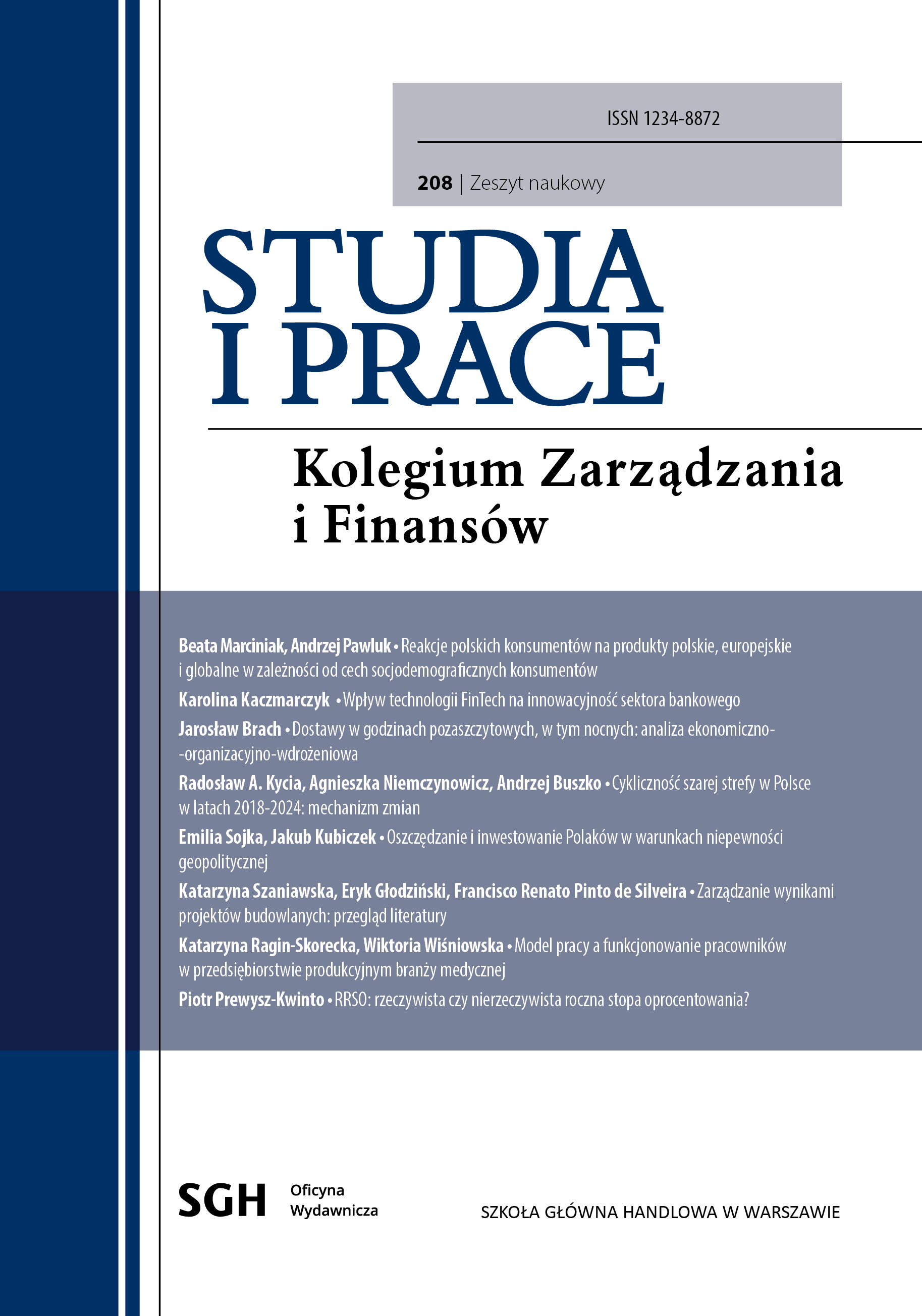
The Impact of FinTech Technologies on Innovation in the Banking Sector
DOI:
https://doi.org/10.33119/SIP.2026.208.2Keywords:
FinTech, financial technologies, banking sector, financial innovations, digital transformationAbstract
The aim of this article is to assess the impact of the FinTech industry on the development of innovative solutions in the banking sector and to identify the benefits and barriers associated with their implementation. The study employed the diagnostic survey method, which aimed to explore public opinion and the level of social awareness regarding financial technologies. The research tool was an original questionnaire distributed via the Internet. This method enabled the collection of quantitative data in a fast, anonymous, and accessible manner for a wide group of respondents. The analysis of the results showed that, despite the growing popularity of the FinTech sector in banking, the level of public knowledge on this topic remains insufficient. Respondents familiar with the term FinTech perceive financial technologies as a significant support for the banking sector, particularly in the context of mobile banking. However, a number of risks and challenges were also identified, including issues related to cybersecurity. The study results confirm the positive impact of the FinTech industry on the development of banking services and highlight the need to intensify educational efforts regarding financial technologies.
Downloads
References
Wydawnictwa zwarte
Gładecki, K. (2022). Historia fintechów: FinTech 3.0. W: FinTech Miscellanea (s. 204–205), M. Ż. J. Górka. Warszawa: Wydawnictwa Uniwersytetu Warszawskiego.
Jaworski, A. (2022). Historia fintechów: FinTech 1.0. W: FinTech Miscellanea (s. 201), M. Ż. J. Górka. Warszawa: Wydawnictwa Uniwersytetu Warszawskiego.
Lee, T., Kim, H.‑W. (2015). An Exploratory Study on Fintech Industry in Korea: Crowdfunding Case. W: 2nd International Conference on Innovative Engineering Technologies (s. 58–64), 7–8 August 2015. Bangkok.
Polański, J. (2022). Historia fintechów: FinTech 2.0. W: FinTech Miscellanea (s. 202–203), M. Ż. J. Górka. Warszawa: Wydawnictwa Uniwersytetu Warszawskiego.
Artykuły naukowe
Adhimursandi, D., Suharno Kuleh, Y. (2021). Understanding the Convenience of Mobile Banking Adoption for Banking, International Journal of Multicultural and Multireligious Understanding, 8 (12), s. 510–521. DOI: 10.18415/ijmmu.v8i12.3259.
Alt, R., Fridgen, G., Chang, Y. (2024). The Future of Fintech – Towards Ubiquitous Financial Services, Electronic Markets, 34 (3), s. 1–13. DOI: 10.1007/s12525-023-00687-8.
Belanche, D., Casaló Ariño, L. V., Flavián, C. (2019). Artificial Intelligence in FinTech: Understanding Robo-Advisors Adoption among Customers, Industrial Management & Data Systems, 119 (7), s. 1411–1430. DOI: 10.1108/IMDS-08-2018-0368.
Chowdhury, M. A., Soh, W. N., Abdul Rahim, N. B., Johari, J. B. (2024). How FinTech is Doing Innovations and Efficiency in the Banking Sector, International Journal of Business and Society, 25 (3), s. 888–907. DOI: 10.33736/ijbs.8514.2024.
Czarkowska, M., Bagniewski, B. (2022). Wpływ rozwoju FinTech na stacjonarne oddziały instytucji bankowych w Polsce, E-mentor, 5 (97), s. 13–25. DOI: 10.15219/em97.1588.
Financial Stability Board (2017). Financial Stability Implications from FinTech, Financial Stability Board.
Giglio, F. (2021). Fintech: A Literature Review, European Research Studies Journal, XXIV (2B), s. 600–627. DOI: 10.1108/IMDS-08-2018-036810.35808/ersj/2254.
Gu, F., Gao, J., Zhu, X., Ye, J. (2023). The Impact of Digital Inclusive Finance on SMEs’ Technological Innovation Activities – Empirical Analysis Based on the Data of New Third Board Enterprises, Plos One, 18 (11), s. 1–21. DOI: 10.1371/journal.pone.0293500.
Jagodzińska-Komar, E., Grzywacz, J. (2019). Rola interfejsu API w modelu otwartej bankowości, Studia i Prace Kolegium Zarządzania i Finansów, 172, s. 41–51.
Leong, K., Sung, A. (2018). What is It and How to Use Technologies to Create Business Value in Fintech Way?, International Journal of Innovation, Management and Technology, 9 (2), s. 74–78. DOI: 10.18178/ijimt.2018.9.2.791.
Panigrahi, R., Ghose, M. K., Pramanik, M. (2013). Cloud Computing: A new Era of Computing in the Field of Information Management, International Journal of Computer Science Engineering, 2 (05), s. 188–195.
Paramesha, M., Ran, N. L., Rane, J. (2024). Artificial Intelligence, Machine Learning, Deep Learning, and Blockchain in Financial and Banking Services: A Comprehensive Review, Partners Universal Multidisciplinary Research Journal, 01 (02), s. 68–83. DOI: 10.5281/zenodo.12826933.
Rot, A., Zygała, R. (2018). Technologia blockchain jako rewolucja w transakcjach cyfrowych. Aspekty technologiczne i potencjalne zastosowania, Informatyka Ekonomiczna, 4 (50), s. 122–134. DOI: 10.15611/ie.2018.4.09.
Różanowski, K. (2007). Sztuczna inteligencja rozwój, szanse i zagrożenia, Zeszyty Naukowe Warszawskiej Wyższej Szkoły Informatyki, 2, s. 109–135.
Seroka, A. (2021). Rozwój sektora FinTech w polskiej bankowości, Przestrzeń, Ekonomia, Społeczeństwo, 19, s. 65–87. DOI: 10.23830/19/I/2021/6587.
Siddiqui, Z., Ahmed, M. (2022). FinTech Innovations in Developing Economies, Journal of Financial Innovation, 15 (3), s. 45–62. DOI: 10.22495/rgcv12i1p5.
Ślażyńska-Kluczek, D. (2022). Neobanki jako element cyfrowej transformacji finansów, Przegląd Prawno-Ekonomiczny, 3, s. 151–168. DOI: 10.31743/ppe.13748.
Takeda, A., Ito, Y. (2021). A Review of FinTech Research, International Journal of Technology Management, 86 (1), s. 67–88. DOI: 10.1504/IJTM.2021.115761.
Waliullah, M., George, M. Z. H., Hasan, M. T., Alam, M. K., Maniura, S. K., Siddiqui, N. A. (2025). Assesing The Influence of Cybersecurity Threats and Risk on the Adoption and Growth of Digital Banking: A Systematic Literature Review, American Journal of Advanced Technology and Engineering Solutions, 01 (01), s. 226–257. DOI: 10.48550/arXiv.2503.22710.
Materiały internetowe
Bank.pl (2024). Raport Specjalny | IT@BANK 2024 – VSoft | Open Banking i API – z konieczności do wartości, https://bank.pl/raport-specjalny-itbank-2024‑vsoft-open-banking-i-api-zkoniecznosci-do-wartosci/ (dostęp: 20.07.2025).
OECD (2021). Artificial Intelligence, Machine Learning and Big Data in Finance: Opportunities, Challenges and Implications for Policy Makers, https://www.oecd.org/en/publications/artificial-intelligence-machine-learning-and-big-data-in-finance_98e761e7‑en.html (dostęp:12.06.2025).
SAP (2025). Czym jest uczenie maszynowe?, https://www.sap.com/poland/products/artificialintelligence/what-is-machine-learning.html (dostęp: 16.06.2025).
Zeidy, I. (2022). The Role of Financial Technology (FINTECH) in Changing Financial Industry and Increasing Efficiency in the Economy, https://www.comesa.int/wp-content/uploads/2022/05/The-Role-of-Financial-Technology.pdf (dostęp: 20.06.2025).
Downloads
Published
How to Cite
Issue
Section
License
Copyright (c) 2026 Studies and Work of the Collegium of Management and Finance

This work is licensed under a Creative Commons Attribution 4.0 International License.