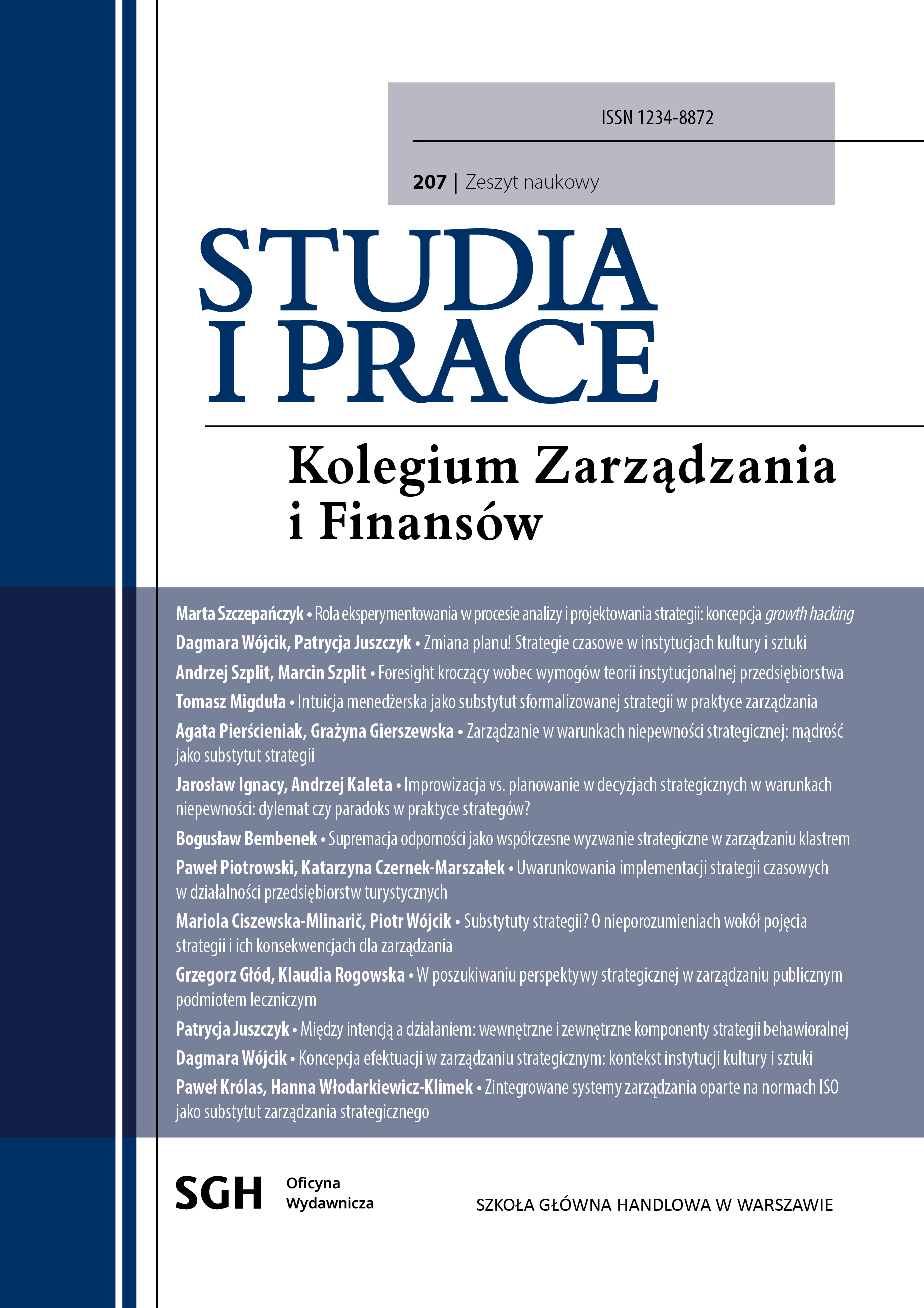
Managing in a Strategic Uncertainty: Wisdom as a Substitute for Strategy
DOI:
https://doi.org/10.33119/SIP.2026.207.5Keywords:
chaos theory, organisational wisdom, strategic uncertainty, strategy, strategy substitute, wisdomAbstract
In a dynamically changing environment, strategic management is evolving, requiring reflective engagement and ability to solve complex problems. The article argues that “organisational wisdom could be a substitute for strategy.” The study is based on a narrative literature review presented from an expert perspective. It discusses three concepts of strategy (classical, contemporary and managing in chaos) and two models of organisational wisdom (classical and modern). The analysis focuses on ten criteria describing the characteristics of strategy, its development process and its role within the organisation. The study confirms the article thesis. It has been found that classical organisational wisdom is similar to classical strategy. However, it is the modern organisational wisdom that demonstrates the most significant potential for substituting contemporary strategies and management in chaos. This study expands the development of strategic management theory by emphasising the role of wisdom in shifting paradigms. In the face of a “turbulent environment”, managers should consciously develop organisational wisdom, which has the potential to be a substitute for strategy.
Downloads
References
Wydawnictwa zwarte
Birren, J. E., Svensson, C. M. (2005). Wisdom in History. W: A Handbook of Wisdom. Psychological Perspectives (s. 4), R. J. Sternberg, J. Jordan (Eds.). New York: Cambridge University Press.
Czakon, W. (2024). Jak powstają wielkie strategie i dlaczego nie wszystkie muszą być wielkie. Warszawa: Polskie Wydawnictwo Ekonomiczne.
Gierszewska, G., Jaksa, J. (2023). Ocena potencjału strategicznego przedsiębiorstwa. Warszawa:Oficyna Wydawnicza PW.
Gough, D., Oliver, S., Thomas, J. (2012). Moving Forward. London: Sage.
Kessler, E. H., Bailey, J. R. (Eds.). (2007). Handbook of Organizational and Managerial Wisdom. London: Sage.
Lenart-Gansiniec, R. (2021). Systematyczny przegląd literatury w naukach społecznych. Przewodnik dla studentów, doktorantów i nie tylko. Warszawa: Wydawnictwo Naukowe Scholar.
Leś, T. (2016). Koncepcje mądrości w filozofii Sokratesa, Platona i Arystotelesa. Kraków: Wydawnictwo Uniwersytetu Jagiellońskiego.
Obłój, K. (2002). Tworzywo skutecznych strategii. Na styku starych i nowych reguł konkurencji. Warszawa: Polskie Wydawnictwo Ekonomiczne.
Peters, E. E. (1997). Teoria chaosu a rynki kapitałowe. WIG Press.
Pierścieniak, A. (2025). Modern Organizational Wisdom: Theory and Practice. London: Routledge.
Prigogine, I., Stengers, I. (1984). Order out of Chaos: Man’s New Dialogue with Nature. New York: Bantam Books.
Spencer, L., Ritchie, J., Lewis, J., Dillon, L. (2003). Quality in Qualitative Evaluation: A Framework for Assessing Research Evidence. London: Government Chief Social Researcher’s Office.
Stacey, R. D. (1996). Strategic Management and Organisational Dynamics. Lanham: Pitman Publishing.
Strauss, L. (2021). O Machiavellim. Warszawa: Teologia Polityczna.
Sun Zi (2020). Sztuka wojny. Filozofia i praktyka oddziaływania na bieg zdarzeń. Kraków: Polskie Towarzystwo Geopolityczne.
Wheatley, M. J. (1999). Leadership and the New Science: Discovering Order in a Chaotic World (2nd ed.). San Francisco: Berrett-Koehler Publishers.
Artykuły naukowe
Ali-Siadat, S., Rajaeepour, S. (2015). Strategic Intelligence and Organizational Wisdom, Journal of Management, 7 (2), s. 45–62.
Alvesson, M., Willmott, H. (1992). On the Idea of Emancipation in Management and Organization Studies, Academy of Management Review, 17 (3), s. 432–464.
Arıcıoğlu, M. A., Berk, O. N. (2022). A Comparative Proposal on Learning the Chaos to Understand the Environment, Chaos Theory and Applications, 4 (1), s. 19–25.
Ardelt, M., Sharma, B. (2021). Linking Wise Organizations to Wise Leadership, Job Satisfaction, and Well-Being, Frontiers in Communication, 6, 685850.
Bechtold, B. L. (1997). Chaos Theory as a Model for Strategy Development, Empowerment in Organizations, 5 (4), s. 193–201.
Bierly III, P. E., Kessler, E. H., Christensen, E. W. (2000). Organizational Learning, Knowledge, and Wisdom, Journal of Organizational Change Management, 13, s. 595–618.
Binsztok, A. (2004). Wdrażanie zmian przez chaos w zarządzaniu strategicznym jako krok ku innowacyjności przedsiębiorstw, Prace Naukowe Akademii Ekonomicznej we Wrocławiu, (1045), s. 187–196.
Duncan, R. B. (1972), Characteristics of Organizational Environments and Perceived Environmental Uncertainty, Administrative Science Quarterly, 17 (3), s. 313–327. DOI:10.2307/2392145.
Eisenhardt, K. M., Sull, D. N. (2001). Strategy as Simple Rules, Harvard Business Review, 6 (4).
Ferrari, R. (2015). Writing Narrative Style Literature Reviews, Medical Writing, 24 (4), s. 230–235.
Greenhalgh, T., Robert, G., Macfarlane, F., Bate, P., Kyriakidou, O., Peacock, R. (2005). Storylines of Research in Diffusion of Innovation: A Meta-Narrative Approach to Systematic Review, Social Science & Medicine, 61 (2), s. 417–430.
Hays, J. M. (2007). Organizational Wisdom: Toward a Conceptualization, Journal of Management Inquiry, 16 (2), s. 124–134.
Hurst, D. K. (1986). Why Strategic Management is Bankrupt, Organizational Dynamics, 15 (2), s. 5–27.
Jamal, F., Bertotti, M., Lorenc, T., Harden, A. (2015). Reviewing Conceptualisations of Community: Reflections on a Meta-Narrative Approach, Qualitative Research, 15 (3), s. 314–333.
Kessler, E. H. (2006). Organizational Wisdom: Human, Managerial, and Strategic Implications, Group & Organization Management, 31 (3), s. 296–299.
Knights, D., Morgan, G. (1991). Corporate Strategy, Organizations, and Subjectivity: A Critique, Organization Studies, 12 (2), s. 251–273.
Krupski, R. (2004). Zarządzanie przedsiębiorstwem w turbulentnym otoczeniu, Prace Naukowe Akademii Ekonomicznej we Wrocławiu, 1014, s. 350–359.
Kumar, P. (2023). Improving IMRaD for Writing Research Articles in Social, and Health Sciences, International Research Journal of Economics and Management Studies IRJEMS, 2 (1), s. 50–53.
Lara, L. G., Vizeu, F., Alves, E. B. (2019). The Instrumentalization of Metaphors in the Management Field: Reflections from the Use of the Book “The Art of War” on Business, Brazilian Business Review, 16 (5), s. 416–430.
Levy, D. L., Alvesson, M., Willmott, H. (2003). Critical Approaches to Strategic Management, Studying Management Critically, 1, s. 92–110.
McBride, N. (2005). Chaos Theory as a Model for Interpreting Information Systems in Organizations, Information Systems Journal, 15 (3), s. 233–254.
Mintzberg, H. (1987). The Strategy Concept I: Five Ps for Strategy, California Management Review, 30 (1), s. 11–24.
Mora Cortez, R., Johnston, W. J. (2019). Cultivating Organizational Wisdom for Value Innovation, Journal of Business & Industrial Marketing, 34 (6), s. 1171–1182.
Muszyński, W. (2000). Zmiany przez chaos czy chaos zmian?, Prace Naukowe Akademii Ekonomicznej we Wrocławiu, (879), s. 195–205.
Peltonen, T. (2022). Organizational Phronesis: Practical Wisdom in Organizational Contexts, Philosophy of Management, 21 (1), s. 45–67.
Pierścieniak, A., Gierszewska, G. (2023). Niepewność strategiczna: definicja i operacjonalizacja, Przegląd Organizacji, (4), s. 93–102.
Pierścieniak, A., Stelmaszczyk, M. (2020). Organizational Wisdom: The Impact of Organizational Learning on the Absorptive Capacity of an Enterprise, European Research Studies Journal, 23, s. 271–281.
Pinheiro, P., Raposo, M., Hernández, R. (2012). Measuring Organizational Wisdom Applying an Innovative Model of Analysis, Management Decision, 50 (8), s. 1465–1487.
Rocha, R. G., Kragulj, F., Pinheiro, P. (2022). Practical Wisdom, the (not so) Secret Ingredient for Responsible Knowledge Management, VINE Journal of Information and Knowledge Management Systems, 52 (3), s. 426–447.
Rowley, J. (2006). What Do We Need to Know about Wisdom?, Management Decision, 44 (9), s. 1246–1257.
Różewski, P., Jankowski, J. (2015). Model of Multilayer Knowledge Diffusion for Competence Development in an Organization, Mathematical Problems in Engineering, 2015 (1), 529256.
Sawyerr, O. O., Ebrahimi, B. P. (2022). Executive Environmental Scanning and Strategic Uncertainty: The Impact of Institutional Context, International Studies of Management & Organization, 52 (1), s. 7–24.
Scott-Kennel, J., Von Batenburg, Z. (2012). The Role of Knowledge and Learning in the Internationalisation of Professional Service Firms, The Service Industries Journal, 32 (10), s. 1667– 1690.
Shrivastava, P. (1986). Is Strategic Management Ideological?, Journal of Management, 12 (3), s. 363–377.
Shotter, J., Tsoukas, H. (2014). In Search of Phronesis: Leadership and the Art of Judgment, Academy of Management Learning & Education, 13 (2), s. 224–243.
Stacey, R. D. (1995). The Science of Complexity: An Alternative Perspective for Strategic Change Processes, Strategic Management Journal, 16 (6), s. 477–495.
Vaillant, Y., Vendrell‐Herrero, F., Bustinza, O. F., Xing, Y. (2025). HRM Algorithms: Moderating the Relationship between Chaotic Markets and Strategic Renewal, British Journal of Management, 36 (2), s. 529–545.
Downloads
Published
How to Cite
Issue
Section
License
Copyright (c) 2026 Studies and Work of the Collegium of Management and Finance

This work is licensed under a Creative Commons Attribution 4.0 International License.