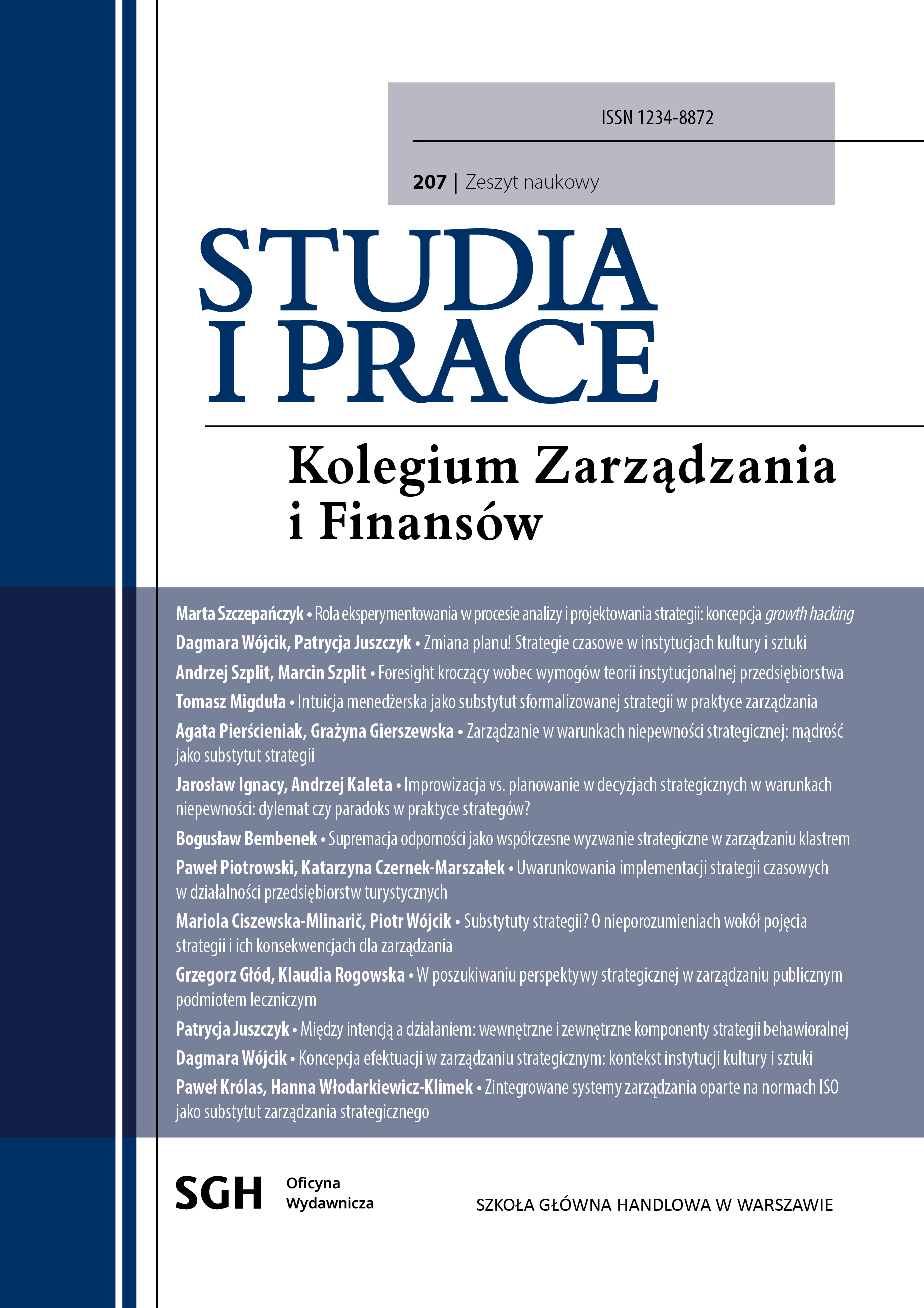
Substitutes for Strategy? Misunderstanding around the Concept of Strategy and Their Consequences for Management
DOI:
https://doi.org/10.33119/SIP.2026.207.9Keywords:
strategic planning, strategy, substitutesAbstract
The aim of this article is to refute the thesis on the existence of substitutes for strategy, pointing out that it stems from misunderstandings about the idea and role of strategy. We deconstruct the thesis, pointing out that the dispute over the definition and ontology of strategy also has consequences for management practice. Strategy, understood as a unique contextual set of conscious choices and actions, is a unique mechanism for creating a sustainable competitive advantage. Identifying strategy with operational tools, management practices, organisational routines or business model innovation stems from conceptual errors, incorrect differentiation of management levels and reductionism. Contemporary approaches to management based on flexibility, iteration and learning do not eliminate the need for a clear and conscious strategy but rather complement it by integrating the aforementioned constructs. The search for substitutes for strategy is an attempt to circumvent the complexity and depth of strategic processes. Strategy remains an irreplaceable foundation of effective management that cannot be reduced to a set of even most sophisticated substitutes.
Downloads
References
Wydawnictwa zwarte
Amit, R., Zott, C. (2021). Business Model Innovation Strategy: Transformational Concepts and Tools for Entrepreneurial Leaders. Hoboken, New Jersey: John Wiley and Sons.
Andrews, K. R. (1971). The Concept of Corporate Strategy. Homewood, IL: Richard D. Irwin.
Argyris, C., Schön, D. (1978). Organizational Learning: A Theory of Action Perspective. Addison-Wesley.
Barney, J. B., Clark, D. N. (2007). Resource-Based Theory: Creating and Sustaining Competitive Advantage. Oxford: Oxford University Press.
Chandler Jr., A. D. (1962). Strategy and Structure: Chapters in the History of the American Industrial Enterprise. Boston: MIT Press.
Christensen, C. M. (1997). The Innovator’s Dilemma: When New Technologies Cause Great Firms to Fail. Boston: Harvard Business Review Press.
Ciszewska-Mlinarič, M., Wójcik, P., Morgan-Thomas, A. (2025). Leadership in the Digitalized Era – The Challenges of Business Model Innovation and Overcoming Strategies. W: Leadership Challenges: Sustainability, Skills and Inclusivity in Industry 5.0, R. Śliwiński (Ed.). London: Routledge (w druku).
Czakon, W. (2020). Krótkowzroczność strategiczna menedżerów. Kraków: Wydawnictwo Uniwersytetu Jagiellońskiego.
Denning, S. (2018). The Age of Agile: How Smart Companies Are Transforming the Way Work Gets Done. AMACOM.
Eisenhardt, K. M. (1997). Strategic Decision Making as Improvisation. W: Strategic Decisions (s. 251–257). Boston, MA: Springer.
Foss, N. J., Klein, P. G. (2022). Why Managers Matter: The Perils of the Bossless Company. London, UK: Hachette.
Gavetti, G. (2005). Kodak and the Digital Revolution (A). Teaching Note. Boston: Harvard Business Publishing.
Gavetti, G., Henderson, R., Giorgi, S. (2005). Kodak and the Digital Revolution (A) (Case 705448‑PDF-ENG). Boston: Harvard Business Publishing.
Hamel, G., Zanini, M. (2020). Humanocracy: Creating Organizations as Amazing as the People Inside Them. Boston: Harvard Business Press.
Krupski, R. (2005). Zarządzanie przedsiębiorstwem w turbulentnym otoczeniu. Warszawa: Polskie Wydawnictwo Ekonomiczne.
Laloux, F. (2014). Reinventing Organizations, vol. 58. Brussels: Nelson Parker.
Nonaka, I., Takeuchi, H. (1995). The Knowledge-Creating Company: How Japanese Companies Create the Dynamics of Innovation. Oxford: Oxford University Press.
Obłój, K. (2014). Strategia organizacji – w poszukiwaniu trwałej przewagi konkurencyjnej. Wydanie III zmienione. Warszawa: Polskie Wydawnictwo Ekonomiczne.
Obłój, K. (2016). Pasja i dyscyplina strategii: jak z marzeń i decyzji zbudować sukces firmy. Wydanie II zmienione. Warszawa: Poltext.
Osterwalder, A., Pigneur, Y. (2010). Business Model Generation: A Handbook for Visionaries, Game Changers, and Challengers, vol. 1. John Wiley and Sons.
Polanyi, M. (1966). The Tacit Dimension. London: Routledge & Kegan Paul.
Porter, M. E. (1980). Competitive Strategy: Techniques for Analyzing Industries and Competitors. Free Press.
Radford, K. J. (2012). Strategic and Tactical Decisions. Springer Science & Business Media.
Ries, E. (2011). The Lean Startup: How Today’s Entrepreneurs Use Continuous Innovation to Create Radically Successful Businesses. Crown Business.
Rumelt, R. P. (2011). Good Strategy, Bad Strategy: The Difference and Why it Matters. Crown Business.
Smart, S. B., Graham, J. R. (2012). Introduction to Financial Management (3 rd ed.). Andover: South-Western Cengage Learning.
Stańczyk-Hugiet, E. I. (2013). Dynamika strategiczna w ujęciu ewolucyjnym. Wrocław: Wydawnictwo Uniwersytetu Ekonomicznego.
Trigeorgis, L. (1996). Real Options: Managerial Flexibility and Strategy in Resource Allocation. Boston: MIT Press.
Weick, K. E. (1987). Substitutes for Strategy. W: Research in Organizational Behavior, vol. 9 (s. 85–122), L. L. Cummings, B. M. Staw (Eds.). JAI Press.
Weick, K. E. (1995). Sensemaking in Organizations. Sage Publications.
Zakrzewska-Bielawska, A. (2025). Ambidexterity: A Strategic Approach to Overcoming Exploration and Exploitation Paradox. W: Management, Organizations, and Paradoxes: Insights from the Central and Eastern European Region (s. 67–90), M. Rozkwitalska-Welenc, A. Zakrzewska-Bielawska, A. M. Lis (Eds.). London: Routledge.
Artykuły naukowe
Abraham, S. (2013). Will Business Model Innovation Replace Strategic Analysis?, Strategy & Leadership, 41 (2), s. 31–38.
Acciarini, C., Brunetta, F., Boccardelli, P. (2021). Cognitive Biases and Decision-Making Strategies in Times of Change: A Systematic Literature Review, Management Decision, 59 (3),s. 638–652.
Amit, R., Zott, C. (2012). Creating Value through Business Model Innovation, MIT Sloan Management Review, 53, s. 41–47.
Artinger, F., Petersen, M., Gigerenzer, G., Weibler, J. (2015). Heuristics as Adaptive Decision Strategies in Management, Journal of Organizational Behavior, 36 (S1), s. S33–S52.
Bąk, S., Jedynak, P. (2025). Enterprise Resilience Assessment – An Overview of Models, Organizacja i Kierowanie, 197 (1), s. 7–21.
Barney, J., Wright, M., Ketchen Jr, D J. (2001). The Resource-Based View of the Firm: Ten Years After 1991, Journal of Management, 27 (6), s. 625–641.
Bindra, S., Parameswar, N., Dhir, S. (2019). Strategic Management: The Evolution of the Field, Strategic Change, 28 (6), s. 469–478.
Bingham, C. B., Eisenhardt, K. M. (2011). Rational Heuristics: The ‘Simple Rules’ that Strategists Learn from Process Experience, Strategic Management Journal, 32 (13), s. 1437–1464.
Boulding, K. E. (1956). General Systems Theory – The Skeleton of Science, Management Science, 2 (3), s. 197–208.
Budler, M., Župič, I., Trkman, P. (2021). The Development of Business Model Research: A Bibliometric Review, Journal of Business Research, 135, s. 480–495.
Bunge, M. (1979). A Systems Concept of Society: Beyond Individualism and Holism, Theory and Decision, 10 (1), s. 13–30.
Casadesus-Masanell, R., Ricart, J. E. (2010). From Strategy to Business Models and onto Tactics, Long Range Planning, 432–3, s. 195–215.
Casadesus‐Masanell, R., Zhu, F. (2013). Business Model Innovation and Competitive Imitation: The Case of Sponsor‐Based Business Models, Strategic Management Journal, 34 (4), s. 464–482.
Chesbrough, H. (2010). Business Model Innovation: Opportunities and Barriers, Long Range Planning, 432–3, s. 354–363.
Ciszewska-Mlinarič, M., Wójcik, P. (2023). What do We Talk about When We Talk about Strategic Renewal: A Systematic Literature Review of 40 Years of Research, Central European Management Journal, 31 (3), s. 416–441.
Ciuchta, M. P., O’Toole, J., Miner, A. S. (2021). The Organizational Improvisation Landscape:Taking Stock and Looking Forward, Journal of Management, 47 (1), s. 288–316.
Clauss, T. (2017). Measuring Business Model Innovation: Conceptualization, Scale Development, and Proof of Performance, R&D Management, 47 (3), s. 385–403.
Courtney, H. (2001). Making the Most of Uncertainty, The McKinsey Quarterly, s. 38–38.
Crossan, M. M. (1998). Improvisation in Action, Organization Science, 9 (5), s. 593–599.
Crossan, M. M., Vera, D., Nanjad, L. (2008). Transcendent Leadership: Strategic Leadership in Dynamic Environments, Leadership Quarterly, 19 (5), s. 569–581.
Cummings, S., Daellenbach, U. (2009). A Guide to the Future of Strategy?: The History of Long Range Planning, Long Range Planning, 42 (2), s. 234–263.
Cyfert, S., Dyduch, W., Szumowski, W., Prause, G. (2025). Are We Ready for Digital Transformation? The Role of Organizational Culture, Leadership and Competence in Building DigitalAdvantage, Central European Management Journal, 33 (2), s. 219–231.
Czakon, W., Klimas, P., Kawa, A. (2023). Re-Thinking Strategic Myopia: A Necessary Condition Analysis of Heuristic and Firm’s Performance, Industrial Marketing Management, 115,s. 99–109.
D’Aveni, R. A. (1995). Coping with Hypercompetition: Utilizing the New 7S’s Framework, Academy of Management Perspectives, 9 (3), s. 45–57.
Desyllas, P., Salter, A., Alexy, O. (2022). The Breadth of Business Model Reconfiguration and Firm Performance, Strategic Organization, 202, s. 231–269.
Dyduch, W., Chudziński, P., Cyfert, S., Zastempowski, M. (2021). Dynamic Capabilities, Value Creation and Value Capture: Evidence from SMEs under Covid-19 Lockdown in Poland, Plos One, 16 (6), e0252423.
Eisenhardt, K. M. (1999). Strategy as Strategic Decision Making, MIT Sloan Management Review, 40 (3), 65.
Eisenhardt, K. M., Furr, N. R., Bingham, C. B. (2010). Microfoundations of Performance: Balancing Efficiency and Flexibility in Dynamic Environments, Organization Science, 21 (6), s. 1263–1273.
Eisenhardt, K. M., Martin, J. A. (2000). Dynamic Capabilities: What Are They?, Strategic Management Journal, 21 (10–11), s. 1105–1121.
Eisenhardt, K. M., Sull, D. (2001). Strategy as Simple Rules, Harvard Business Review, 79 (1), s. 107–116.
Foss, N. J., Saebi, T. (2017). Fifteen Years of Research on Business Model Innovation: How Far Have We Come, and Where Should We Go?, Journal of Management, 431, s. 200–227.
Gioia, D. A., Thomas, J. B. (1996). Identity, Image, and Issue Interpretation: Sensemaking during Strategic Change in Academia, Administrative Science Quarterly, 41 (3), s. 370–403.
Grant, R. M. (2003). Strategic Planning in a Turbulent Environment: Evidence from the Oil Majors, Strategic Management Journal, 24 (6), s. 491–517.
Green, S. (1988). Strategy, Organizational Culture and Symbolism, Long Range Planning, 21 (4), s. 121–129.
Greven, A., Kruse, S., Vos, A., Strese, S., Brettel, M. (2023). Achieving Product Ambidexterity in New Product Development: The Role of Middle Managers’ Dynamic Managerial Capabilities, Journal of Management Studies, 60 (7), s. 1786–1818.
Grzegorczyk, S. (2012). Zarządzanie operacyjne w szkole wyższej jako przedmiot badań, Studia i Prace Kolegium Zarządzania i Finansów, 118, s. 143–157.
Guercini, S., La Rocca, A., Runfola, A., Snehota, I. (2014). Interaction Behaviors in Business Relationships and Heuristics: Issues for Management and Research Agenda, Industrial Marketing Management, 43 (6), s. 929–937.
Guerras-Martin, L. Á., Madhok, A., Montoro-Sánchez, Á. (2014). The Evolution of Strategic Management Research: Recent Trends and Current Directions, BRQ Business Research Quarterly, 17 (2), s. 69–76.
Gupta, B. (2011). A Comparative Study of Organizational Strategy and Culture across Industry, Benchmarking: An International Journal, 18 (4), s. 510–528.
Hacklin, F., Björkdahl, J., Wallin, M. W. (2018). Strategies for Business Model Innovation: How Firms Reel in Migrating Value, Long Range Planning, 511, s. 82–110.
Hadida, A. L., Tarvainen, W., Rose, J. (2015). Organizational Improvisation: A Consolidating Review and Framework, International Journal of Management Reviews, 17 (4), s. 437–459.
Hamel, G. (2011). First, Let’s Fire All the Managers, Harvard Business Review (December 2011), s. 48–60.
Helfat, C. E., Winter, S. G. (2011). Untangling Dynamic and Operational Capabilities: Strategy for the (N) ever‐Changing World, Strategic Management Journal, 32 (11), s. 1243–1250.
Hepfer, M., Lawrence, T. B. (2022). The Heterogeneity of Organizational Resilience: Exploring Functional, Operational and Strategic Resilience, Organization Theory, 3 (1), 263178
Hodgkinson, G. P., Burkhard, B., Foss, N. J., Grichnik, D., Sarala, R. M., Tang, Y., Van Essen, M. (2023). The Heuristics and Biases of Top Managers: Past, Present, and Future, Journal of Management Studies, 60 (5), s. 1033–1063.
Hughes, P., Morgan, R. E., Hodgkinson, I. R., Kouropalatis, Y., Lindgreen, A. (2020). A Diagnostic Tool to Determine a Strategic Improvisation Readiness Index Score (IRIS) to Survive, Adapt, and Thrive in a Crisis, Industrial Marketing Management, 88, s. 485–499.
Jarzabkowski, P. (2008). Shaping Strategy as a Structuration Process, Academy of Management Journal, 51 (4), s. 621–650.
Jaser, Z. (2021). The Real Value of Middle Managers, Harvard Business Review, 7, s. 6–21.
Kahan, S. (2018). The Age of Agile: A Guide to a Revolution in Innovation Management, Strategy & Leadership, 46 (2), s. 48–49.
Kaplan, S. (2011). Five Reasons Companies Fail at Business Model Innovation, Harvard Business Review.
Kaul, A. (2019). Culture vs Strategy: Which to Precede, Which to Align?, Journal of Strategy and Management, 12 (1), s. 116–136.
Khanna, T. (2015). A Case for Contextual Intelligence, Management International Review, 55 (2), s. 181–190.
Lanzolla, G., Markides, C. (2021). A Business Model View of Strategy, Journal of Management Studies, 58 (2), s. 540–553.
Leiblein, M. J., Reuer, J. J., Zenger, T. (2018). What Makes a Decision Strategic?, Strategy Science, 3 (4), s. 558–573.
Lewin, A. Y., Volberda, H. W. (1999). Prolegomena on Coevolution: A Framework for Research on Strategy and New Organizational Forms, Organization Science, 10 (5), s. 519–534.
Makadok, R. (2001). Toward a Synthesis of the Resource‐Based and Dynamic‐Capability Views of Rent Creation, Strategic Management Journal, 22 (5), s. 387–401.
Massa, L., Tucci, C. L., Afuah, A. (2017). A Critical Assessment of Business Model Research, Academy of Management Annals, 11 (1), s. 73–104.
McGrath, R. G., Nerkar, A. (2004). Real Options Reasoning and a New Look at the R&D Investment Strategies of Pharmaceutical Firms, Strategic Management Journal, 25 (1), s. 1–21.
Midtgård, K., Selart, M. (2025). Cognitive Biases in Strategic Decision-Making, Administrative Sciences, 15 (6), 227.
Mintzberg, H. (1978). Patterns in Strategy Formation, Management Science, 24 (9), s. 934–948.
Mintzberg, H. (1990). The Design School: Reconsidering the Basic Premises of Strategic Management, Strategic Management Journal, 11 (3), s. 171–195.
Mintzberg, H. (1994a). Rethinking Strategic Planning Part I: Pitfalls and Fallacies, Long Range Planning, 27 (3), s. 12–21.
Mintzberg, H. (1994b). The Fall and Rise of Strategic Planning, Harvard Business Review, 72 (1), s. 107–114.
Morgan-Thomas, A., Wójcik, P., Ciszewska-Mlinarič, M. (2026). Strategic Renewal in Internationalising SMEs: a Paradox Perspective, Critical Perspectives on International Business (w druku).
Olson, P. D., Bokor, D. W. (1995). Strategy Process-Content Interaction: Effects on Growth Perf, Journal of Small Business Management, 33 (1), 34.
Omidvar, O., Safavi, M., Glaser, V. L. (2023). Algorithmic Routines and Dynamic Inertia: How Organizations Avoid Adapting to Changes in the Environment, Journal of Management Studies, 60 (2), s. 313–345.
Osterwalder, A., Pigneur, Y., Tucci, C. L. (2005). Clarifying Business Models: Origins, Present, and Future of the Concept, Communications of the Association for Information Systems, 161, s. 1–38.
Peteraf, M., Di Stefano, G., Verona, G. (2013). The Elephant in the Room of Dynamic Capabilities: Bringing Two Diverging Conversations Together, Strategic Management Journal, 34 (12), s. 1389–1410.
Peteraf, M. A. (1993). The Cornerstones of Competitive Advantage: A Resource‐Based View, Strategic Management Journal, 14 (3), s. 179–191.
Petricevic, O., Teece, D. J. (2019). The Structural Reshaping of Globalization: Implications for Strategic Sectors, Profiting from Innovation, and the Multinational Enterprise, Journal of International Business Studies, 50 (9), s. 1487–1512.
Piórkowska, K. (2017). Badania naukowe w zarządzaniu strategicznym – refleksje nad wielowymiarowością konstruktów, pluralizmem metod i badaniami wielopoziomowymi, Zeszyty Naukowe Uniwersytetu Ekonomicznego w Krakowie, 954 (6), s. 111–129.
Pisano, G. P. (2015). You Need an Innovation Strategy, Harvard Business Review, 93 (6), s. 44–54.
Porter, M. E. (1996). What is Strategy?, Harvard Business Review, 74 (6), s. 61–78.
Prahalad, C. K. (1993). The Role of Core Competencies in the Corporation, Research-Technology Management, 36 (6), s. 40–47.
Quigley, T. J., Chirico, F., Baù, M. (2022). Does the CEO Effect on Performance Differ in Private Versus Public Firms?, Strategic Organization, 20 (3), s. 652–673.
Quigley, T. J., Hambrick, D. C. (2015). Has the “CEO Effect” Increased in Recent Decades? A New Explanation for the Great Rise in America’s Attention to Corporate Leaders, Strategic Management Journal, 36 (6), s. 821–830.
Rachinger, M., Rauter, R., Müller, C., Vorraber, W., Schirgi, E. (2019). Digitalization and its Influence on Business Model Innovation, Journal of Manufacturing Technology Management, 30 (8), s. 1143–1160.
Rajan, R. G., Zingales, L. (1998). Power in a Theory of the Firm, The Quarterly Journal of Economics, 113 (2), s. 387–432.
Rašković, M. (2022). International Business Policymaking for a “Wicked” World, Journal of International Business Policy, 5 (3), s. 353–362.
Ritter, T., Lettl, C. (2018). The Wider Implications of Business-Model Research, Long Range Planning, 51 (1), s. 1–8.
Robinson, S. L., Rousseau, D. M. (1994). Violating the Psychological Contract: Not the Exception but the Norm, Journal of Organizational Behavior, 15 (3), s. 245–259.
Ronda‐Pupo, G. A., Guerras‐Martin, L. Á. (2012). Dynamics of the Evolution of the Strategy Concept 1962–2008: A Co‐Word Analysis, Strategic Management Journal, 33 (2), s. 162–188.
Rothaermel, F. T., Fuller, A. W. (2025). Strategy Formation and Dynamic Capabilities: Motorola’s Entry into China, Academy of Management Perspectives (w druku).
Rouleau, L., Balogun, J. (2011). Middle Managers, Strategic Sensemaking, and Discursive Competence, Journal of Management Studies, 48 (5), s. 953–983.
Sabaruddin, L. O., MacBryde, J., D’Ippolito, B. (2023). The Dark Side of Business Model Innovation, International Journal of Management Reviews, 25 (1), s. 130–151.
Seidl, D., Ma, S., Splitter, V. (2024). What Makes Activities Strategic: Toward a New Framework for Strategy‐As‐Practice Research, Strategic Management Journal, 45 (12), s. 2395–2419.
Sharpe, W. H., Nguyen, P. M., Colombage, S. (2025). CEO Overconfidence, Customer Satisfaction, and Firm Value: An Investigation of Mediating and Moderating Effects, European Management Journal, 43 (1), s. 101–114.
Simon, H. (1957). A Behavioral Model of Rational Choice, Models of man, social and rational: Mathematical Essays on Rational Human Behavior in a Social Setting, 6 (1), s. 241–260.
Simon, H. A. (1955). A Behavioral Model of Rational Choice, The Quarterly Journal of Economics, s. 99–118.
Spieth, P., Breitenmoser, P., Röth, T. (2025). Business Model Innovation: Integrative Review, Framework, and Agenda for Future Innovation Management Research, Journal of Product Innovation Management, 42 (1), s. 166–193.
Spieth, P., Schneckenberg, D., Matzler, K. (2016). Exploring the Linkage between Business Model (and) Innovation and the Strategy of the Firm, RandD Management, 46 (3), s. 403–413.
Stańczyk-Hugiet, E. (2016). Badania wielopoziomowe w zarządzaniu, Zarządzanie i Finanse, 14 (2), s. 401–410.
Stańczyk-Hugiet, E., Piórkowska, K., Stańczyk, S. (2016). Ewolucyjny nurt w naukach o zarządzaniu. Stan wiedzy, Przegląd Organizacji, 2 (9).
Stańczyk-Hugiet, E., Piórkowska, K., Stańczyk, S. (2017). Demystifying Emergence of Organizational Routines, Journal of Organizational Change Management, 30 (4), s. 525–547.
Teece, D. J. (2007). Explicating Dynamic Capabilities: The Nature and Microfoundations of (Sustainable) Enterprise Performance, Strategic Management Journal, 28 (13), s. 1319–1350.
Teece, D. J. (2010). Business Models, Business Strategy and Innovation, Long Range Planning, 43 (2–3), s. 172–194.
Teece, D. J., Pisano, G., Shuen, A. (1997). Dynamic Capabilities and Strategic Management, Strategic Management Journal, 18 (7), s. 509–533.
Thomas III, L. G. (1996). The Two Faces of Competition: Dynamic Resourcefulness and the Hypercompetitive Shift, Organization Science, 7 (3), s. 221–242.
Villalpando, D., Campbell, R. J., Pérez-Nordtvedt, L. (2025). The Time to Succeed: CEO Appointment Phase Entrainment and Post-Succession Firm Operational Performance, Journal of Management, 01492063241311853.
Wernerfelt, B. (1984). A Resource‐Based View of the Firm, Strategic Management Journal, 5 (2), s. 171–180.
White, J. V., Markin, E., Marshall, D., Gupta, V. K. (2022). Exploring the Boundaries of Business Model Innovation and Firm Performance: A Meta-Analysis, Long Range Planning, 55 (5), 102242.
Wiggins, R. R., Ruefli, T. W. (2005). Schumpeter’s Ghost: Is Hypercompetition Making the Best of Times Shorter?, Strategic Management Journal, 26 (10), s. 887–911.
Winter, S. G. (2003). Understanding Dynamic Capabilities, Strategic Management Journal, 24 (10), s. 991–995.
Witt, M. A., Lewin, A. Y., Li, P. P., Gaur, A. (2023). Decoupling in International Business: Evidence,
Drivers, Impact, and Implications for IB Research, Journal of World Business, 58 (1),101399.
Wójcik, P., Ciszewska-Mlinarič, M., Morgan-Thomas, A., Madziński, M. (2025). How Do We Get There? Dynamics of Strategic Renewal: A Multiple Case Study of Polish SMEs’, Central European Management Journal, 33 (4), s. 697–716.
Wójcik, P., Obłój, K., Buono, A. F. (2022). Addressing Social Concern through Business-Nonprofit Collaboration: Microfoundations of a Firm’s Dynamic Capability for Social Responsibility, Journal of Business Research, 143, s. 119–139.
Yi, S., Knudsen, T., Becker, M. C. (2016). Inertia in Routines: A Hidden Source of Organizational Variation, Organization Science, 27 (3), s. 782–800.
Zakrzewska-Bielawska, A. (2017). Ambidexterity jako zdolność dynamiczna w odpowiedzi na niepewność otoczenia, Studia Oeconomica Posnaniensia, 5 (9), s. 174–190.
Zott, C., Amit, R. (2010). Business Model Design: An Activity System Perspective, Long Range Planning, 43 (2–3), s. 216–226.
Zott, C., Amit, R., Massa, L. (2011). The Business Model: Recent Developments and Future Research, Journal of Management, 37 (4), s. 1019–1042.
Materiały internetowe
Banholzer, M., Birshan, M., Doherty, R., LaBerge, L. (2023). Innovation: Your Solution for Weathering Uncertainty, https://www.mckinsey.com/capabilities/strategy-and-corporate-finance/our-insights/innovation-your-solution-for-weathering-uncertainty (dostęp:01.12.2025).
Krivkovich, A., Di Lodovico, A., Weddle, B., Maor, D., Mahadevan, D., Steele, R. (2025). A New Operating Model for a New World, https://www.mckinsey.de/capabilities/people-andorganizational-performance/our-insights/a-new-operating-model-for-a-new-world (dostęp:01.12.2025).
Downloads
Published
How to Cite
Issue
Section
License
Copyright (c) 2026 Studies and Work of the Collegium of Management and Finance

This work is licensed under a Creative Commons Attribution 4.0 International License.