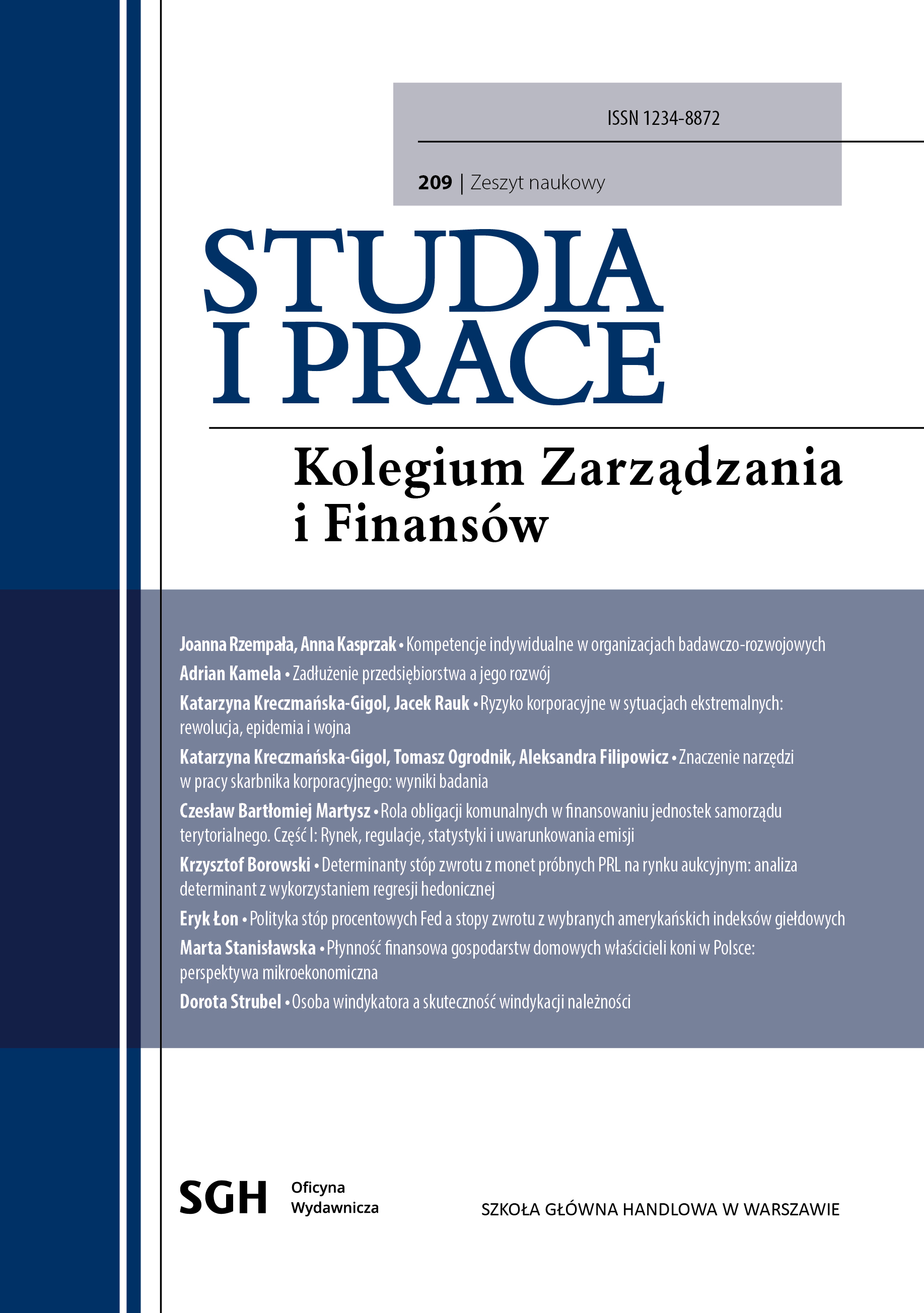
Płynność finansowa gospodarstw domowych właścicieli koni w Polsce: perspektywa mikroekonomiczna
Słowa kluczowe:
płynność finansowa, kruchość finansowa, wydatki uznaniowe, gospodarstwa domowe, właściciele koniAbstrakt
Artykuł analizuje płynność i kruchość finansową gospodarstw domowych właścicieli koni w Polsce w perspektywie mikroekonomicznej. Na podstawie badania CAWI przeprowadzonego wśród 636 właścicieli koni z 15 województw oceniono udział wydatków związanych z utrzymaniem koni w budżecie domowym, wpływ poziomu dochodów i bufora oszczędnościowego na stabilność finansową oraz reakcje na wzrost cen usług i produktów jeździeckich. Wykorzystano statystyki opisowe i analizy porównawcze z zastosowaniem środowiska R. Wyniki wskazują, że głównym źródłem ryzyka nie jest sam poziom dochodów, lecz ograniczona dostępność środków płynnych przy wysokich, stałych wydatkach związanych z utrzymaniem koni. Gospodarstwa o niskiej płynności częściej ograniczają inne wydatki uznaniowe, rezygnują z oszczędności i rozważają redukcję aktywności jeździeckiej. Wnioski podkreślają znaczenie edukacji finansowej i budowy rezerw płynnościowych w grupie właścicieli koni.
Downloads
Bibliografia
Wydawnictwa zwarte
Agarwal, S., Mannil, N. (2023). Household Financial Decision Making. W: Handbook of Financial Decision Making (ch. 18). Cheltenham: Edward Elgar Publishing. DOI: 10.4337/9781802204179.00033.
Deaves, R. (2024). Household Finance: An Introduction to Individual Financial Behavior. New York: Oxford University Press. DOI: 10.1093/9780197699898.001.0001.
R Core Team (2024). R: A Language and Environment for Statistical Computing. Vienna:R Foundation for Statistical Computing.
Serpell, J. (1996). In the Company of Animals: A Study of Human – Animal Relationships. Cambridge:Cambridge University Press.
Artykuły naukowe
Brunetti, M., Giarda, E., Torricelli, C. (2016). Is Financial Fragility a Matter of Illiquidity? An Appraisal for Italian Households, Review of Income and Wealth, 62 (4), s. 628–649. DOI:10.1111/roiw.12189.
Carlsson, F., He, H., Martinsson, P., Qin, P., Sutter, M. (2012). Household Decision Making in Rural China: Using Experiments to Estimate the Influences of Spouses, Journal of Economic Behavior & Organization, 84 (2), s. 525–536. DOI: 10.1016/j.jebo.2012.08.010.
Chen, X., Hu, G., Wen, H. (2025). Investigating the Factors Influencing Household Financial Vulnerability in China: An Exploration Based on the Shapley Additive Explanations Approach, Sustainability, 17, 5523. DOI: 10.3390/su17125523.
Clercq, B. de, van Tonder, J. A., van Aardt, C. J. (2019). Consumer Financial Vulnerability:Identifying Transmission Linkages that Could Give Rise to Higher Levels of Consumer Financial Vulnerability, Southern African Business Review, 19 (1), s. 112–136. DOI: 10.25159/1998-8125/5836.
Dolan, P., Peasgood, T., White, M. (2008). Do We Really Know what Makes us Happy? A Review of the Economic Literature on the Factors Associated with Subjective Well-Being, Journal of Economic Psychology, 29 (1), s. 94–122. DOI: 10.1016/j.joep.2007.09.001.
Gaigalienė, A., Kaniauskaitė, G. (2023). The Financial Vulnerability of European Households, Management Theory and Studies for Rural Business and Infrastructure Development, 45 (4), s. 334–342. DOI: 10.15544/mts.2023.33.
Gan, J. (2010). Housing Wealth and Consumption Growth: Evidence from a Large Panel of Households, The Review of Financial Studies, 23 (6), s. 2229–2267. DOI: 10.1093/rfs/hhp127.
Gao, W., Xing, B. (2025). Consumer Credit and Household Financial Vulnerability, Advances in Economics, Management and Political Sciences, 180, s. 132–146.
Gelman, M., Gorodnichenko, Y., Kariv, S., Koustas, D., Shapiro, M. D., Silverman, D., Tadelis, S. (2023). The Response of Consumer Spending to Changes in Gasoline Prices, American Economic Journal: Macroeconomics, 15 (2), s. 129–160. DOI: 10.1257/mac.20210024.
Gomes, F., Haliassos, M., Ramadorai, T. (2021). Household Finance, Journal of Economic Literature, 59 (3), s. 919–1000. DOI: 10.1257/jel.20201461.
Holm, M. B. (2018). Consumption with Liquidity Constraints: An Analytical Characterization, Economics Letters, 167, s. 40–42. DOI: 10.1016/j.econlet.2018.03.004.
Hubbard, R. G., Skinner, J., Zeldes, S. P. (1986). Precautionary Saving and Social Insurance, NBER Working Paper, s. 360–399.
Kahneman, D., Deaton, A. (2010). High Income Improves Evaluation of Life but not Emotional Well-Being, Proceedings of the National Academy of Sciences of the United States of America, 107 (38), s. 16489–16493. doi: 10.1073/pnas.1011492107.
Kaicker, N., Gupta, A., Gaiha, R. (2024). Recreation and Social Obligations during Covid in India: Does Social Distancing Act as a Barrier?, Review of Development Economics, 28 (2), s. 527–543. DOI: 10.1111/rode.13064.
Karpyshyn, N., Tabaka, S. (2020). Behavioral Financial Decisions of the Population in the Process of Consumption, World of Finance, 3 (64), s. 19–28. DOI: 10.35774/sf2020.03.019.
Kim, S., Koh, K. (2025). Consumption Responses to Income Shocks through Lottery Winning: Evidence from Older Adults in Singapore, Oxford Bulletin of Economics and Statistics, 87, s. 1–25. DOI: 10.1111/obes.12629.
Kramer, B. (2016). When Expectations Become Aspirations: Reference-Dependent Preferences and Liquidity Constraints, Economic Theory, 61, s. 685–721. DOI: https://doi.org/10.1007/s00199-015-0949-9.
Liang, Y., Meng, C., Chen, R., Yang, Y., Zeng, Y. (2024). Pet Ownership and its Influence on Animal Welfare Attitudes and Consumption Intentions among Chinese University Students, Animals, 14, s. 3242. DOI: 10.3390/ani14223242.
Loewenstein, G. (2000). Emotions in Economic Theory and Economic Behavior, American Economic Review, 90 (2), s. 426–432. DOI: 10.1257/aer.90.2.426.
Jappelli, T., Pistaferri, L. (2010). The Consumption Response to Income Changes, Annual Review of Economics, 2, s. 479–506. DOI: 10.1146/annurev.economics.050708.142933.
Mewse, A. J., Lea, S. E. G., Wrapson, W. (2010). First Steps out of Debt: Attitudes and Social Identity as Predictors of Contact by Debtors with Creditors, Journal of Economic Psychology, 31 (6), s. 1021–1034. DOI: 10.1016/j.joep.2010.08.009.
O’Donoghue, T., Rabin, M. (2015). Present Bias: Lessons Learned and to be Learned, American Economic Review, 105 (5), s. 273–279. DOI: 10.1257/aer.p20151085.
Olafsson, A., Pagel, M. (2018). The Liquid Hand-to-Mouth: Evidence from Personal Finance Management Software, The Review of Financial Studies, 31 (11), s. 4398–4446. DOI: https://doi.org/10.1093/rfs/hhy055.
Press, O.‑A. (2024). Essays on Household Finance, PhD Series, 43. DOI: 10.22439/phd.43.2024.
Reece, S., Dickerson, J., Kelly, B., McEachan, R. R. C., Pickett, K. E. (2023). The Long-Term Impact of the Covid-19 Pandemic on Financial Insecurity in Vulnerable Families: Findings from the Born in Bradford Covid-19 Longitudinal Study, PLoS ONE, 18 (11), e0295064. DOI:10.1371/journal.pone.0295064.
Rossi, M., Trucchi, S. (2016). Liquidity Constraints and Labor Supply, European Economic Review, 87, s. 176–193. DOI: https://doi.org/10.1016/j.euroecorev.2016.05.001.
Tanaka, T., Camerer, C. F., Nguyen, Q. (2016). Risk and Time Preferences: Linking Experimental and Household Survey Data from Vietnam. W: Behavioral Economics of Preferences, Choices, and Happiness (s. 3–33), S. Ikeda, H. Kato, F. Ohtake, Y. Tsutsui (Eds.). Tokyo: Springer. DOI: 10.1007/978-4-431-55402-8_1.
West, S., Mottola, G. (2016). A Population on the Brink: American Renters, Emergency Savings, and Financial Fragility, Poverty & Public Policy, 8 (1), s. 56–71. DOI: 10.1002/pop4.130.
Pobrania
Opublikowane
Jak cytować
Numer
Dział
Licencja
Prawa autorskie (c) 2026 Studia i Prace Kolegium Zarządzania i Finansów

Utwór dostępny jest na licencji Creative Commons Uznanie autorstwa 4.0 Międzynarodowe.