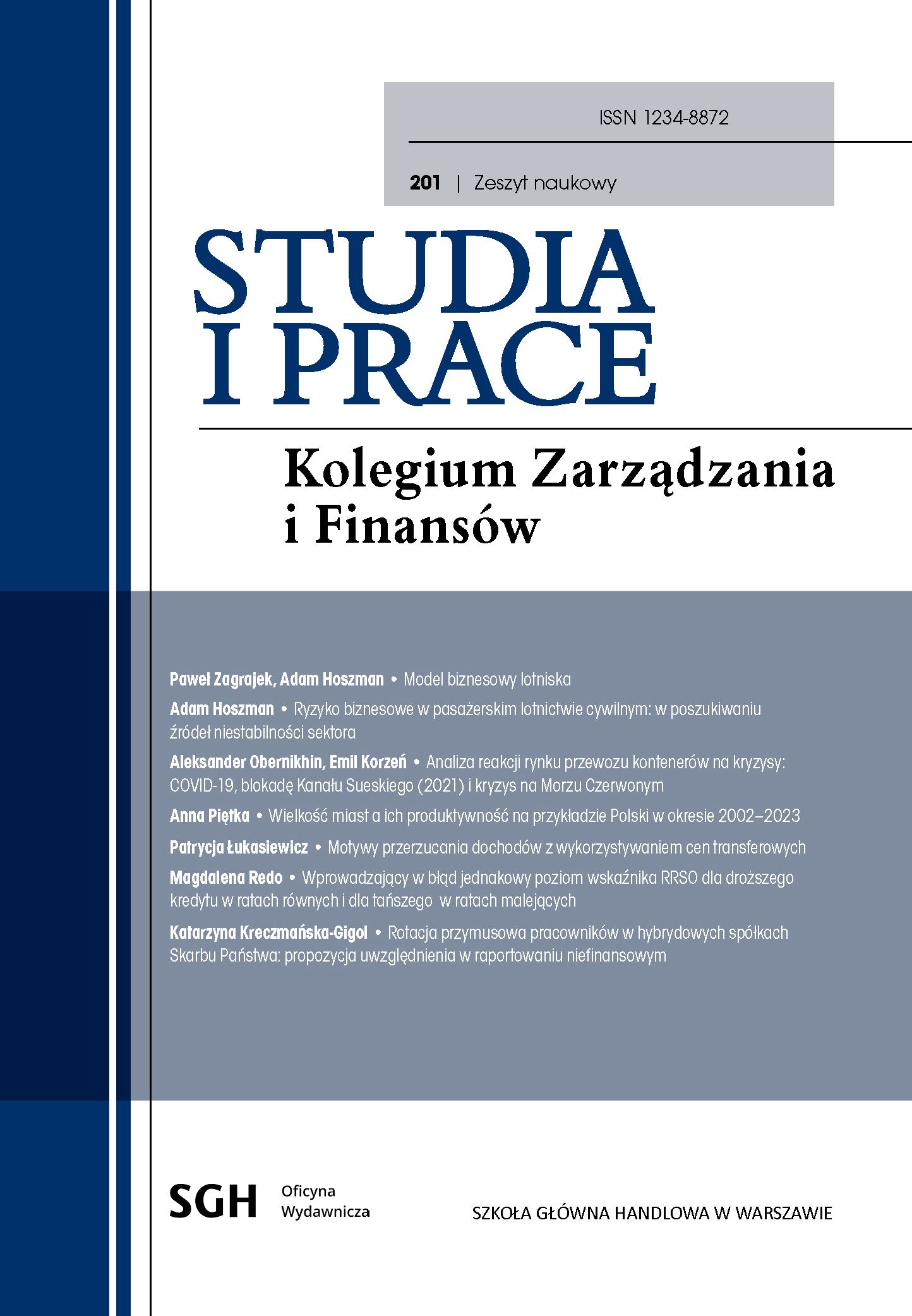
City size and productivity: the example of Poland in the period 2002-2023
DOI:
https://doi.org/10.33119/SIP.2025.201.4Keywords:
city size, city productivityAbstract
The article analyses the relationship between the size of cities and their productivity in Poland, focusing on two questions: whether the cities productivity increases with their size, and whether there is a relationship between the size of cities and the dynamics of productivity growth. In the first part, based on the literature review, the theoretical framework is presented. Then, using exploratory spatial data analysis, it is shown that larger cities are characterised by higher productivity. At the same time, the analysis of productivity dynamics from 2002 to 2023 did not allow for a clear identification of the relationship between city size and the growth rate of productivity. The article concludes with a summary and indicates possible directions for future research.
Downloads
References
Wydawnictwa zwarte
Florida, R., Adler, P., Mellander, C. (2018). The City as Innovation Machine. W: Transitions in Regional Economic Development, I. Turok et al. (eds.) (s. 151–170). Abingdon and New York: Routledge.
Friedmann, J. (1966). Regional Development Policy: A Case Study of Venezuela. Cambridge: MIT Press.
Fujita, M., Krugman, P., Venables, A. J. (1999). The Spatial Economy: Cities, Regions, and International Trade. Cambridge: MIT Press.
Lösch, A. (1961). Gospodarka przestrzenna. Warszawa: PWN.
Perroux, F. (1970). Note on the Concept of Growth Poles. W: Regional Economics: Theory and Practice, D. L. McKee, R. D. Dean, W. H. Leahy (eds.) (s. 93–103). New York: The Free Press.
Rembisz, W., Sielska, A. (2024). Mikroekonomia współcześnie. Ujęcie analityczno-formalne. Warszawa: Wydawnictwo AEH.
Sobala-Gwosdz, A., Janas, K., Jarczewski, W., Czakon, P. (2024). Hierarchia funkcjonalna miast w Polsce i jej przemiany w latach 1990–2020. Badania Obserwatorium Polityki Miejskiej. Warszawa- Kraków: Instytut Rozwoju Miast i Regionów. DOI: 10.51733/opm.2024.01.
Śleszyński, P. (2018). Polska średnich miast: założenia i koncepcja deglomeracji w Polsce. Kraków: Klub Jagielloński.
Artykuły naukowe
Ahrend, R., Lembcke, A. C., Schumann, A. (2017). The Role of Urban Agglomerations for Economic and Productivity Growth, International Productivity Monitor, 32, 161.
Alonso, W. (1971). The Economic of Urban Size, Papers and Proceedings of the Regional Science Association, 26, s. 67–83. DOI: 10.1111/j.1435-5597.1971.tb01493.x.
Arnott, R. J., Stiglitz, J. E. (1979). Aggregate Land Rents, Expenditure on Public Goods, and Optimal City Size, The Quarterly Journal of Economics, 93 (4), s. 471–500. DOI: 10.2307/1884466.
Bettencourt, L. M. A., Lobo, J., Helbing, D., Kühnert, C., West, G. B. (2007). Growth, Innovation, Scaling, and the Pace of Life in Cities, Proceedings of the National Academy of Sciences, 104 (17), s. 7301–7306. DOI: 10.1073/pnas.0610172104.
Black, D., Henderson, V. (1999). A Theory of Urban Growth, Journal of Political Economy, 107 (2), s. 252–284.
Burnett, P. (2016). Overpopulation, Optimal City Size and the Efficiency of Urban Sprawl, Review of Urban & Regional Development Studies, 28 (3), s. 143–161. DOI: 10.1111/rurd.12051.
Camagni, R., Capello, R., Caragliu, A. (2013). One or Infinite Optimal City Sizes? In Search of an Equilibrium Size for Cities, The Annals of Regional Science, 51, s. 309–341. DOI: 10.1007/s00168-012-0548-7.
Capello, R. (2004). Beyond Optimal City Size: Theory and Evidence Reconsidered, Contributions to Economic Analysis, 266, s. 57–85. DOI: 10.1016/s0573-8555(04)66003-2.
Christaller, W. (1963). Ośrodki centralne w południowych Niemczech, Przegląd Zagranicznej Literatury Geograficznej, 1, s. 1–72.
Churski, P., Adamiak, C., Szyda, B., Dubownik, A., Pietrzykowski, M., Śleszyński, P. (2023). Nowa delimitacja miejskich obszarów funkcjonalnych w Polsce i jej zastosowanie w praktyce zintegrowanego podejścia terytorialnego (place based approach), Przegląd Geograficzny, 95 (1), s. 29–55. DOI: 10.7163/przg.2023.1.2.
Combes, P. P., Duranton, G., Gobillon, L., Puga, D., Roux, S. (2012). The Productivity Advantages of Large Cities: Distinguishing Agglomeration from Firm Selection, Econometrica, 80 (6),s. 2543–2594. DOI: 10.3982/ecta8442.
Duranton, G., Puga, D. (2003). Micro-Foundations of Urban Agglomeration Economies, National Bureau Of Economic Research Working paper, 9931, s. 3–46. DOI: 10.3386/w9931.
Duranton, G., Puga, D. (2023). Urban Growth and its Aggregate Implications, Econometrica, 91 (6), s. 2219–2259. DOI: 10.3386/w9931.
Frick, S. A., Rodríguez‐Pose, A. (2018). Big or Small Cities? On City Size and Economic Growth, Growth and Change, 49 (1), s. 4–32. DOI: 10.1111/grow.12232.
Friedman, J. (1986). The World City Hypothesis, Development and Change, 17 (1), s. 69–83. DOI: 10.1017/cbo9780511522192.019.
Fujita, M., Thisse, J. F. (2003). Does Geographical Agglomeration Foster Economic Growth? And Who Gains and Loses from It?, The Japanese Economic Review, 54 (2), s. 121–145. DOI:10.1111/1468-5876.00250.
Gaspar, J., Glaeser, E. L. (1998). Information Technology and the Future of Cities, Journal of Urban Economics, 43 (1), s. 136–156. DOI: 10.3386/w5562.
Glaeser, E., Kallal, H., Scheinkman, J., Shleifer, A. (1992). Growth in Cities, Journal of Political Economy, 100 (6), s. 1126–1152. DOI: 10.3386/w3787.
Henderson, J. V. (1974). The Sizes and Types of Cities, American Economic Review, 64 (4), s. 640–656.
Jones, P., Collier, P., Spijkerman, D. (2020). Cities as Engines of Growth: Evidence from a New Global Sample of Cities, Journal of Applied Business and Economics, 22 (2). DOI: 10.33423/ jabe.v22i2.2808.
Jóźwik, J., Dymek D. (2022). Kryteria identyfikacji miast na świecie, Prace Geograficzne, 166, s. 9–26. DOI: 10.4467/20833113PG.22.001.
Krugman, P. (1991). Increasing Returns and Economic Geography, Journal of political economy, 99 (3), s. 483–499. DOI: 10.1086/261763.
Lucas, R (1988). On the Mechanics of Economic Development, Journal of Monetary Economics, 22 (1), s. 3–42. DOI: 10.1016/0304-3932(88)90168-7
Lucas, R. (2004). Life Earnings and Rural-Urban Migration, Journal of Political Economy, 112 (S1), s. S29 – S59. DOI: 10.1086/379942.
Mankiw, N., Romer, D., Weil, D. (1992). A Contribution to the Empirics of Economic Growth, Quarterly Journal of Economics, 107, s. 407–437. DOI: 10.3386/w3541.
Martin, P., Ottaviano, G. I. P. (2001). Growth and Agglomeration, International Economic Review, 42 (4), s. 947–968. DOI: 10.1111/1468-2354.00141.
Roca, J. D. L., Puga, D. (2017). Learning by Working in Big Cities, The Review of Economic Studies, 84 (1), s. 106–142. DOI: 10.1093/restud/rdw031.
Romer, P. M. (1986). Increasing Returns and Long-Run Growth, Journal of Political Economy, 94 (5), s. 1002–1037. DOI: 10.1086/261420.
Runge, A. (2012). Metodologiczne problemy badania miast średnich w Polsce, Prace Geograficzne, 129, s. 83–101.
Sassen, S. (2004). The Global City: Introducing a Concept, Brown Journal of World Affairs, 11 (2), s. 27–43.
Solow, R. (1956). A Contribution to the Theory of Economic Growth, Quarterly Journal of Economics, 70, s. 65–94.
Materiały internetowe
Główny Urząd Statystyczny (GUS). (2024). Bank Danych Lokalnych, https://bdl.stat.gov.pl/bdl/start (dostęp: 13.12.2024).
Our World in Data (2024). https://ourworldindata.org/ (dostęp: 13.12.2024).
Główny Urząd Statystyczny (GUS). (2023). Prognoza ludności na lata 2023–2060, https://stat.gov.pl/obszary-tematyczne/ludnosc/prognoza-ludnosci/prognoza-ludnosci-nalata-2023–2060,11,1.html (dostęp: 28.03.2025).
Downloads
Published
How to Cite
Issue
Section
License
Copyright (c) 2025 Studies and Work of the Collegium of Management and Finance

This work is licensed under a Creative Commons Attribution 4.0 International License.