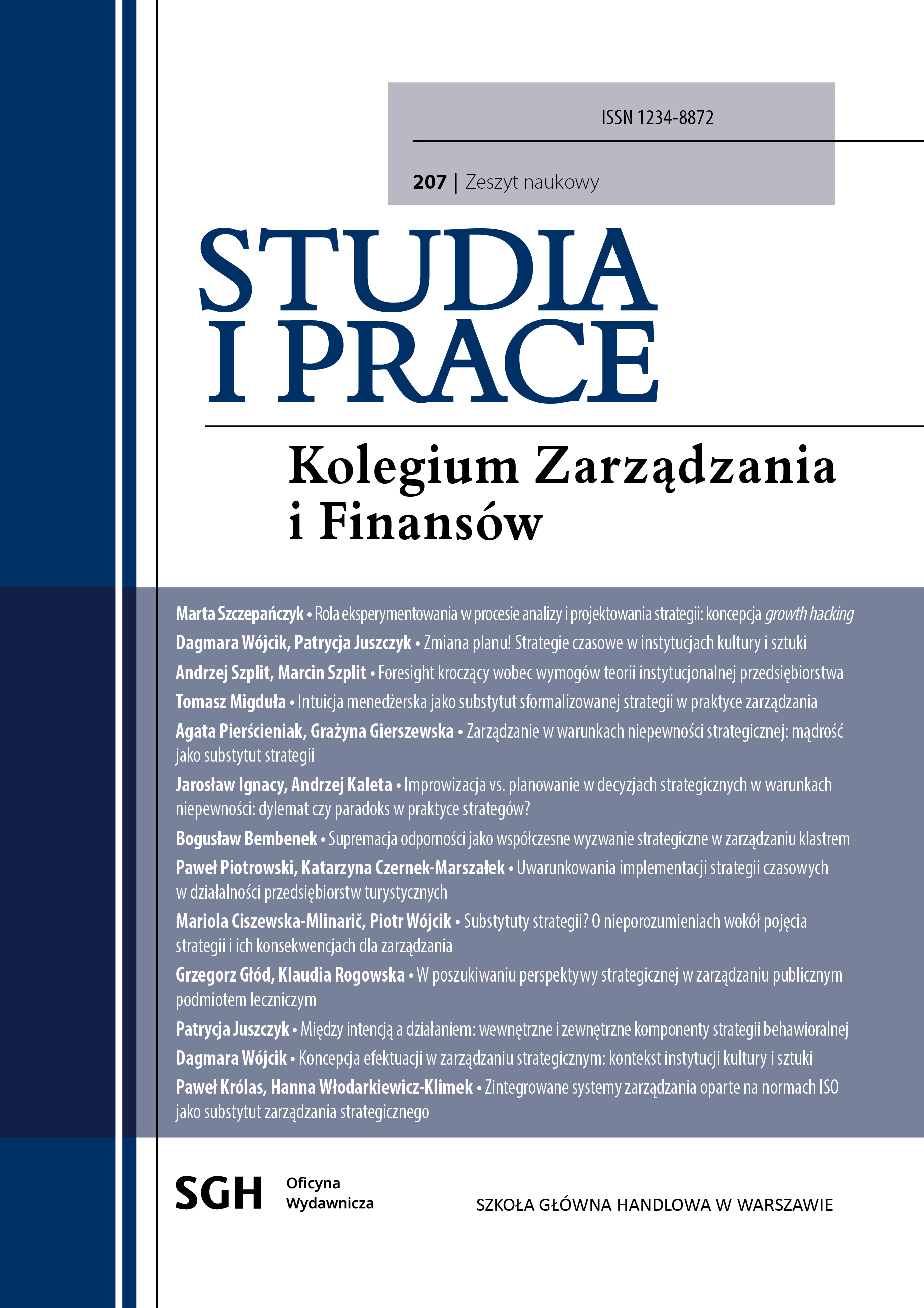
The Role of Experimentation in the Process of Strategy Analysis and Design
Brak
DOI:
https://doi.org/10.33119/SIP.2026.207.1Keywords:
ANOVA, development strategy design, growth hacking, strategic analysisAbstract
This article attempts to explain the assumptions behind the growth hacking concept and demonstrate its role in strategic management. The aim of this paper is to examine differences in company approaches to strategic analysis and the development strategy design process depending on the company size and knowledge of the growth hacking concept. First, it reviews the literature on this topic with emphasis on the importance of experimentation. The empirical section presents the ANOVA analysis to indicate that company approaches to strategic analysis do not differ significantly in terms of size and knowledge of the growth hacking concept. These differences are significant for strategy design. It can be assumed that the analysis process is much more accessible to companies than the process of formulating strategic assumptions, which is characterised by a greater complexity and requires significant commitment and creativity. Furthermore, the knowledge of the growth hacking concept does not mean its practical application by companies.
Downloads
References
Artykuły naukowe
Bargoni, A., Jabeen, F., Santoro, G., Ferraris, A. (2024a). Growth Hacking and International Dynamic Marketing Capabilities: A Conceptual Framework and Research Propositions, International Marketing Review, 41 (1), s. 74–106. DOI: 10.1108/IMR-07-2022-0156.
Bargoni, A., Santoro, G., Petruzzelli, A. M., Ferraris, A. (2024b). Growth Hacking: A Critical Review to Clarify its Meaning and Guide its Practical Application, Technological Forecasting and Social Change, 200, 123111. DOI: 10.1016/j.techfore.2023.123111.
Bohnsack, R., Liesner, M. M. (2019). What the Hack? A Growth Hacking Taxonomy and Practical Applications for Firms, Business Horizons, 62 (6), s. 799–818. DOI: 10.1016/j.bushor.2019.09.001.
Brecht, P., Hendriks, D., Stroebele, A., Hahn, C. H., Wolff, I. (2021). Discovery and Validation of Business Models: How B2B Startups Can Use Business Experiments, Technology Innovation Management Review, 11 (3), s. 17–31.
Cavallo, A., Cosenz, F., Noto, G. (2024). Business Model Scaling and Growth Hacking in Digital Entrepreneurship, Journal of Small Business Management, 62 (4), s. 2058–2085. DOI:10.1080/00472778.2023.2195463.
Chruściel, P. (2023). Koncepcja wpływu wdrożenia narzędzi lean management na formowanie się organizacji inteligentnej, Zeszyty Naukowe Politechniki Częstochowskiej. Zarządzanie, 49 (1), s. 7–21. DOI: 10.17512/znpcz.2023.1.01.
Conway, T., Hemphill, T. (2019). Growth Hacking as an Approach to Producing Growth amongst UK Technology Start-ups: An Evaluation, Journal of Research in Marketing and Entrepreneurship, 21 (2), s. 163–179. DOI:10.1108/JRME-12-2018-0065.
Cristofaro, M., Giardino, P. L., Barboni, L. (2025). Growth Hacking: A Scientific Approach for Data-Driven Decision Making, Journal of Business Research, 186.
Feiz, D., Zarei, A., Minbashrazgah, M. M., Shaabani, A. H. (2021). Typology of Growth Hacking Strategies Along the Growth Hacking Funnel, Iranian Journal of Management Studies (IJMS), 14 (2), s. 331–346.
Gerlich, C., Brenk, K., Antonio J. L., Kanbach, D. K., Kraus, S. (2025). Wielding a Double-Edged Sword: Unravelling the Development of Dynamic Capabilities through Growth Hacking, Journal of Business Research, 189, 115172.
Giordino, D., Troise, C., Bresciani, S., Camilleri, M. A. (2025). Growth Hacking Capability: Antecedents and Performance Implications in the Context of SMEs, Journal of Business Research, 192, 115288.
Joshi, Y., Bodhi, R., Chatterjee, S., Mariani, M. (2025). The Impact of Growth Hacking on Firm Performance under Environmental Turbulence: A Moderated-Mediation Analysis, Journal of Business Research, 191, 115271.
Krystosiak, K., Ejsmont, K. (2014). Zastosowanie analizy wariancji ANOVA w zarządzaniu reklamacjami, Ekonomika i Organizacja Przedsiębiorstwa, 11, s. 83–89.
Mahdiraji, H. A., Arabi, H. S., Duan, K., Vrontis, D. (2025). Harnessing Technological Resources for Effective Growth Hacking: A Mixed-Method Framework Using Systematic Literature Review, Content Analysis, and Multi-Layer Decision-Making, Journal of Business Research, 190.
Malska, W., Twaróg, B. (2017). Testy ANOVA jako narzędzie wspomagające weryfikację hipotez statystycznych, Acta Scientifica Academiae Ostroviensis. Sectio A, Nauki Humanistyczne, Społeczne i Techniczne, 10 (2), s. 148–159.
Mazurek-Kucharska, B. (2012). Wybrane problemy pomiaru satysfakcji, Kwartalnik Ekonomistów i Menedżerów, 24 (2), s. 29–44. DOI: 10.5604/01.3001.0009.5786.
Miotk, A. (2018). Growth Hacking – Low-Cost Marketing Communication for Small Businesses, Marketing i Rynek [Preprint], s. 23–35.
Sanasi, S., Ghezzi, A., Cavallo, A. (2023). What Happens after Market Validation? Experimentation for Scaling in Technology-Based Startups, Technological Forecasting and Social Change, 196. DOI: 10.1016/j.techfore.2023.122839.
Santoro, G., Jabeen, F., Kliestik, T., Bresciani, S. (2024). AI-Powered Growth Hacking: Benefits, Challenges, and Pathways, Management Decision, 63 (10), s. 3389–3407. DOI: 10.1108/MD-10-2023-1964.
Schiavone, F., Perillo, C., Mandiello, A., Bernhard, F. (2025). Growth Hacking and Network Effects: Learning for Growth and Learning for Survival, Journal of Business Research, 200, 115594. DOI: 10.1016/j.jbusres.2025.115594.
Scuotto, V., Tzanidis, T., Murray, A., Manlio, D. G. (2025). Growth Hacking: Leveraging Hyper- Scalability, Hyper-Specialization, and Human-Centric Strategies for Competitive Advantage, Journal of Business Research, (190), 115217.
Troisi, O., Maione, G., Grimaldi, M., Loia, F. (2020). Growth Hacking: Insights on Data-Driven Decision-Making from Three Firms, Industrial Marketing Management, 90, s. 538–557. DOI: 10.1016/j.indmarman.2019.08.005.
Wałachowska, A. (2021). Edukacja zdalna szansą na wyższe wyniki w nauce?, Zeszyty Naukowe Wydziału Elektrotechniki i Automatyki Politechniki Gdańskiej, 72, s. 22–24. DOI:10.32016/1.72.17.
Materiały internetowe
Statsoft (b.d.). https://www.statsoft.pl/textbook/stathome_stat.html?https%3A%2F%2Fwww.statsoft.pl%2Ftextbook%2Fstdisfit.html (dostęp: 20.10.2025).
Wang, W. (2022). A Purpose Driven Framework to Growth-Hacking, manuscript version: 3.0, https://ssrn.com/abstract=4400716 (dostęp: 20.10.2025).
Downloads
Published
How to Cite
Issue
Section
License
Copyright (c) 2026 Studies and Work of the Collegium of Management and Finance

This work is licensed under a Creative Commons Attribution 4.0 International License.