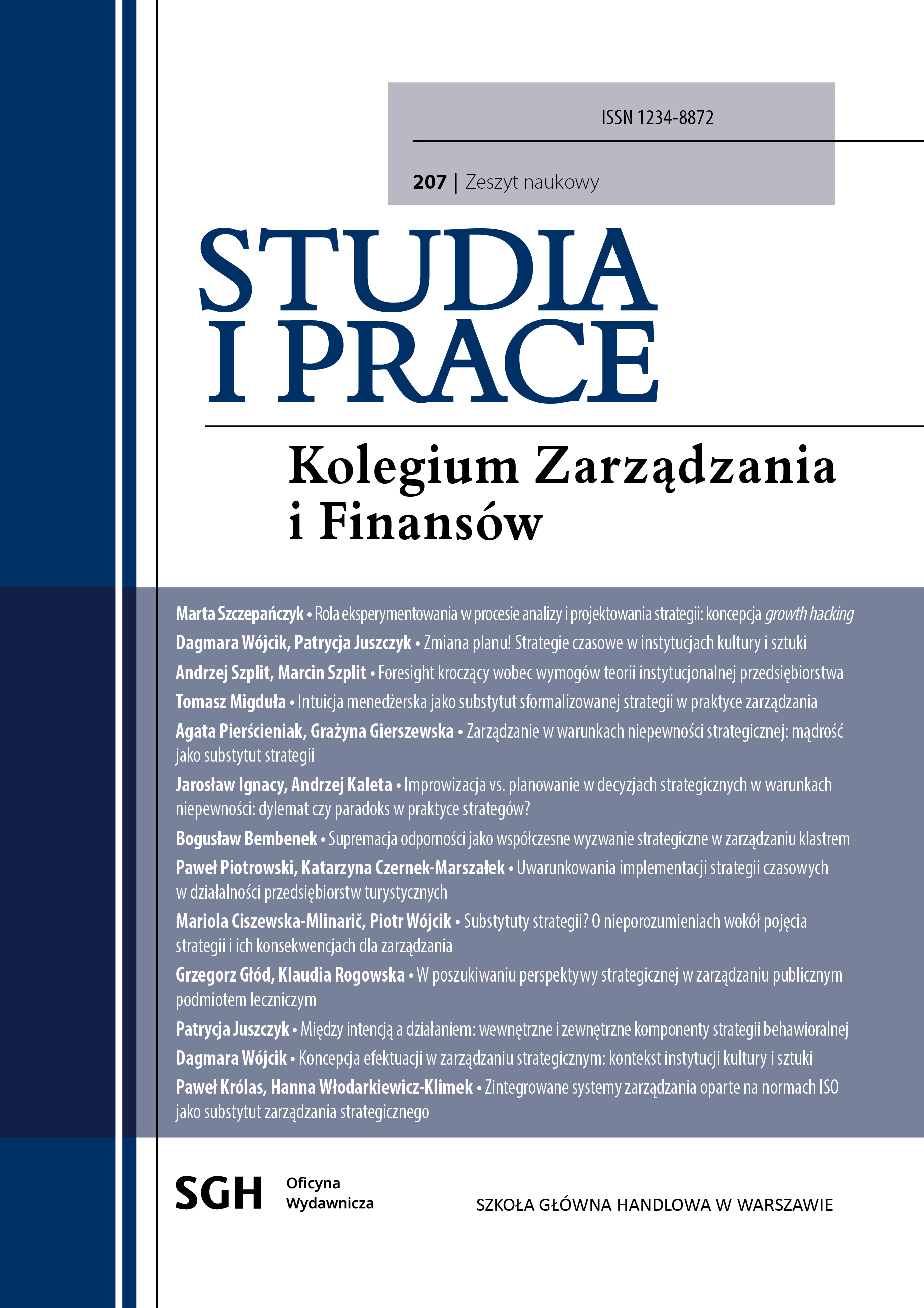
Managerial Intuition as a Substitute for Formalised Strategy in Management Practice
DOI:
https://doi.org/10.33119/SIP.2026.207.4Keywords:
managerial intuition, strategic management, strategic planning, development strategy design, strategy substituteAbstract
The article examines the phenomenon of substituting formalised strategy with managerial intuition, analysing how it affects decision-making processes in the absence of a formal plan. Based on a survey comparing SMEs with large corporations, it identifies two distinct operational models: an intuitive model, which provides greater speed and flexibility and an analytical model, which ensures consistency. Despite fundamental differences, both approaches are considered equally effective in achieving
goals. The findings indicate that managerial intuition is not an irrational hunch but rather an expert competence based on the experience and direct market contact. It constitutes an effective adaptive mechanism, representing not so much a lack of strategy as its alternative in a non-formalised form.
Downloads
References
Wydawnictwa zwarte
Johnson, G., Scholes, K., Whittington, R. (2010). Podstawy strategii. Warszawa: Polskie Wydawnictwo Ekonomiczne.
Kahneman, D. (2012). Pułapki myślenia. O myśleniu szybkim i wolnym. Poznań: Media Rodzina.
Kiełtyka, L., Jędrzejczyk, W. (2015). Intuicja w zarządzaniu – problematyka i kierunki badań. W: Zachowania organizacyjne. Relacje społeczne w przestrzeni zmian (s. 133–142), K. Januszkiewicz, M. Czajkowska, M. Kołodziejczak, M. Zalewska-Turzyńska (red.). Łódź: Wydawnictwo Uniwersytetu Łódzkiego. DOI: 10.18778/7969-802-8.12.
Leszczewska, K. (2017). Stadia rozwoju przedsiębiorstw rodzinnych – studium przypadku. W: Firmy rodzinne – rozwój teorii i praktyki zarządzania (s. 9–27), Ł. Sułkowski, A. Marjański (red.). Łódź–Warszawa: Społeczna Akademia Nauk.
Obłój, K. (2017). Praktyka strategii firmy. Jak zarządzać przeszłością, radzić sobie z teraźniejszością i tworzyć przyszłość. Warszawa: Poltext.
Polowczyk, J. (2008). Skuteczne strategie biznesowe. Praktyka i teoria. Poznań: Wydawnictwo Wyższej Szkoły Bankowej w Poznaniu.
Rumelt, R. P. (2012). Dobra strategia, zła strategia. Czym się różnią i dlaczego to ma znaczenie. Warszawa: MT Biznes.
Rumelt, R. P. (2022). Sedno strategii. Jak lider może stać się strategiem. Warszawa: MT Biznes.
Sułkowski, Ł., Marjańska-Potakowska, J. (2017). Stadia rozwoju przedsiębiorstw rodzinnych –studium przypadku. W: Firmy rodzinne – rozwój teorii i praktyki zarządzania (s. 61–79), Ł. Sułkowski, A. Marjański (red.). Łódź–Warszawa: Społeczna Akademia Nauk.
Artykuły naukowe
Akinci, C., Sadler-Smith, E. (2012). Intuition in Management Research: A Historical Review, International Journal of Management Reviews, 14 (1), s. 104–122. DOI: 10.1111/j.1468-2370.2011.00313.x.
Evans, J. (2008). Dual-Processing Accounts of Reasoning, Judgment, and Social Cognition, Annual Review of Psychology, 59, s. 255–278. DOI: 10.1146/annurev.psych.59.103006.093629.
Hodgkinson, G., Langan-Fox, J., Sadler-Smith, E. (2008). Intuition: A Fundamental Bridging Construct in the Behavioral Sciences, British Journal of Psychology, 99, s. 1–27. DOI:10.1348/000712607X216666.
Khatri, N., Ng, H. (2000). The Role of Intuition in Strategic Decision Making, Human Relations, 53, s. 57–86. DOI: 10.1177/0018726700531004.
Kraus, S., Harms, R., Schwarz, E. (2008). Strategic Business Planning and Success in Small Firms, Entrepreneurship and Innovation Management, 8 (4), s. 381–396.
Kraus, S., Reiche, B., Reschke, C. (2005). The Role of Strategic Planning in SMEs, Literature Review and Implications.
Lal, S., Mani, H., Meera, K. L., Sharma, A., Sasidharan, A., Radha, T. (2023). Developing a Strategic Planning Framework for Small and Medium Enterprises (SMES), European Chemical Bulletin, 12 (5), s. 460–469.
Malewska, K. (2015). Intuition in Decision-Making – Theoretical and Empirical Aspects, International Journal of Business and Economic Development, 3, a3. DOI: 10.15678/znuek.2019.0983.0502.
Miller, C. (2005). Intuition in Strategic Decision Making: Friend or Foe in the Fast-Paced 21st Century?, Academy of Management Executive, 19, s. 19–30. DOI: 10.5465/ame.2005.15841948.
Molenda, R. (2018). Intuicja menedżera jako specyficzny aspekt zarządzania wiedzą, Studia Ekonomiczne/Uniwersytet Ekonomiczny w Katowicach, 377, s. 66–75.
O’Regan, N., Ghobadian, A., Liu, J. (2000). Strategic Planning for SMEs, Scenario and Strategy Planning, 2, s. 18–22.
Radomska, J. (2013). Myślenie strategiczne – modny trend czy skuteczna alternatywa dla planowania strategicznego?, Management and Business Administration. Central Europe, 21, s. 41–54. DOI: 10.7206/mba.ce.2084-3356.45.
Saah, P. (2022). Critical Factors for the Successful Implementation of a Strategic Business Plan among Small and Medium Size Enterprises, International Review of Management and Marketing, 12, s. 19–28. DOI: 10.32479/irmm.13280.
Salas, E., Rosen, M., DiazGranados, D. (2010). Expertise-Based Intuition and Decision Making in Organizations, Journal of Management, 36, s. 941–973. DOI: 10.1177/0149206309350084.
Seidl, D., Ma, S., Splitter, V. (2024). What Makes Activities Strategic: Toward a New Framework for Strategy-As-Practice Research, Strategic Management Journal, 45 (12), s. 2395–2419. DOI: 10.1002/smj.3668.
Sołoducho-Pelc, L. (2014). Koncepcja i wdrażanie strategii w małych, średnich i dużych przedsiębiorstwach, Prace Naukowe Uniwersytetu Ekonomicznego we Wrocławiu, 366, s. 470–484. DOI: 10.15611/pn.2014.366.45
Sołoducho-Pelc, L. (2011). Wybory strategiczne małych i średnich przedsiębiorstw, Zeszyty Naukowe Uniwersytetu Ekonomicznego w Poznaniu, 171, s. 365–374.
Wołczek, P. (2016). Cechy strategii generujące problemy wdrożeniowe a wielkość przedsiębiorstwa, Prace Naukowe Uniwersytetu Ekonomicznego we Wrocławiu, 444, s. 559–570. DOI:10.15611/pn.2016.444.49.
Materiały niepublikowane
Beliczyński, J. (2024). Podstawy strategii firmy i zarządzania strategicznego, Uniwersytet Ekonomiczny w Krakowie, Kraków, maszynopis niepublikowany (wersja robocza pierwszego rozdziału planowanego podręcznika do przedmiotu „Zarządzanie strategiczne”).
Downloads
Published
How to Cite
Issue
Section
License
Copyright (c) 2026 Studies and Work of the Collegium of Management and Finance

This work is licensed under a Creative Commons Attribution 4.0 International License.