Pasek boczny artykułu
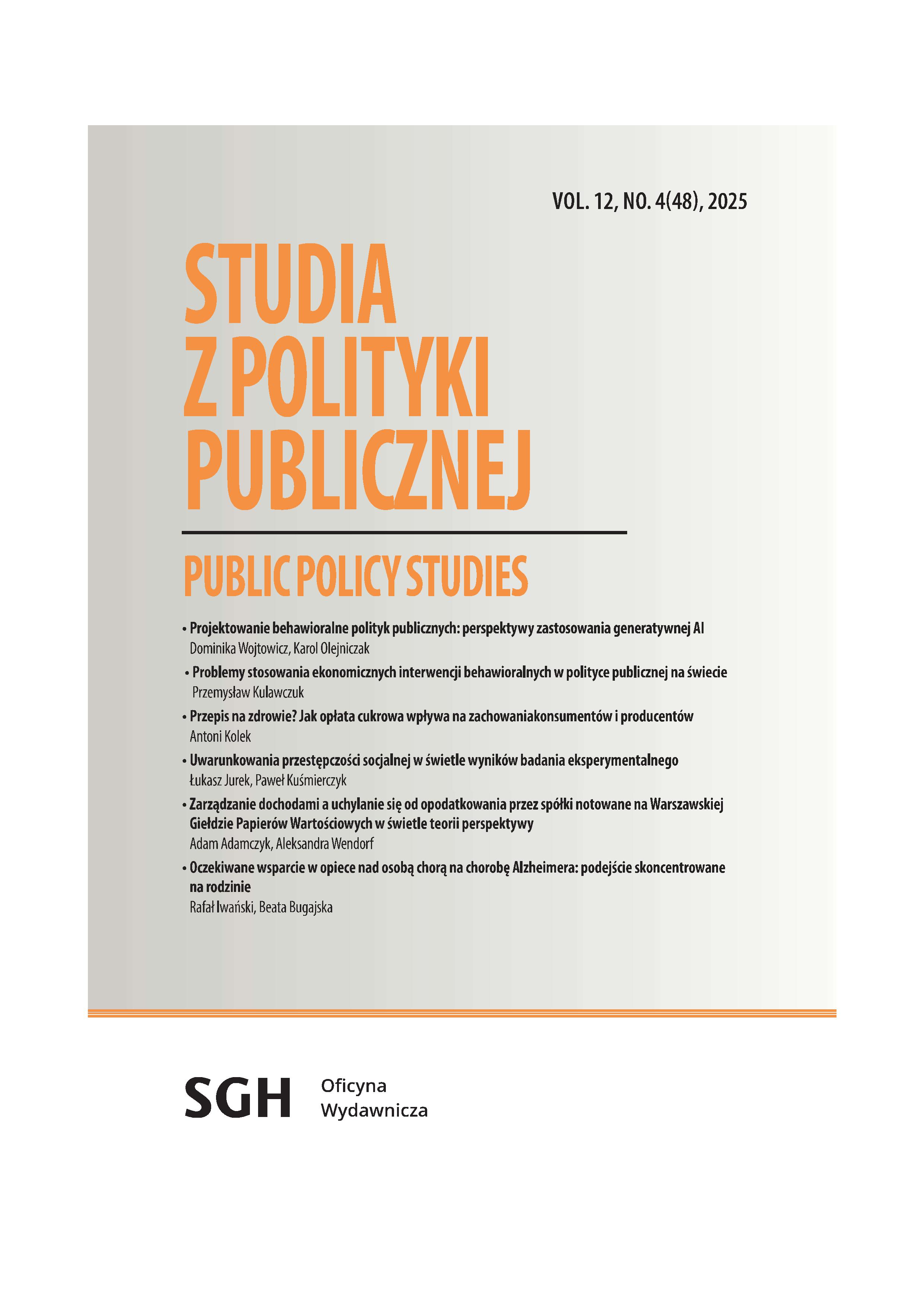
Treść głównego artykułu
Abstrakt
Przestępczość socjalna to ważny i aktualny problem badawczy. Nadużywanie świadczeń socjalnych nie tylko obniża efektywność systemu zabezpieczenia społecznego, ale również powoduje szereg innych poważnych konsekwencji społecznych i ekonomicznych. Mimo dużej drażliwości tego problemu, wciąż pozostaje on stosunkowo słabo rozpoznany. Celem niniejszego artykułu jest diagnoza jego uwarunkowań. W toku prac badawczych
wykorzystana została metoda eksperymentalna. Idea badania polegała na tym, aby w warunkach
laboratoryjnych stworzyć realia imitujące system socjalny, z jego podstawowymi elementami: składką/podatkiem, wspólnym funduszem, ryzykiem i świadczeniem. W tych
okolicznościach weryfikowano faktyczne zachowania uczestników dotyczące korzystania z dostępnej pomocy, a dokładniej: czy zgłaszają oni prawidłowe roszczenia, czy też nie. Na podstawie uzyskanych wyników można stwierdzić, że indywidualna skłonność do nadużywania świadczeń jest bardzo zróżnicowana. Uzależniona jest od płci (mężczyźni więcej oszukują niż kobiety) i faktycznej ekspozycji na ryzyko (więcej oszukują osoby, które nie doświadczają nieszczęścia). Poza tym indywidualna skłonność do nadużyć rośnie wraz ze wzrostem ogólnego poziomu nadużyć w grupie. Nie stwierdzono powiązań między nadużywaniem
świadczeń a efektywnością pracy oraz hojnością świadczeń. Potwierdzony został wysoki potencjał eksperymentu laboratoryjnego do badania przestępczości socjalnej,
niemniej konieczne są dalsze (bardziej zaawansowane) badania w tym zakresie.
Słowa kluczowe
Szczegóły artykułu
Prawa autorskie (c) 2025 Łukasz Jurek, Paweł Kuśmierczyk

Utwór dostępny jest na licencji Creative Commons Uznanie autorstwa 4.0 Międzynarodowe.
Czasopismo „Studia z Polityki Publicznej/Public Policy Studies” zapewnia dostęp do treści artykułów w trybie otwartego dostępu (Open Access) na zasadach licencji Creative Commons Uznanie autorstwa 4.0 Międzynarodowe (CC BY 4.0).


Więcej informacji: Polityka Open Access czasopisma "Studia z Polityki Publicznej/Public Policy Studies"
Referencje
- Appelgren, L. (2019) ‘Optimal auditing of social benefit fraud: a case study’, Empirical Economics, 56(1), pp. 203–231. Available at: https://doi.org/10.1007/s00181-017-1356-9.
- Ariely, D. (2017) Szczera prawda o nieuczciwości. Sopot: Smak słowa.
- Barr, N. (2020) The Economics of the Welfare State. 6th edn. Oxford: Oxford University Press.
- Becker, G.S. (1968) ‘Crime and Punishment: An Economic Approach’, Journal of Political Economy, 76(2). Available at: https://doi.org/10.1086/259394.
- Boone, J., Sadrieh, A. and van Ours, J.C. (2009) ‘Experiments on unemployment benefit sanctions and job search behavior’, European Economic Review, 53(8), pp. 937–951. Available at: https://doi.org/10.1016/j.euroecorev.2009.04.005.
- Butera, L. et al. (2022) ‘Measuring the Welfare Effects of Shame and Pride’, American Economic Review, 112(1), pp. 122–168. Available at: https://doi.org/10.1257/aer.20190433.
- Chunn, D.E. and Gavigan, S.A.M. (2004) ‘Welfare law, welfare fraud, and the moral regulation of the “never deserving” poor’, Social and Legal Studies, pp. 219–243. Available at: https://doi.org/10.1177/0964663904042552.
- Cooper, D.J. and Kagel, J.H. (2016) ‘Other-Regarding Preferences A Selective Survey of Experimental Results’, in The Handbook of Experimental Economics, Volume Two, pp. 217–289. Available at: https://doi.org/10.1515/9781400883172-005.
- Cullis, J. et al. (2015) ‘Do poachers make harsh gamekeepers? Attitudes to tax evasion and to benefit fraud’, Journal of Behavioral and Experimental Economics , 58. Available at: https://doi.org/10.1016/j.socec.2015.08.003.
- Dai, Z., Galeotti, F. and Villeval, M.C. (2018) ‘Cheating in the lab predicts fraud in the field: An experiment in public transportation’, Management Science, 64(3), pp. 1081–1100. Available at: https://doi.org/10.1287/mnsc.2016.2616.
- Dean, H. and Melrose, M. (1997) ‘Manageable discord: Fraud and resistance in the social security system’, Social Policy and Administration, 31(2), pp. 103–118. Available at: https://doi.org/10.1111/1467-9515.00043.
- Erkal, N., Gangadharan, L. and Nikiforakis, N. (2011) ‘Relative earnings and giving in a real-effort experiment’, American Economic Review, 101(7), pp. 3330–3348. Available at: https://doi.org/10.1257/aer.101.7.3330.
- Fischbacher, U. (2007) ‘Z-Tree: Zurich toolbox for ready-made economic experiments’, Experimental Economics, 10(2), pp. 171–178. Available at: https://doi.org/10.1007/s10683-006-9159-4.
- Fraud and Error in the Benefit System: Background information and methodology (2019). Newcastle. Available at: https://www.gov.uk/government/collections/fraud-and-error-in-the-benefit-system.
- Guala, F. (2005) The methodology of experimental economics, The Methodology of Experimental Economics. Cambridge: Cambridge University Press. Available at: https://doi.org/10.1017/CBO9780511614651.
- Halla, M., Lackner, M. and Schneider, F.G. (2010) ‘An empirical analysis of the dynamics of the welfare state: The case of benefit morale’, Kyklos, 63(1), pp. 55–74. Available at: https://doi.org/10.1111/j.1467-6435.2010.00460.x.
- Halla, M. and Schneider, F.G. (2014) ‘Taxes and benefits: Two options to cheat on the state’, Oxford Bulletin of Economics and Statistics, 76(3), pp. 411–431. Available at: https://doi.org/10.1111/obes.12024.
- Heinemann, F. (2008) ‘Is the welfare state self-destructive? A study of government benefit morale’, Kyklos, 61(2), pp. 237–257. Available at: https://doi.org/10.1111/j.1467-6435.2008.00400.x.
- Ifcher, J. and Zarghamee, H. (2016) ‘Ethics and Experimental Economics’, in E.A.M. Searing and D.R. Searing (eds) Practicing Professional Ethics in Economics and Public Policy. Berlin and Heidelberg: Springer, pp. 195–205. Available at: https://doi.org/10.1007/978-94-017-7306-5_9.
- Itaya, J.I. and Kurita, K. (2024) ‘Population dynamics of welfare stigma: welfare fraud versus incomplete take-up’, Journal of Population Economics, 37(1). Available at: https://doi.org/10.1007/s00148-024-01009-8.
- Jorens, Y. (2023) Fraud and error in the field of EU social security coordination (Reference year 2022).
- Jurek, Ł. (2021) ‘Absentyzm chorobowy: aspekty prawne i ekonomiczne’, Praca i Zabezpieczenie Społeczne, 11, pp. 19–28. Available at: https://doi.org/10.33226/0032-6186.2021.11.3.
- Jurek, Ł. et al. (2023) Moralność socjalna. Wrocław: Wydawnictwo Uniwersytetu Ekonomicznego we Wrocławiu.
- Jurek, Ł. (2023) ‘The Impact of the Employee’s Personal Characteristics on the Abuse of Sickness Absence: Empirical Evidence From Poland’, Wroclaw Review of Law, Administration & Economics, 12(2), pp. 1–22. Available at: https://doi.org/10.2478/wrlae-2022-0008.
- Jurek, Ł. (2024a) ‘Age and Propensity to Abuse Welfare Benefits’, Public Policy Studies, 11(2), pp. 7–24. Available at: https://doi.org/10.33119/KSzPP/2024.2.1.
- Jurek, Ł. (2024b) ‘Nadużycia socjalne w Polsce: perspektywa badawcza i implikacje praktyczne’, Polityka Społeczna, 3, pp. 29–37. Available at: https://doi.org/10.5604/01.3001.0054.6277.
- Jurek, Ł. (2024c) ‘The use of digital technology in the fight against welfare fraud: comparative analysis of selected national experiences’, in P. Luty, N. Semerad, and P. Versal (eds) Knowledge and digitization against corruption and fraud. Wrocław: Publishing House of Wroclaw University of Economics and Business, pp. 23–35.
- Kim, Y. and Maroulis, S. (2018) ‘Rethinking Social Welfare Fraud from a Complex Adaptive Systems Perspective’, Administration and Society, 50(1). Available at: https://doi.org/10.1177/0095399715587520.
- Kukuła, Z. (2016) Przestępczość socjalna z perspektywy prawa karnego i kryminologii. Warszawa: Difin.
- Kuśmierczyk, P. (2010) ‘Ethics and Experimental Economics’, in W.T. Bagatelas et al. (eds) Studies in Economics and Policy Making: Central and Eastern European Perspectives. Opladen & Farmington Hills: Budrich UniPress Ltd., pp. 77–90. Available at: https://doi.org/10.2307/j.ctvhhhgbd.7.
- Lefebvre, M. et al. (2011) Tax Evasion, Welfare Fraud, and ‘The Broken Windows’ Effect: An Experiment in Belgium, France and the Netherlands. 5609,. Bonn. Available at: https://nbn-resolving.de/urn:nbn:de:101:1-201104134484.
- Lindbeck, A. (1995) ‘Hazardous Welfare-State Dynamics’, The American Economic Review, 85(2), pp. 9–15.
- Lindbeck, A. (2004) ‘An Essay on Welfare State Dynamics’, in B. S€odersten (ed.) Globalization and the Welfare State. London: Palgrave Macmillan, pp. 149–171. Available at: https://doi.org/10.1057/9780230524422_8.
- Marriott, L. and Lai, J.C. (2023) ‘Tax Evasion and Benefit Fraud: A Study of the Use of Techniques of Neutralization’, Deviant Behavior, 44(8), pp. 1264–1285. Available at: https://doi.org/10.1080/01639625.2023.2179442.
- Modin, M. and Lindblom, E. (2021) Underlag inför 2022 års omfattningsstudier. Stockholm.
- Moffitt, R. (1983) ‘An Economic Model of Welfare Stigma’, The American Economic Review, 73(5), pp. 1023–1035.
- Otocka, E. (2008) ‘Przestępczość ubezpieczeniowa w Polsce: formy wyłudzeń’, Acta Universitatis Lodziensis. Folia Oeconomica, 222, pp. 63–74.
- Steffensmeier, D. and Allan, E. (1996) ‘Gender and crime: Toward a Gendered Theory of Female Offending’, Annual Review of Sociology, 22, pp. 459–487. Available at: https://doi.org/10.1146/annurev.soc.22.1.459.
- Stiglitz, J.E. (2018) ‘1. The Welfare State in the Twenty-First Century’, in The Welfare State Revisited, pp. 3–37. Available at: https://doi.org/10.7312/ocam18544-004.
- Swan, R.S. et al. (2008) ‘The untold story of welfare fraud’, Journal of Sociology and Social Welfare, 35(3), pp. 133–151. Available at: https://doi.org/10.15453/0191-5096.3360.
- Walsh, D. and Bull, R. (2013) ‘The investigation and investigative interviewing of benefit fraud suspects in the UK: Historical and contemporary perspectives’, in Applied Issues in Investigative Interviewing, Eyewitness Memory, and Credibility Assessment, pp. 33–58. Available at: https://doi.org/10.1007/978-1-4614-5547-9_3.
- Yaniv, G. (1997) ‘Welfare fraud and welfare stigma’, Journal of Economic Psychology, 18(4). Available at: https://doi.org/10.1016/S0167-4870(97)00016-0.
Referencje
Appelgren, L. (2019) ‘Optimal auditing of social benefit fraud: a case study’, Empirical Economics, 56(1), pp. 203–231. Available at: https://doi.org/10.1007/s00181-017-1356-9.
Ariely, D. (2017) Szczera prawda o nieuczciwości. Sopot: Smak słowa.
Barr, N. (2020) The Economics of the Welfare State. 6th edn. Oxford: Oxford University Press.
Becker, G.S. (1968) ‘Crime and Punishment: An Economic Approach’, Journal of Political Economy, 76(2). Available at: https://doi.org/10.1086/259394.
Boone, J., Sadrieh, A. and van Ours, J.C. (2009) ‘Experiments on unemployment benefit sanctions and job search behavior’, European Economic Review, 53(8), pp. 937–951. Available at: https://doi.org/10.1016/j.euroecorev.2009.04.005.
Butera, L. et al. (2022) ‘Measuring the Welfare Effects of Shame and Pride’, American Economic Review, 112(1), pp. 122–168. Available at: https://doi.org/10.1257/aer.20190433.
Chunn, D.E. and Gavigan, S.A.M. (2004) ‘Welfare law, welfare fraud, and the moral regulation of the “never deserving” poor’, Social and Legal Studies, pp. 219–243. Available at: https://doi.org/10.1177/0964663904042552.
Cooper, D.J. and Kagel, J.H. (2016) ‘Other-Regarding Preferences A Selective Survey of Experimental Results’, in The Handbook of Experimental Economics, Volume Two, pp. 217–289. Available at: https://doi.org/10.1515/9781400883172-005.
Cullis, J. et al. (2015) ‘Do poachers make harsh gamekeepers? Attitudes to tax evasion and to benefit fraud’, Journal of Behavioral and Experimental Economics , 58. Available at: https://doi.org/10.1016/j.socec.2015.08.003.
Dai, Z., Galeotti, F. and Villeval, M.C. (2018) ‘Cheating in the lab predicts fraud in the field: An experiment in public transportation’, Management Science, 64(3), pp. 1081–1100. Available at: https://doi.org/10.1287/mnsc.2016.2616.
Dean, H. and Melrose, M. (1997) ‘Manageable discord: Fraud and resistance in the social security system’, Social Policy and Administration, 31(2), pp. 103–118. Available at: https://doi.org/10.1111/1467-9515.00043.
Erkal, N., Gangadharan, L. and Nikiforakis, N. (2011) ‘Relative earnings and giving in a real-effort experiment’, American Economic Review, 101(7), pp. 3330–3348. Available at: https://doi.org/10.1257/aer.101.7.3330.
Fischbacher, U. (2007) ‘Z-Tree: Zurich toolbox for ready-made economic experiments’, Experimental Economics, 10(2), pp. 171–178. Available at: https://doi.org/10.1007/s10683-006-9159-4.
Fraud and Error in the Benefit System: Background information and methodology (2019). Newcastle. Available at: https://www.gov.uk/government/collections/fraud-and-error-in-the-benefit-system.
Guala, F. (2005) The methodology of experimental economics, The Methodology of Experimental Economics. Cambridge: Cambridge University Press. Available at: https://doi.org/10.1017/CBO9780511614651.
Halla, M., Lackner, M. and Schneider, F.G. (2010) ‘An empirical analysis of the dynamics of the welfare state: The case of benefit morale’, Kyklos, 63(1), pp. 55–74. Available at: https://doi.org/10.1111/j.1467-6435.2010.00460.x.
Halla, M. and Schneider, F.G. (2014) ‘Taxes and benefits: Two options to cheat on the state’, Oxford Bulletin of Economics and Statistics, 76(3), pp. 411–431. Available at: https://doi.org/10.1111/obes.12024.
Heinemann, F. (2008) ‘Is the welfare state self-destructive? A study of government benefit morale’, Kyklos, 61(2), pp. 237–257. Available at: https://doi.org/10.1111/j.1467-6435.2008.00400.x.
Ifcher, J. and Zarghamee, H. (2016) ‘Ethics and Experimental Economics’, in E.A.M. Searing and D.R. Searing (eds) Practicing Professional Ethics in Economics and Public Policy. Berlin and Heidelberg: Springer, pp. 195–205. Available at: https://doi.org/10.1007/978-94-017-7306-5_9.
Itaya, J.I. and Kurita, K. (2024) ‘Population dynamics of welfare stigma: welfare fraud versus incomplete take-up’, Journal of Population Economics, 37(1). Available at: https://doi.org/10.1007/s00148-024-01009-8.
Jorens, Y. (2023) Fraud and error in the field of EU social security coordination (Reference year 2022).
Jurek, Ł. (2021) ‘Absentyzm chorobowy: aspekty prawne i ekonomiczne’, Praca i Zabezpieczenie Społeczne, 11, pp. 19–28. Available at: https://doi.org/10.33226/0032-6186.2021.11.3.
Jurek, Ł. et al. (2023) Moralność socjalna. Wrocław: Wydawnictwo Uniwersytetu Ekonomicznego we Wrocławiu.
Jurek, Ł. (2023) ‘The Impact of the Employee’s Personal Characteristics on the Abuse of Sickness Absence: Empirical Evidence From Poland’, Wroclaw Review of Law, Administration & Economics, 12(2), pp. 1–22. Available at: https://doi.org/10.2478/wrlae-2022-0008.
Jurek, Ł. (2024a) ‘Age and Propensity to Abuse Welfare Benefits’, Public Policy Studies, 11(2), pp. 7–24. Available at: https://doi.org/10.33119/KSzPP/2024.2.1.
Jurek, Ł. (2024b) ‘Nadużycia socjalne w Polsce: perspektywa badawcza i implikacje praktyczne’, Polityka Społeczna, 3, pp. 29–37. Available at: https://doi.org/10.5604/01.3001.0054.6277.
Jurek, Ł. (2024c) ‘The use of digital technology in the fight against welfare fraud: comparative analysis of selected national experiences’, in P. Luty, N. Semerad, and P. Versal (eds) Knowledge and digitization against corruption and fraud. Wrocław: Publishing House of Wroclaw University of Economics and Business, pp. 23–35.
Kim, Y. and Maroulis, S. (2018) ‘Rethinking Social Welfare Fraud from a Complex Adaptive Systems Perspective’, Administration and Society, 50(1). Available at: https://doi.org/10.1177/0095399715587520.
Kukuła, Z. (2016) Przestępczość socjalna z perspektywy prawa karnego i kryminologii. Warszawa: Difin.
Kuśmierczyk, P. (2010) ‘Ethics and Experimental Economics’, in W.T. Bagatelas et al. (eds) Studies in Economics and Policy Making: Central and Eastern European Perspectives. Opladen & Farmington Hills: Budrich UniPress Ltd., pp. 77–90. Available at: https://doi.org/10.2307/j.ctvhhhgbd.7.
Lefebvre, M. et al. (2011) Tax Evasion, Welfare Fraud, and ‘The Broken Windows’ Effect: An Experiment in Belgium, France and the Netherlands. 5609,. Bonn. Available at: https://nbn-resolving.de/urn:nbn:de:101:1-201104134484.
Lindbeck, A. (1995) ‘Hazardous Welfare-State Dynamics’, The American Economic Review, 85(2), pp. 9–15.
Lindbeck, A. (2004) ‘An Essay on Welfare State Dynamics’, in B. S€odersten (ed.) Globalization and the Welfare State. London: Palgrave Macmillan, pp. 149–171. Available at: https://doi.org/10.1057/9780230524422_8.
Marriott, L. and Lai, J.C. (2023) ‘Tax Evasion and Benefit Fraud: A Study of the Use of Techniques of Neutralization’, Deviant Behavior, 44(8), pp. 1264–1285. Available at: https://doi.org/10.1080/01639625.2023.2179442.
Modin, M. and Lindblom, E. (2021) Underlag inför 2022 års omfattningsstudier. Stockholm.
Moffitt, R. (1983) ‘An Economic Model of Welfare Stigma’, The American Economic Review, 73(5), pp. 1023–1035.
Otocka, E. (2008) ‘Przestępczość ubezpieczeniowa w Polsce: formy wyłudzeń’, Acta Universitatis Lodziensis. Folia Oeconomica, 222, pp. 63–74.
Steffensmeier, D. and Allan, E. (1996) ‘Gender and crime: Toward a Gendered Theory of Female Offending’, Annual Review of Sociology, 22, pp. 459–487. Available at: https://doi.org/10.1146/annurev.soc.22.1.459.
Stiglitz, J.E. (2018) ‘1. The Welfare State in the Twenty-First Century’, in The Welfare State Revisited, pp. 3–37. Available at: https://doi.org/10.7312/ocam18544-004.
Swan, R.S. et al. (2008) ‘The untold story of welfare fraud’, Journal of Sociology and Social Welfare, 35(3), pp. 133–151. Available at: https://doi.org/10.15453/0191-5096.3360.
Walsh, D. and Bull, R. (2013) ‘The investigation and investigative interviewing of benefit fraud suspects in the UK: Historical and contemporary perspectives’, in Applied Issues in Investigative Interviewing, Eyewitness Memory, and Credibility Assessment, pp. 33–58. Available at: https://doi.org/10.1007/978-1-4614-5547-9_3.
Yaniv, G. (1997) ‘Welfare fraud and welfare stigma’, Journal of Economic Psychology, 18(4). Available at: https://doi.org/10.1016/S0167-4870(97)00016-0.