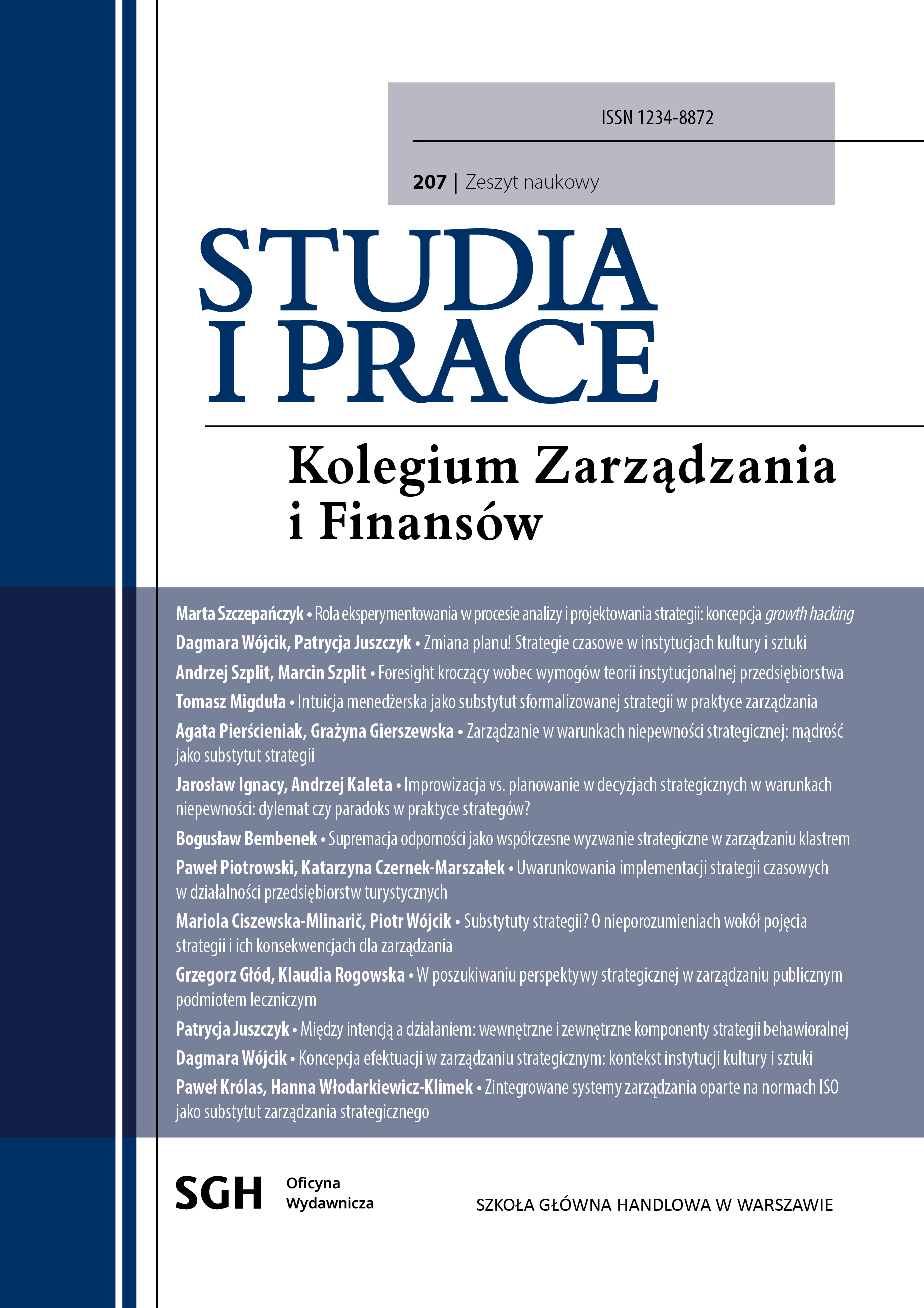
Between Intention and Action: Internal and External Components of Behavioural Strategy
DOI:
https://doi.org/10.33119/SIP.2026.207.11Keywords:
behavioural strategy, management microfoundations, organisational strategy, strategic managementAbstract
The knowledge of various strategic options possessed by managers and their choices affect strategic actions performed by organisations. It is crucial given the evidence that most managerial decisions are made without a complete analysis of all decision variables. In this context, recent years have seen a growing number of research studies in behavioural economics, creating a research stream on the concept of behavioural strategy, combining cognitive and social aspects with the theory and practice of strategic management. Recent research findings on behavioural strategy reveal the existence of two types of behavioural strategy components which affect strategic decisions made by organisations. The aim of this paper is to identify and discuss the internal and external components of behavioural strategy that are important for developing the organisational strategy of market entities. This theoretical and conceptual paper presents considerations based on a narrative literature review.
Downloads
References
Wydawnictwa zwarte
Bromiley, P., Rau, D. (2017). Behavioral Strategic Management. London: Routledge.
Czakon, W. (2020). Krótkowzroczność strategiczna menedżerów. Kraków: Wydawnictwo Uniwersytetu Jagiellońskiego.
De Waal, A. (2017). Strategic Performance Management: A managerial and behavioral approach. Bloomsbury Publishing.
Fang, C., Liu, C. (2018). Behavioral Strategy: An Alternative Account of Superior Profitability? W: Behavioral Strategy in Perspective (s. 209–219). Leeds: Emerald Publishing Limited.
Gilovich, T., Griffin, D., Kahneman, D. (Eds.). (2002). Heuristics and Biases: The Psychology of Intuitive Judgment. Cambridge, MA: Cambridge University Press.
Hambrick, D. C., Crossland, C. (2018). A Strategy for Behavioral Strategy: Appraisal of Small, Midsize, and Large Tent Conceptions of this Embryonic Community. W: Behavioral Strategy in Perspective (s. 23–39). Leeds: Emerald Publishing Limited.
Jankowska-Mihułowicz, M. (2006). Wpływ sytuacji decyzyjnej na przebieg procesu podejmowania decyzji strategicznych. W: Zarządzanie strategiczne w badaniach teoretycznych i w praktyce, A. Kaleta, K. Moszkowicz (red.). Wrocław: Wydawnictwo Akademii Ekonomicznej we Wrocławiu.
March, J. G. Simon, H. A. (1958). Organizations. New York: Wiley.
Najmaei, A. (2017). Revisiting the Strategic Leadership Paradigm: A Gender Inclusive Perspective. W: Inclusive Leadership: Negotiating Gendered Spaces (s. 203–228). Cham: Springer International Publishing.
Polowczyk, J. (2012). Zarządzanie strategiczne w przedsiębiorstwie w ujęciu behawioralnym. Poznań: Wydawnictwo Uniwersytetu Ekonomicznego w Poznaniu.
Puranam, P. (2018). The Organizational Foundations of Behavioral Strategy. W: Behavioral Strategy in Perspective (s. 79–89). Leeds: Emerald Publishing Limited.
Simon, H. A. (1947). Administrative Behavior. New York: Macmillan.
Takemura, K. (2021). Behavioral Decision Theory. Singapore: Springer.
Thaler, R. H., Sunstein, C. R. (2009). Nudge: Improving Decisions about Health, Wealth, and Happiness. New York: Penguin.
Artykuły naukowe
Acciarini, C., Brunetta, F., Boccardelli, P. (2021). Cognitive Biases and Decision-Making Strategies in Times of Change: A Systematic Literature Review, Management Decision, 59 (3), s. 638–652.
Akinci, C., Sadler‐Smith, E. (2012). Intuition in Management Research: A Historical Review, International Journal of Management Reviews, 14 (1), s. 104–122.
Alawwad, A. (2024). The Influence of External Factors on Corporate Strategy and Strategies for Adaptation in Light of the Global Challenges, International Journal of Financial, Administrative, and Economic Sciences, 3 (10), s. 91–125.
Alkaraan, F., Northcott, D. (2013). Strategic Investment Decision-Making Processes: The Influence of Contextual Factors, Meditari Accountancy Research, 21 (2), s. 117–143.
Anwar, J., Bibi, A., Ahmad, N. (2022). Behavioral Strategy: Mapping the Trends, Sources and Intellectual Evolution, Journal of Strategy and Management, 15 (1), s. 140–168.
Appelbaum, S. H., Gandell, J., Yortis, H., Proper, S., Jobin, F. (2000). Anatomy of a Merger: Behavior of Organizational Factors and Processes Throughout the Pre‐During‐Post‐Stages (part 1), Management Decision, 38 (9), s. 649–662.
Baltes, B. B., Zhdanova, L. S., Clark, M. A. (2011). Examining the Relationships Between Personality, Coping Strategies, and Work-Family Conflict, Journal of Business and Psychology, 26 (4), s. 517–530.
Barr, P. S., Stimpert, J. L., Huff, A. S. (1992). Cognitive Change, Strategic Action, and Organizational Renewal, Strategic Management Journal, 13 (S1), s. 15–36.
Becker, M. C. (2005). A Framework for Applying Organizational Routines in Empirical Research: Linking Antecedents, Characteristics and Performance Outcomes of Recurrent Interaction Patterns, Industrial and Corporate Change, 14 (5), s. 817–846.
Bennett, W. L. (1998). The Uncivic Culture: Communication, Identity, and the Rise of Lifestyle Politics, PS: Political Science & Politics, 31 (4), s. 741–761.
Bingham, C. B., Eisenhardt, K. M. (2011). Rational Heuristics: The ‘Simple Rules’ that Strategists Learn from Process Experience, Strategic Management Journal, 32 (13), s. 1437–1464.
Birkinshaw, J., Zimmermann, A., Raisch, S. (2016). How Do Firms Adapt to Discontinuous Change? Bridging the Dynamic Capabilities and Ambidexterity Perspectives, California Management Review, 58 (4), s. 36–58.
Bohórquez, E., Pérez, M., Benavides, A., Pérez, E. (2023). Organizational Climate and Its Importance for Organizational Success: A Literature Review, Perspectives and Trends in Education and Technology: Selected Papers from ICITED 2022, s. 441–450.
Bolinger, M. T., Josefy, M. A., Stevenson, R., Hitt, M. A. (2022). Experiments in Strategy Research: A Critical Review and Future Research Opportunities, Journal of Management, 48 (1), s. 77–113.
Bryson, J. M., Seo, D., Cheng, Y. D., Crosby, B. C., Wang, S. (2025). Ongoing Strategizing in Practice: Examining CEO Activities and a Social Enterprise’s Pathways to Growth and Greater Effectiveness, Public Management Review, s. 1–34.
Budhwar, P. S., Sparrow, P. R. (2002). Strategic HRM through the Cultural Looking Glass: Mapping the Cognition of British and Indian Managers, Organization Studies, 23 (4), s. 599–638.
Coulibaly-Ballet, M., Elidrissi, D., Jerinic, Z. (2017). Effects of Culture on Behavioral Strategies, Culture and Behavioral Strategy, 211.
Cristofaro, M. (2019). The Role of Affect in Management Decisions: A Systematic Review, European Management Journal, 37 (1), s. 6–17.
Cristofaro, M., Giardino, P. L., Camilli, R., Hristov, I. (2024). Understanding Behavioral Strategy: A Historical Evolutionary Perspective in “Management Decision”, Management Decision, 62 (13), s. 426–455.
Czakon, W., Czernek-Marszałek, K. (2021). Competitor Perceptions in Tourism Coopetition, Journal of Travel Research, 60 (2), s. 312–335.
Czakon, W., Kawa, A. (2018). Network Myopia: An Empirical Study of Network Perception, Industrial Marketing Management, 73, s. 116–124.
Czakon, W., Klimas, P., Kawa, A., Kraus, S. (2023). How Myopic Are Managers? Development and Validation of a Multidimensional Strategic Myopia Scale, Journal of Business Research, 157, 113573.
Einhorn, H. J., Hogarth, R. M. (1981). Behavioral Decision Theory: Processes of Judgement and Choice, Annual Review of Psychology, 32 (1981), s. 53–88.
Eisenhardt, K. M., Zbaracki, M. J. (1992). Strategic Decision Making, Strategic Management Journal, 13 (S2), s. 17–37.
Ericson, M. (2010). Towards a Sensed Decision‐Making Approach: From Déjà Vu to Vu Jàdé, Management Decision, 48 (1), s. 132–155.
Feldman, M. S. (2000). Organizational Routines as a Source of Continuous Change, Organization science, 11 (6), s. 611–629.
Felin, T., Foss, N. J., Ployhart, R. E. (2015). The Microfoundations Movement in Strategy and Organization Theory, Academy of Management Annals, 9 (1), s. 575–632.
Fellnhofer, K., Sadler-Smith, E., Sinclair, M., Liu, K. (2024). Shaping Novel Paths for Future Management Research and Practice in Enhancing Intuition, Academy of Management Collections, 3 (4), s. 57–75.
Fredrickson, J. W. (1986). The Strategic Decision Process and Organizational Structure, Academy of management review, 11 (2), s. 280–297.
Gallén, T. (1997). The Cognitive Style and Strategic Decisions of Managers, Management Decision, 35 (7), s. 541–551.
Ginsberg, A., Venkatraman, N. (1985). Contingency Perspectives of Organizational Strategy: A Critical Review of the Empirical Research, Academy of Management Review, 10 (3), s. 421–434.
Haider, S., Mariotti, F. (2016). Unfolding Critical Events and Strategic Decisions: The Role of Spatial and Temporal Cognition, Management Decision, 54 (7), s. 1813–1842.
Hambrick, D. C., Mason, P. A. (1984). Upper Echelons: The Organizations as a Reflection of its Top Managers, Academy of Management Review, 9 (2), s. 193–206.
Helfat, C. E., Peteraf, M. A. (2015). Managerial Cognitive Capabilities and the Microfoundations of Dynamic Capabilities, Strategic Management Journal, 36 (6), s. 831–850.
Hesselbarth, I., Alnoor, A., Tiberius, V. (2023). Behavioral Strategy: A Systematic Literature Review and Research Framework, Management Decision, 61 (9), s. 2740–2756.
Hodgkinson, G. P., Healey, M. P. (2008). Cognition in Organizations, Annual Review of Psychology, 59 (1), s. 387–417.
Hodgkinson, G. P., Healey, M. P. (2011). Psychological Foundations of Dynamic Capabilities: Reflexion and Reflection in Strategic Management, Strategic Management Journal, 32 (13), s. 1500–1516.
Huy, Q., Zott, C. (2019). Exploring the Affective Underpinnings of Dynamic Managerial Capabilities: How Managers’ Emotion Regulation Behaviors Mobilize Resources for Their Firms, Strategic Management Journal, 40 (1), s. 28–54.
Irwin, J., Lahneman, B., Parmigiani, A. (2018). Nested Identities as Cognitive Drivers of Strategy, Strategic Management Journal, 39 (2), s. 269–294.
Kaplan, S. (2008). Cognition, Capabilities, and Incentives: Assessing Firm Response to the Fiber-Optic Revolution, Academy of Management Journal, 51 (4), s. 672–695.
Khani, H. R. Q., Baig, M. K. (2025). Cognitive Process and Individual Traits; the Factors Affecting Decision Making Style of Managers, Journal of Business and Management Research, 4 (1), s. 215–238.
Kolbe, L. M., Bossink, B., de Man, A. P. (2020). Contingent Use of Rational, Intuitive and Political Decision-Making in R&D, Management Decision, 58 (6), s. 997–1020.
La Pira, F. (2011). Entrepreneurial Intuition, an Empirical Approach, Journal of Management and Marketing Research, 6, 1.
Lezghed, O., Grine-Dahmane, L. (2020). The Coopetitive Behavior, Journal of Applied Business & Economics, 22 (13).
Lindenberg, S., Foss, N. J. (2011). Managing Joint Production Motivation: The Role of Goal Framing and Governance Mechanisms, Academy of Management Review, 36 (3), s. 500–525.
Livengood, R. S., Reger, R. K. (2010). That’s Our Turf! Identity Domains and Competitive Dynamics, Academy of Management Review, 35 (1), s. 48–66.
Luoma, J., Martela, F. (2021). A Dual-Processing View of Three Cognitive Strategies in Strategic Decision Making: Intuition, Analytic Reasoning, and Reframing, Long Range Planning, 54 (3), 102065.
Luoma, J., Falk T., Totzek D., Tikkanen H., Mrozek A. (2018). Big Splash, No Waves? Cognitive Mechanisms Driving Incumbent Firms’ Responses to Low-Price Market Entry Strategies, Strategic Management Journal, 39 (5), s. 1388–1410.
Mezias, J. M., Starbuck, W. H. (2003). Studying the Accuracy of Managers’ Perceptions: A Research Odyssey, British Journal of Management, 14 (1), s. 3–17.
Miller, C. C., Ireland, R. D. (2005). Intuition in Strategic Decision Making: Friend or Foe in the Fast-Paced 21st Century?, Academy of Management Perspectives, 19 (1), s. 19–30.
Morrison, K. A., Misener, K. E. (2021). Exploring the Conditions for Strategic Planning in Nonprofit Community Sport, Sport Management Review, 24 (5), s. 747–769.
Nadkarni, S., Barr, P. S. (2008). Environmental Context, Managerial Cognition, and Strategic Action: An Integrated View, Strategic Management Journal, 29 (13), s. 1395–1427.
Nadkarni, S., Narayanan, V. K. (2007). Strategic Schemas, Strategic Flexibility, and Firm Performance: The Moderating Role of Industry Clockspeed, Strategic Management Journal, 28 (3), s. 243–270.
Nishii, L. H., Leroy, H. (2022). A Multi-Level Framework of Inclusive Leadership in Organizations, Group & Organization Management, 47 (4), s. 683–722.
Ocasio, W., Joseph, J. (2018). The Attention-Based View of Great Strategies, Strategy Science, 3 (1), s. 289–294.
Panagiotaras, S., Kapareliotis, I., Patsiotis, A. (2025). Corporate Identity: An Analysis of Evolution Over Time. Symphonya, Emerging Issues in Management (symphonya.unicusano.it), (5), s. 46–67.
Park, C. L., Paiva, E. L. (2018). How Do National Cultures Impact the Operations Strategy Process, International Journal of Operations & Production Management, 38, s. 1937–1963.
Parker, L. D. (1980). Evaluating Group Decision‐Making in the Corporate Environment, Management Decision, 18 (1), s. 35–44.
Picone, P. M., De Massis, A., Tang, Y., Piccolo, R. F. (2021). The Psychological Foundations of Management in Family Firms: Values, Biases, and Heuristics, Family Business Review, 34 (1), s. 12–32.
Piórkowska, K. (2016). Behavioural Strategy: Adaptability Context, Management, 20 (1).
Powell, R. (2006). War as a Commitment Problem, International Srganization, 60 (1), s. 169–203.
Powell, T. C., Lovallo, D., Fox, C. R. (2011). Behavioral Strategy, Strategic Management Journal, 32 (13), s. 1369–1386.
Purwanti, A., Judijanto, L., Thalib, N. (2023). The Influence of the External Environment on Business Strategy Planning and Implementation, West Science Journal Economic and Entrepreneurship, 1 (02), s. 42–49.
Quinn, B. J. (1989). Strategic Change: ‘Logical Incrementalism’, MIT Sloan Management Review, 30 (4).
Rerup, C. (2009). Attentional Triangulation: Learning from Unexpected Rare Crise, Organization Science, 20 (5), s. 876–893.
Ridge, W., Kern, J. D., White, A. M. (2014). The Influence of Managerial Myopia on Firm Dtrategy, Management Decision, 52 (3), s. 602–623.
Schulz-Hardt, S., Jochims, M., Frey, D. (2002). Productive Conflict in Group Decision Making: Genuine and Contrived Dissent as Strategies to Counteract Biased Information Seeking, Organizational Behavior and Human Decision Processes, 88 (2), s. 563–586.
Schumacher, C., Keck, S., Tang, W. (2020). Biased Interpretation of Performance Feedback: The Role of CEO Overconfidence, Strategic Management Journal, 41 (6), s. 1139–1165.
Schwenk, C. R. (1989). Linking Cognitive, Organizational and Political Factors in Explaining Strategic Change, Journal of Management Studies, 26 (2), s. 177–187.
Selart, M. (2005). Understanding the Role of Locus of Control in Consultative Decision‐Making: A Case Study, Management Decision, 43 (3), s. 397–412.
Sele, K., Mahringer, C. A., Danner-Schröder, A., Grisold, T., Renzl, B. (2024). We Are All Pattern Makers! How a Flat Ontology Connects Organizational Routines and Grand Challenges, Strategic Organization, 22 (3), s. 530–549.
Sharma, B. (2004). Marketing Strategy, Contextual Factors and Performance: An Investigation of Their Relationship, Marketing Intelligence & Planning, 22 (2), s. 128–143.
Shrader, C. B., Taylor, L., Dalton, D. R. (1984). Strategic Planning and Organizational Performance: A Critical Appraisal, Journal of Management, 10 (2), s. 149–171.
Shrivastava, P., Grant, J. H. (1985). Empirically Derived Models of Strategic Decision‐Making Processes, Strategic Management Journal, 6 (2), s. 97–113.
Sibony, O., Lovallo, D., Powell, T. C. (2017). Behavioral Strategy and the Strategic Decision Architecture of the Firm, California Management Review, 59 (3), s. 5–21.
Simon, H. A. (1987). Making Management Decisions: The Role of Intuitions and Dmotion, Academy of Management Executive, 1 (1), s. 57–64.
Simon, H. (1957). A Behavioral Model of Rational Choice, Models of Man, Social and Rational: Mathematical Essays on Rational Human Behavior in a Social Setting, 6 (1), s. 241–260.
Sinclair, M., Ashkanasy, N. M. (2005). Intuition: Myth or a Decision-Making Tool?, Management Learning, 36 (3), s. 353–370.
Sinnaiah, T., Adam, S., Mahadi, B. (2023). A Strategic Management Process: The Role of Decision-Making Style and Organisational Performance, Journal of Work-Applied Management, 15 (1), s. 37–50.
Sonenshein, S. (2010). We’re Changing – Or Are We? Untangling the Role of Progressive, Regressive, and Stability Narratives during Strategic Change Implementation, Academy of Management Journal, 53 (3), s. 477–512.
Thaler, R. H. (2000). From Homo Economicus to Homo Sapiens, Journal of economic perspectives, 14 (1), s. 133–141.
Tikkanen, H., Lamberg, J. A., Parvinen, P., Kallunki, J. P. (2005). Managerial Cognition, Action and the Business Model of the Firm, Management Fecision, 43 (6), s. 789–809.
Tversky, A., Kahneman, D. (1974). Judgment under Uncertainty: Heuristics and Biases: Biases in Judgments Reveal Some Heuristics of Thinking under Uncertainty, Science, 185 (4157), s. 1124–1131.
Wright, P., Ferris, S. P. (1997). Agency Conflict and Corporate Strategy: The Effect of Divestment on Corporate Value, Strategic Management Journal, 18 (1), s. 77–83.
Yang, D., Wang, A. X., Zhou, K. Z., Jiang, W. (2019). Environmental Strategy, Institutional Force, and Innovation Capability: A Managerial Cognition Perspective, Journal of Business Ethics, 159 (4), s. 1147–1161.
Downloads
Published
How to Cite
Issue
Section
License
Copyright (c) 2026 Studies and Work of the Collegium of Management and Finance

This work is licensed under a Creative Commons Attribution 4.0 International License.