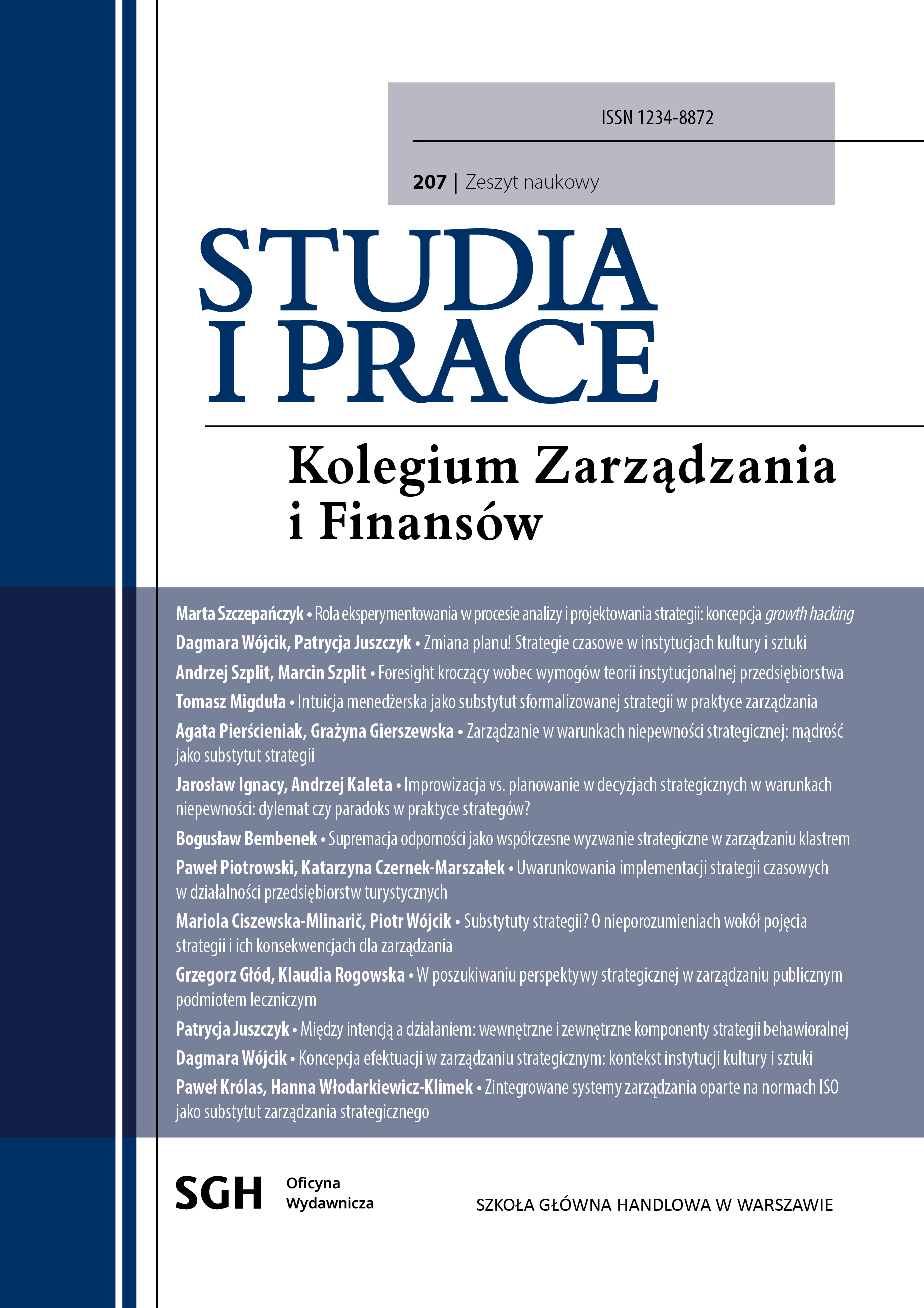
The Concept of Effectuality in Strategic Management: Culture and Art Institutions
DOI:
https://doi.org/10.33119/SIP.2026.207.12Keywords:
culture and art institutions, effectual approach, effectuation concept, effectuation in managementAbstract
In the context of increasing complexity and uncertainty, traditional planning strategies are losing significance and organisations are increasingly seeking flexible substitutes. Effectuation, perceived as a logic of action based on available resources, real-time responsiveness, experimentation, co-creation with partners and the active shaping of the future, represents an alternative to causal approaches in organisational management. It gains particular importance in organisations operating in turbulent environments such as culture and art institutions, where forecasting and long-term planning often prove insufficient, inadequate or impossible. As the literature indicates, the concept of effectuation is not merely a substitute but rather a complementary logic, enabling the creative use of constraints and adaptive actions. This article presents the effectual concept as a potential conceptual framework for explaining modes of action and decision-making in the conditions of uncertainty and it outlines directions for further research on the application of effectuation in strategic management and in building advantage through the creative use of uncertainty and generation of opportunities in culture and art institutions.
Downloads
References
Wydawnictwa zwarte
Berfelo, D. (2024). The Gendered Effect of the Usage of the Causation and/or Effectuation Decision Making Styles in the Entrepreneurial Process. Bachelor’s thesis. University of Twente.
Czakon, W. (2012). Sieci w zarządzaniu strategicznym. Warszawa: Oficyna a Wolters Kluwer business.
Ekström, K. M. (2019). Market Orientation as the Epicentre of Art Museums: Museum Shops, Fashion Exhibitions and Private Collections. W: Museum marketization (s. 134–151). London: Routledge.
Juszczyk, P. (2022). Wzorce zachowań koopetycyjnych organizacji hybrydowych w sektorze kultury. W: Organizacja hybrydowa w teorii i praktyce (s. 65–77), H. Cichocki, A. Tomaszewski (red.). Warszawa: Oficyna Wydawnicza SGH.
Mäensivu, K., Toivonen, M., Tammela, K. (2016). Innovation with Effectuation: An Opportunity for the Public Sector. W: Innovating in Practice: Perspectives and Experiences (s. 179–202). Springer International Publishing.
Moore, M. H. (1997). Creating Public Value: Strategic Management in Government. Harvard University Press.
Sarasvathy, S. D. (2008). Effectuation: Elements of Entrepreneurial Expertise. Edward Elgar Publishing.
Sharma, S., Layes, J., Esposito, M., Akbar, Y. H. (2025). Integrating Effectuation, AI, and Strategic Calibration: A Conceptual Framework. W: Proceedings of the wISE Scholarship in ASEAN+ Oceania Conference: Fostering the Innovation, Strategy & Entrepreneurship Community.
Snippe, J. (2024). Navigating Social Entrepreneurship: An Exploration of Causation and Effectuation in Decision-Making. Bachelor’s thesis. University of Twente.
Wójcik, D. (2022). Współpraca międzyorganizacyjna w sektorze kreatywnym: kontekst sztuk performatywnych. Warszawa: Difin.
Artykuły naukowe
Alnasser, N. S. (2023). Strategies Applied by Different Arts and Cultural Organizations: Partnerships, Audience Engagement and Programming, Arts & Cultural Management Review, 2023.
Alnasser, N. S., Yi, L. J. (2023). Strategies Applied by Different Arts and Cultural Organizations for Their Audience Development: A Comparative Review, Heliyon, 9 (5).
Astuti, N. C. (2024). Internationalisation of Born-Digital Enterprises Using an Effectuation Lens: Case Studies in the Games Industry, Cogent Business & Management, 11 (1), 2361866.
Bérubé, J., Gauthier, J.‑B. (2020). Coopetition in Projects in Cultural Industries, Journal of Modern Project Management, 7 (4), s. 177–190.
Brettel, M., Mauer, R., Engelen, A., Küpper, D. (2012). Corporate Effectuation: Entrepreneurial Action and Its Impact on R&D Project Performance, Journal of Business Venturing, 27 (2), s. 167–184.
Callander, A. (2019). Artmaking as Entrepreneurship: Effectuation and Emancipation in Artwork Formation, Artivate: A Journal of Entrepreneurship in the Arts, 8 (1), s. 61–78.
Chandler, G. N., DeTienne, D. R., McKelvie, A., Mumford, T. V. (2011). Causation and Effectuation Processes: A Validation Study, Journal of Business Venturing, 26 (3), s. 375–390.
Chatzichristodoulou, M., Brown, K., Hunt, N., Kuling, P., Sant, T. (2022). Covid-19: Theatre Goes Digital – Provocations, International Journal of Performance Arts and Digital Media, 18 (1), s. 1–6.
Dew, N., Read, S., Sarasvathy, S. D., Wiltbank, R. (2008). Outlines of a Behavioral Theory of the Entrepreneurial Firm, Journal of Economic Behavior & Organization, 66 (1), s. 37–59.
Dutta, T., Packard, M. D. (2024). The Needle of Charisma and the Threads of Trust: Advancing Effectuation Theory’s Crazy Quilt Principle, Journal of Business Venturing, 39 (4), 106409.
Ferrari, S., de Vasconcellos, S. (2024). Exploring the Affordable Loss Principle: A Systematic Literature Review, Internext, 19 (2).
Gradzik, S. (2023). Odporność festiwalu w dobie pandemii. Zastosowanie mechanizmów teorii efektuacji w organizowaniu Festiwalu Łódź Czterech Kultur, Studies in Risk and Sustainable Development, 397, s. 1–17.
Haaland, K. H., Henriksveen, V. J., Natvig, G. (2024). The Role of Artificial Intelligence in Evolving Theory of Effectuation within Entrepreneurial Practice. Manuscript in preparation.
Johanson, M., Oliveira, L., Fleury, A. (2024). A Bird in the Hand is Worth Two in the Bush: How SMEs Leverage Different Types of Knowledge and Networks during Effectual Internationalization, Journal of Business Research, 185, 114943.
Juszczyk, P., Wójcik, D. (2023). The Concept of Chance Management in Coopetition among Cultural Institutions, European Management Studies, 21 (2), s. 25–50.
Kidd, J., Nieto McAvoy, E., Ostrowska, A. (2021). Implications of the COVID-19 Digital ‘Pivot’ in Museums and Galleries: Lessons from Practitioners. AHRC Policy and Evidence Centre. Cardiff University.
King, E., Smith, M. P., Wilson, P. F., Williams, M. A. (2021). Digital Responses of UK Museum Exhibitions to the COVID-19 Crisis, March–June 2020, Curator: The Museum Journal, 64 (3), s. 487–504.
Krupski, R. (2008). Okazje jako przedmiot badań w zakresie zarządzania strategicznego, Zarządzanie strategiczne w badaniach teoretycznych i praktyce, Prace Naukowe Uniwersytetu Ekonomicznego we Wrocławiu, 20, s. 156–162.
March, J. G. (1991). Exploration and Exploitation in Organizational Learning, Organization Science, 2 (1), s. 71–87.
Masilamani, V., Budumuru, U. R., Yang, X., Kolli, N. S., Adidam, P. T. (2024). Effectuation and Co-Creation in Social Enterprises: Examining the Relationship in the Context of Uncertainty, Journal of Social Entrepreneurship, s. 1–21.
Oakley, K. (2004). Not So Cool Britannia: The Role of the Creative Industries in Economic Development, International Journal of Cultural Studies, 7 (1), s. 67–77.
Olive-Tomas, A., Harmeling, S. S. (2020). The Rise of Art Movements: An Effectual Process Model of Picasso’s and Braque’s Give-and-Take during the Creation of Cubism (1908–1914), Small Business Economics, 54 (3), s. 819–842.
Reymen, I. M., Andries, P., Berends, H., Mauer, R., Stephan, U., Van Burg, E. (2015). Understanding Dynamics of Strategic Decision Making in Venture Creation: A Process Study of Effectuation and Causation, Strategic Entrepreneurship Journal, 9 (4), s. 351–379.
Ritala, P. (2012). Coopetition Strategy – When Is It Successful? Empirical Evidence on Innovation and Market Performance, British Journal of Management, 23 (3), s. 307–324.
Ryman, J. A., Roach, D. C. (2024). Innovation, Effectuation, and Uncertainty, Innovation, 26 (2), s. 328–348.
Sarasvathy, S. D. (2001). Causation and Effectuation: Toward a Theoretical Shift from Economic Inevitability to Entrepreneurial Contingency, Academy of Management Review, 26 (2), s. 243–263.
Wójcik, D., Czernek-Marszałek, K. (2024). Social Relationships in Performing Arts Entrepreneurship, Journal of Organizational Change Management, 37 (6), s. 1230–1256.
Wójcik, D., Juszczyk, P. (2023). Timing Strategies in Cooperation among Cultural and Art Institutions, Organization and Management, 194 (3), s. 45–78.
Ziemiański, P., Czaplińska, P. (2018). Zastosowanie założeń koncepcji efektuacji w organizowaniu wydarzenia kulturalnego – studium przypadku, Zarządzanie w Kulturze, 19 (4), s. 437–451.
Downloads
Published
How to Cite
Issue
Section
License
Copyright (c) 2026 Studies and Work of the Collegium of Management and Finance

This work is licensed under a Creative Commons Attribution 4.0 International License.